Standing Alternating Upper And Lower Back Clap
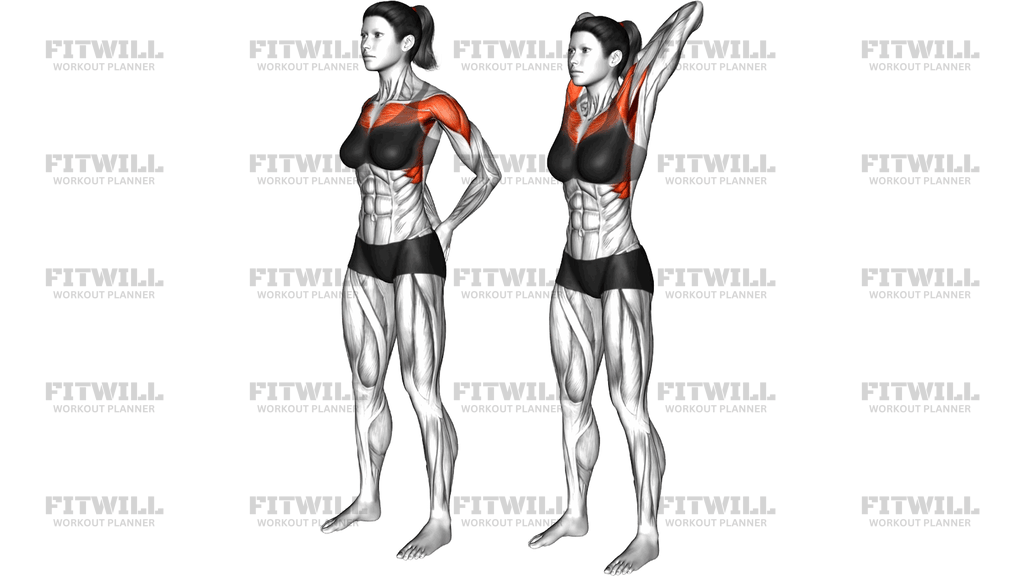
The Standing Alternating Upper And Lower Back Clap is a body-weight mobility drill performed from a tall, upright stance. One arm reaches up and over the same-side shoulder to snake behind the upper back and neck, while the opposite arm swings behind the lower back and reaches upward from below. The goal is to bring both hands as close together as possible behind your spine — ideally touching or clapping — before switching which arm goes on top and repeating on the other side.
This movement targets the areas where most people lose mobility first: the shoulders, upper back, and chest. The overhead arm works through deep external rotation and extension, which stretches the chest and front of the shoulder, while the lower arm drives into internal rotation, lengthening the lats and back of the shoulder. Because the ribs and spine are involved in every reach, it also gently mobilizes the thoracic spine.
You will see this drill used in warm-ups before pressing, pulling, throwing, or swimming sessions, and as a daily check-in for desk workers whose shoulders creep forward during the day. It requires no equipment and no floor space, so it fits easily into an office break, a pre-workout routine, or a cooldown. Many lifters use it as a quick diagnostic — a noticeable difference between the left and right sides usually points to a shoulder or upper-back restriction worth addressing.
Setup matters more than it looks. Stand with your feet about hip-width apart, weight evenly distributed, ribs stacked over your pelvis, and your head neutral. If you arch your lower back or flare your ribs to fake extra reach, you lose the stretch where it counts and load your lumbar spine instead. Keep your torso tall and let the arms do the traveling.
Execute the movement smoothly: sweep one arm overhead with a soft elbow, let the hand slide down between your shoulder blades, and bring the other hand up your spine from below until the fingertips meet or clap. Hold the contact for a beat, release with control, and switch arms so the one that was up top now reaches from the bottom. Move within a comfortable range — a mild stretch sensation is the target, never pinching or sharp pain.
Because it is gentle, self-paced, and bilateral, this drill suits nearly everyone from beginners to advanced trainees. If your hands cannot touch at first, that is completely normal; a towel held between the hands gives you a bridge to close over time as your shoulder rotation and chest flexibility improve.
[ Workout Log & Planner ]
Put your next workout in Fitwill
Keep your plan and training log ready when you are.


Instructions
- Stand tall with your feet hip-width apart, weight spread evenly across both feet, and your arms relaxed at your sides.
- Stack your ribs over your pelvis and brace your core lightly so your lower back stays neutral throughout the drill.
- Reach your right arm straight up overhead, then bend the elbow and let the hand drop behind your head toward the space between your shoulder blades, palm facing your spine.
- At the same time, sweep your left arm behind your lower back and slide the back of that hand up your spine, palm facing away from your body.
- Continue bringing both hands toward each other behind your back until the fingertips touch or you can clap them together, keeping your head level and your torso upright.
- Pause for one to two seconds at your end range, feeling the stretch across the chest and front of the top shoulder and into the back of the lower shoulder.
- Release both arms smoothly back to your sides without letting your shoulders shrug or your back arch.
- Switch roles: reach the left arm overhead and down behind the upper back while the right arm reaches up from behind the lower back.
- Breathe steadily throughout — inhale as the arms travel out, exhale as the hands come together.
- Alternate sides for the desired number of repetitions, typically 5-8 claps per side, keeping the tempo controlled from start to finish.
Tips & Tricks
- The most common fault is arching the lower back to gain reach. If you feel your ribs flare or your belly push forward as the hands close, pull your ribs down and accept a smaller range until your shoulders earn more.
- If one hand easily reaches the other but the reverse feels cramped, spend extra sets with the stiff arm in its harder position — the top arm usually exposes limited external rotation, the bottom arm limited internal rotation.
- Do not force a clap by yanking the hands together. A fast pull tends to make the neck and upper traps take over, so you end the set with tight shoulders and no extra mobility.
- If the gap between your hands is large, hold a towel in the top hand, let it hang behind your back, and grip it with the bottom hand. Walk your grip closer over weeks as the range improves.
- Keep the head neutral and eyes forward. Craning the chin toward the top arm shortens the path for the hand but does nothing for the shoulder itself.
- Warm shoulders move better. A few easy arm circles or a short burst of light cardio before this drill makes the end range noticeably smoother.
- Watch for the elbows swinging wide. The top elbow should point up toward the ceiling and the bottom elbow should stay tucked near your ribs, which keeps the stretch in the shoulder joint instead of straining the elbow.
- Expect a small difference between sides on any given day. Sharp pinching at the front of the shoulder, however, is a signal to shorten the range rather than push through it.
Frequently Asked Questions
What muscles and areas does the Standing Alternating Upper And Lower Back Clap work?
It primarily mobilizes the shoulders, stretching the chest and front deltoid of the overhead arm while lengthening the triceps and lats of the lower arm. The upper back and rotator cuff muscles are also engaged to control the reaching positions.
Is this a strength exercise or a stretch?
It is best treated as a dynamic mobility drill. The muscles work lightly to position the arms, but the main benefit is the active stretch through the shoulders, chest, and upper back.
My hands cannot touch behind my back — is that a problem?
Not at all. Limited internal or external shoulder rotation is very common, especially for people who sit a lot or press frequently. Work within your current range or use a towel to bridge the gap, and the distance usually shrinks with consistent practice.
Why do I have to alternate which arm goes on top?
Each position challenges a different rotation: the top arm demands external rotation while the bottom arm demands internal rotation. Alternating makes sure both shoulders get worked in both directions, which also reveals left-right imbalances.
When should I do this drill — before or after a workout?
It works well in a warm-up before pressing, pulling, swimming, or throwing, and also as a standalone break during the workday. After training it can serve as a gentle cooldown, holding the end position slightly longer.
Should I clap my hands forcefully at the back?
No. Meet the hands gently or simply touch the fingertips. Forcing a loud clap usually comes from wrenching the shoulders or arching the back, which defeats the purpose of the drill.
Can I do the Standing Alternating Upper And Lower Back Clap if I have a shoulder injury?
Check with a qualified professional first. If cleared, keep the range well short of any pinching and start with the easier arm position only, such as just the top reach without the lower hand.
How many reps should I perform per session?
Five to eight controlled reaches per side is plenty. Quality of the end-range hold matters far more than volume, so favor two or three clean sets over a long, sloppy set.
What can I use instead if the position feels impossible?
The towel version is the most practical substitute: hold the towel overhead in the top hand, catch it behind your back with the bottom hand, and walk the grip closer over time. Wall slides and doorway chest stretches are good complementary drills while you build the range.