Standing Single Shoulder Stretch Wall Supported
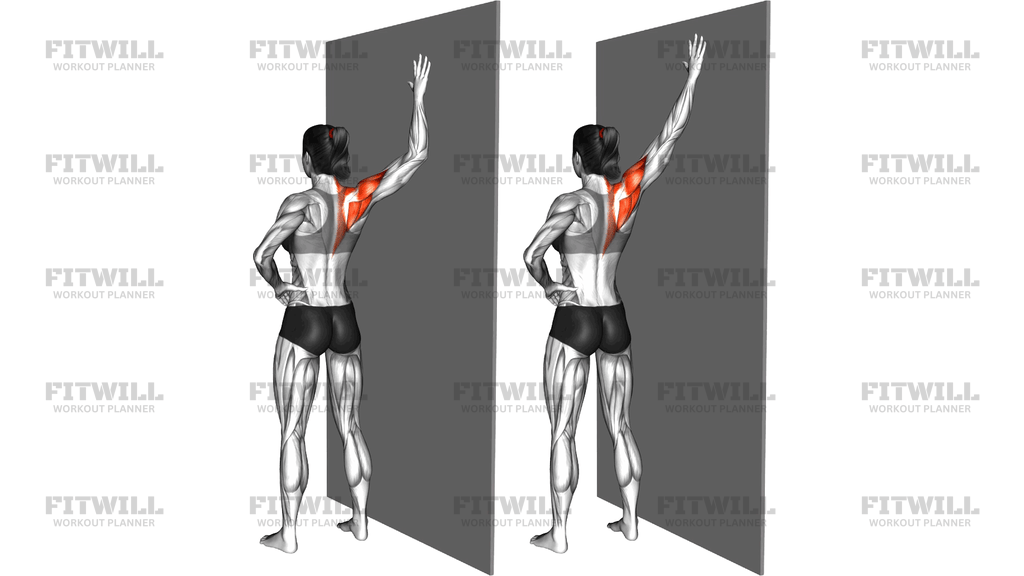
Standing Single Shoulder Stretch Wall Supported is a static stretch performed with your back close to a flat wall. You reach one arm behind and slightly out to the side, place your palm or fingers against the wall, and gradually slide or lean until you feel a stretch through the back of the shoulder, the side of the torso, and the upper back on that side. The other hand can rest on your hip to help you keep your torso tall and level while the working arm settles into position.
This stretch is especially useful for people who spend long hours at a desk, as well as lifters whose pressing and pulling work leaves the shoulders feeling tight and restricted. Overhead athletes, swimmers, and anyone regaining range of motion after a period of reduced activity can benefit from it as part of a warm-up or cooldown routine. Because the wall provides a fixed reference point, the arm is guided into a consistent position, which makes the stretch easier to repeat at the same angle from session to session.
The main tissues lengthened here are the deltoid on the stretched side along with the rotator cuff muscles that steer the upper arm, and the latissimus dorsi and teres major as the arm travels up and away from the body. The trapezius and rhomboid area of the upper back also receives gentle lengthening as the shoulder blade rotates upward. Keeping the arm in contact with the wall means these muscles are stretched in a lengthened, rotated position that is hard to reproduce with a free-hanging arm stretch.
Setup matters more than intensity in this movement. Your distance from the wall determines where the stretch lands: standing too far away forces you to lean the whole torso sideways, while standing too close removes tension from the arm entirely. Aim for a position where your torso stays facing forward and the arm, not the spine, does the reaching. Keep your feet about hip-width apart with your weight balanced so you are not bracing through a twisted lower back.
To execute well, raise the arm slightly behind your body, place the back of the hand or palm against the wall, and let the shoulder blade rotate upward as you slide the hand higher or step closer by a centimeter or two. The stretch should feel like a broad pull through the rear shoulder and outer upper back, never a pinching sensation at the front of the shoulder or a sharp pull anywhere. Hold the end position for twenty to thirty seconds while breathing steadily, then switch sides and match the hold on the other arm.
A practical safety point: move into the stretch gradually and stop at mild to moderate tension. If you have a current or recent shoulder injury, particularly one involving the rotator cuff, use a smaller range and keep the hand lower on the wall until the position feels comfortable, or check with a qualified professional about whether this stretch suits your situation.
[ Workout Log & Planner ]
Put your next workout in Fitwill
Keep your plan and training log ready when you are.


Instructions
- Stand with your back a short distance from a flat wall, feet hip-width apart, and place one hand on your hip.
- Reach the other arm up and slightly out to the side, rotating it behind you so the back of your hand or your palm rests against the wall.
- Check your torso: keep your chest facing forward and your shoulders level rather than twisting away from the wall.
- Engage your core lightly to keep your ribs stacked over your pelvis so the stretch stays in the shoulder and upper back.
- Slide the hand a little higher along the wall or step your feet a few centimeters closer until you feel tension through the rear shoulder and outer upper back.
- Settle into the end position and let the shoulder blade rotate upward with the arm instead of shrugging it toward your ear.
- Hold the position for twenty to thirty seconds, breathing slowly and allowing the tension to ease slightly as you exhale.
- Ease out by stepping back or sliding the hand down the wall a short distance before lifting the arm away completely.
- Rest briefly, then switch arms and repeat on the other side, matching the hold time and range.
Tips & Tricks
- A common mistake is letting the torso lean sideways toward the opposite side to chase a stronger pull. If you catch yourself bending at the waist, step slightly closer to the wall so the arm creates the stretch instead of the spine.
- Keep the working shoulder down away from the ear. Shrugging the shoulder blade up as the hand climbs the wall shortens the very muscles you are trying to lengthen.
- Avoid fully locking the elbow. A soft elbow lets the lats and shoulder contribute to the stretch rather than leaving the joint hanging on passive structures.
- If you feel a pinch at the front of the shoulder, lower the hand a few inches on the wall and reduce how far you step in. The stretch should come from the back of the shoulder, not the front of the joint.
- Tiny adjustments change everything in this position: one or two centimeters closer to the wall is usually enough to progress, so resist the urge to force a big slide.
- Warm shoulders stretch more comfortably. Two or three easy arm circles before you set up will make the wall position feel far less abrupt.
- Breathe out slowly as you settle into the end range. Holding your breath tends to tense the upper traps and blunts the effect of the stretch.
- Match sides carefully. If one shoulder is noticeably tighter, give the tighter side an extra short hold rather than pushing it harder in a single long hold.
- Keep the hand on the hip lightly pressing the hip so the torso stays square. Letting that arm hang makes it easy to rotate the chest away without noticing.
Frequently Asked Questions
Which muscles does the Standing Single Shoulder Stretch Wall Supported target?
It primarily lengthens the deltoid and rotator cuff muscles of the raised arm, with the lats and teres major contributing as the arm travels up and out. The upper trapezius and rhomboid area of the upper back also receive gentle lengthening.
How far should I stand from the wall during the Standing Single Shoulder Stretch Wall Supported?
Start close enough that your palm can rest on the wall with your torso square and your arm nearly straight. If your body leans sideways to reach, you are too far away; if there is no tension when you slide the hand up, step slightly closer.
Is this stretch suitable for beginners?
Yes. The wall guides the arm into position and the intensity is fully controlled by how high you place the hand and how close you stand, so a beginner can work well within a comfortable range.
Should my palm or the back of my hand touch the wall?
Either works, but placing the palm flat against the wall gives you more control when sliding the hand up. If flat-palm contact bothers your wrist, use the back of the hand or rest the fingers lightly instead.
Why do I feel the Standing Single Shoulder Stretch Wall Supported more in my side than my shoulder?
The latissimus dorsi runs from the upper arm down the side of the torso, so a strong pull along the flank usually means the arm is reaching further out than up. Bring the hand slightly more in line with the shoulder to shift the emphasis back to the shoulder itself.
How long should I hold each side?
Twenty to thirty seconds is a solid standard, repeated two to three times per side. For a cooldown, longer holds of forty seconds or more at a gentler intensity work well.
Can I do this stretch before training?
Yes, it works well as part of a warm-up for pressing or overhead work. Keep the holds shorter, around fifteen to twenty seconds, and avoid pushing into deep end-range right before loading the shoulder.
What can I use if I do not have a clear wall space?
A sturdy door frame, the side of a squat rack, or any flat vertical surface works the same way. The key is a surface tall enough for your hand to travel above shoulder height while your body stays supported.
When should I avoid the Standing Single Shoulder Stretch Wall Supported?
Skip it or reduce the range if you feel sharp pain, pinching at the front of the shoulder, or any tingling down the arm. If you are recovering from a shoulder injury, check with a qualified professional before adding this position to your routine.