Standing Top Clap Back Clap
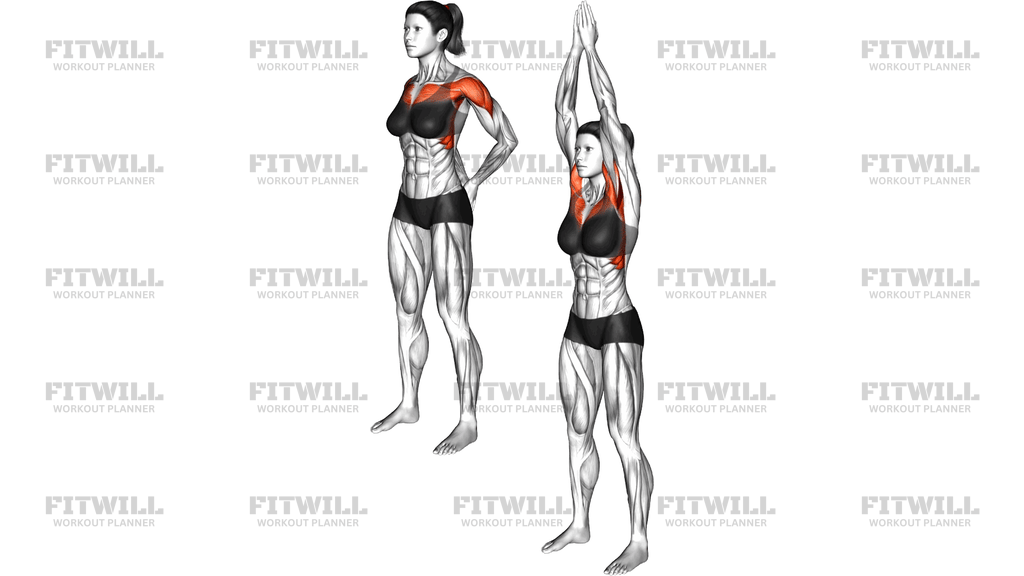
The Standing Top Clap Back Clap is a bodyweight dynamic mobility drill where you swing your arms from behind your back up overhead and clap your hands at the top, then reverse the path and clap behind your lower back. It moves the shoulders through a very large arc of motion in one continuous swing, which is something few exercises do. The image shows the two key positions: hands clasped or clapping behind the hips at the bottom, and arms fully extended overhead with palms meeting at the top.
This drill is popular in warm-ups for pushing and pulling days, in calisthenics and martial arts preparation, and in general shoulder health routines. It trains active shoulder flexion and extension, stretches the chest and front shoulder tissue as the arms travel up, and loads the rear shoulders and upper back as the arms swing behind you. Because you are standing and moving without equipment, it also challenges you to keep the ribcage and torso quiet while the arms do the work.
Setup matters more than it looks. A tall stance with feet about hip-width apart, a braced trunk, and relaxed-but-controlled arms keeps the swing smooth. If you arch your lower back or shrug toward your ears to get the hands overhead, you lose the intended shoulder range and start substituting with spine movement. The clap itself should be light and quick, not forced; the goal is range and rhythm, not impact.
To execute well, think of the arms as pendulums driven by the shoulders. Swing up in front, let the palms meet overhead, then continue the momentum down behind you and clap near your tailbone or lower back, and swing straight back up without pausing. Keep the elbows long and the neck relaxed throughout.
Common use cases include pre-workout shoulder preparation, restoring arm swing after long days of desk work, and as a low-effort movement snack between sets or during breaks. It is generally safe for healthy shoulders, but anyone with impingement-type discomfort or recent shoulder injury should use a smaller arc and skip the claps until the full path feels comfortable.
[ Workout Log & Planner ]
Put your next workout in Fitwill
Keep your plan and training log ready when you are.


Instructions
- Stand tall with your feet roughly hip-width apart, weight spread evenly across both feet, and arms hanging relaxed at your sides.
- Reach both arms behind your back and bring your palms together in a light clap near your lower back or tailbone, keeping the chest open and shoulders drawn gently back.
- Brace your trunk lightly and keep your ribs stacked over your pelvis so the movement stays in the shoulders rather than the lower back.
- From the back clap, swing both arms down and forward, letting the momentum carry them up in front of your body.
- Continue the swing until the arms are fully extended overhead and clap your palms together at the top, keeping the elbows straight and biceps near your ears.
- Reverse the path smoothly: swing the arms back down in front, behind your hips, and clap again at the lower back.
- Breathe naturally, inhaling as the arms rise and exhaling as they swing down behind you.
- Keep the rhythm continuous for the desired number of repetitions, letting each clap flow into the next swing without pausing.
- On the final repetition, bring the arms down to your sides under control and take a moment to reset before the next set.
Tips & Tricks
- If you cannot clap behind your back, slide the hands closer to your hips instead of forcing the hands together at the tailbone, and shorten the overhead clap to a palm tap.
- The most common mistake is arching the lower back and flaring the ribs to buy overhead range; squeeze the glutes lightly and think of reaching up with the shoulders instead of leaning back.
- Shrugging toward the ears at the top clap shifts work to the upper traps; keep a little space between shoulders and ears throughout the swing.
- Bending the elbows mid-swing shortens the arc and defeats the purpose; cue long arms, as if drawing the biggest possible circle with your hands.
- Hard claps can irritate sensitive wrists; make the contact quick and light, or clap just short of touching to control the speed.
- Keep the head neutral and eyes forward; looking up at the hands pulls the neck into extension and tightens the upper traps.
- Start with a moderate tempo to feel the full path, then add a touch of speed once the swing feels smooth; speed should amplify the arc, not replace control.
- A tight chest often limits the back clap position; pair this drill with doorway or wall chest stretches to improve the range over time.
- If one side claps easily while the other feels restricted, slow down and match the stiffer side's range so you do not develop an uneven swing pattern.
Frequently Asked Questions
Which muscles does the Standing Top Clap Back Clap work?
It primarily moves and mobilizes the shoulders, with the deltoids driving the swing. The chest and front shoulders lengthen on the overhead clap, while the rear shoulders and upper back muscles work as the arms swing behind you.
Is the Standing Top Clap Back Clap good for beginners?
Yes, it is low-load and easy to learn, making it suitable for almost anyone with healthy shoulders. Beginners should start with a smaller arc and lighter claps, then increase range as the shoulders loosen up.
Why can't I clap my hands behind my back?
Limited shoulder extension and internal rotation, often from tight chest or front shoulder tissue, is the usual reason. Reach only as far back as comfortable and gradually work the clap lower as your range improves.
Should I feel the Standing Top Clap Back Clap in my lower back?
No, the work should stay in the shoulders and upper torso. If you feel a strain in your lower back, you are likely arching to gain overhead range; tighten your trunk and reach up with the shoulders instead of leaning back.
When should I do the Standing Top Clap Back Clap in my workout?
It works best as a warm-up drill before pressing, pulling, or overhead movements, when the shoulders are cold but you want to raise their temperature and range. It can also be used as a light mobility break during the day.
How many reps of the Standing Top Clap Back Clap should I do?
Ten to twenty continuous, smooth swings is a typical dose for a warm-up. The goal is a comfortable rhythm through the full arc, not fatigue.
Can I substitute arm circles for the Standing Top Clap Back Clap?
Arm circles are a reasonable alternative when space or shoulder range is limited, but they miss the clap positions that push the end ranges of shoulder extension and flexion. The Standing Top Clap Back Clap gives a fuller swing from behind the hips to overhead.
Is the clap impact bad for my shoulders or wrists?
Light claps are generally harmless, but hard slaps add unnecessary impact to the wrist and hand joints. Keep the contact quick and gentle, or clap just short of touching if your wrists are sensitive.
My shoulders click during the Standing Top Clap Back Clap. Should I stop?
Painless clicking is common in the shoulder and is usually not a concern if there is no discomfort. If the movement causes pain, reduce the range, skip the claps, and consult a qualified professional before continuing.