Side Step Sky Punch
Side Step Sky Punch is a standing bodyweight movement that combines a lateral side step with an upward punch toward the ceiling. You start with your fists raised to shoulder height in a guard-like position, step one foot out to the side, and drive one fist straight up overhead while the other stays anchored near your chin. The step and the punch happen together, which forces your lower body and upper body to coordinate under one brace.
This move earns its place in a workout because it trains several things at once without any equipment. The upward punch works the shoulders and triceps through a vertical pressing path, the side step loads the glutes and quads as they absorb and return your body weight, and the rotational transfer between the step and the punch asks the obliques and deep core to keep your ribcage and hips facing forward. Because you repeat it on both sides, it also builds a natural left-right balance check: most people quickly notice one side steps wider or punches cleaner than the other.
The setup matters more than it looks. With your fists at shoulder height and elbows tucked slightly in front of your ribs, your shoulders are already working isometrically before the punch even starts. If your fists drift down or your elbows flare wide, the punch loses its vertical path and the shoulder joint takes the punch at an awkward angle. Likewise, a side step taken with a narrow, stiff base turns the movement into a wobble; a step taken with soft knees and weight in the mid-foot lets the glutes do their job.
To execute it well, think of the punch as coming from the floor. The side step loads your outside leg, and that leg drives the punch upward so the arm is finishing a chain rather than working alone. Punch fully so the arm extends toward the ceiling, then retract the fist back to your chin as the foot comes back in. Keep the movement rhythmic rather than rushed, alternating sides like a controlled shadowboxing pattern aimed at the sky.
Side Step Sky Punch fits well as a warm-up primer, a cardio interval station, or a high-rep finisher for shoulders and legs. It is especially useful in small spaces or home workouts where no equipment is available, and for anyone who wants standing core work that does not involve crunches. The main safety points are simple: keep knees tracking over the toes on each step, avoid arching the lower back as the arm reaches up, and land each step quietly, which is a good sign you are controlling the movement rather than dropping into it.
[ Workout Log & Planner ]
Put your next workout in Fitwill
Keep your plan and training log ready when you are.


Instructions
- Stand tall with your feet hip-width apart and raise both fists to shoulder height, elbows bent and tucked close to your ribs in a guard position.
- Brace your core lightly, pull your shoulders down away from your ears, and soften your knees so you are ready to move.
- Step your right foot out to the side about shoulder-width to slightly wider, keeping your weight balanced across the whole foot and your knees tracking over your toes.
- As the foot lands, drive your right fist straight up toward the ceiling until the arm is nearly extended, while the left fist stays anchored near your chin.
- Keep your hips and chest facing forward; do not let your torso lean or rotate away from the punching side.
- Retract the punch back to your shoulder as you step the right foot back in to the starting stance.
- Repeat on the left side, stepping out with the left foot and punching upward with the left arm.
- Exhale sharply as you punch and step, inhale as you return to center.
- Continue alternating sides at a steady, controlled rhythm for your target reps or time.
- Reset your stance and fist height between sets if your guard position has drifted or your shoulders have crept up.
Tips & Tricks
- The most common mistake is punching straight up while the torso leans back; think of reaching up along an invisible line just in front of your ear instead of behind your head.
- If your side steps are shallow, the glutes never load properly. Step wide enough that you feel the outside hip engage as the foot lands.
- Keep the non-punching fist pressed lightly against your chin area. Letting the idle arm swing loose drains the core brace and turns the move into flailing.
- Land each step with a bent knee. Stiff-legged side steps send impact straight to the knees and ankles instead of through the glutes and quads.
- If your shoulders shrug as you punch, drop your fists slightly below shoulder height for a few reps and consciously press your shoulder blade down before each reach.
- Speed comes last. Master the step-and-punch timing at a slow tempo first, then build pace while keeping the same clean arm path.
- On soft surfaces or if balance is a challenge, narrow the side step slightly. You can always widen it as your control improves.
- Watch for the punching elbow drifting out to the side. The path is vertical, so the elbow should travel up in front of the shoulder, not out from it.
Frequently Asked Questions
What muscles does the Side Step Sky Punch work?
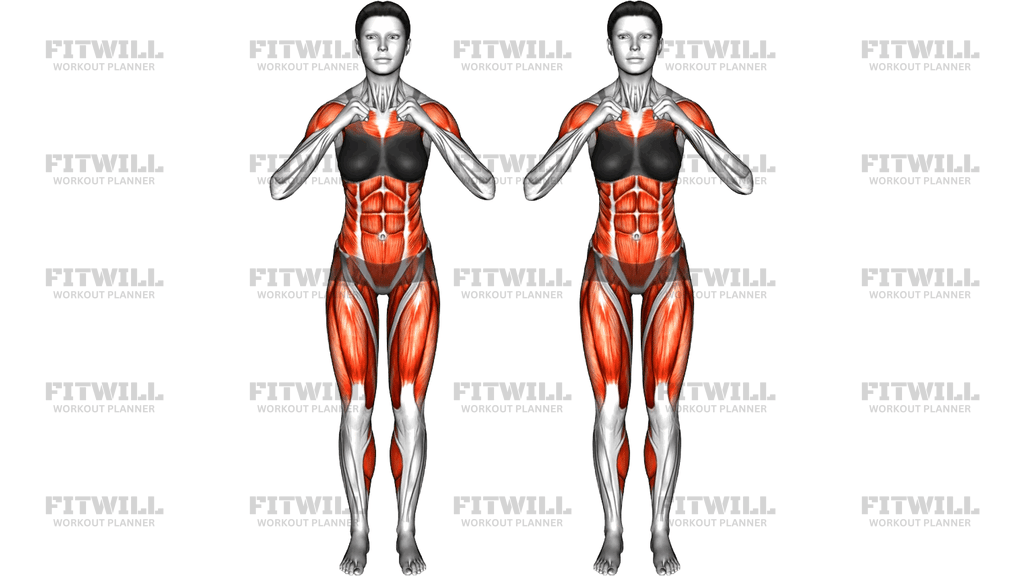
The primary work is in the shoulders, especially the front and side deltoids, with the triceps extending each punch. The side steps recruit the glutes, quads, and calves, while the obliques and deep core stabilize your torso as power transfers from the step to the punch.
Is the Side Step Sky Punch good for beginners?
Yes. It requires no equipment and can be scaled easily by narrowing the side step and slowing the tempo. Beginners should prioritize a clean vertical punch path and quiet landings before adding speed or volume.
Should I punch with the same arm as the stepping leg or the opposite arm?
In the standard version, the arm matches the stepping leg: step right and punch right, then step left and punch left. This keeps the movement symmetrical and makes the side-to-side coordination easy to learn before trying cross-body variations.
Why do my lower back and shoulders feel strained during the punch?
This usually means you are arching backward as you reach overhead or shrugging your shoulders toward your ears. Keep your ribs stacked over your pelvis, press the shoulder blade down before each punch, and reduce the height of the reach slightly until the strain disappears.
Can I use the Side Step Sky Punch as cardio instead of strength work?
Absolutely. Done for longer intervals, such as 30 to 60 seconds of continuous alternating reps, it raises the heart rate quickly and works well as a cardio station or warm-up finisher. Done slowly with focused reps, it functions more as shoulder and leg conditioning.
How wide should my side step be?
Step out roughly shoulder-width to slightly wider than shoulder-width, enough that you feel the outside hip and glute engage when your foot lands. If your knees collapse inward or you lose balance, narrow the step until you can land with control.
What can I substitute if stepping sideways bothers my knees?
Try the same punch pattern from a stationary stance with a slight knee bend, or step in place by lifting the foot a small amount instead of stepping wide. The vertical punch and core brace remain the same in both versions.
How many reps should I do per set?
For strength-focused work, aim for 10 to 16 controlled punches per side. For cardio intervals, go by time, such as 30 to 45 seconds of continuous alternating steps, stopping when your punch height or step quality starts to fade.
Do I need any equipment for the Side Step Sky Punch?
No equipment is required, just enough floor space to step comfortably to each side. Supportive shoes are recommended if you are on a hard surface, since each side step involves a small landing.