Walking Arms Circle
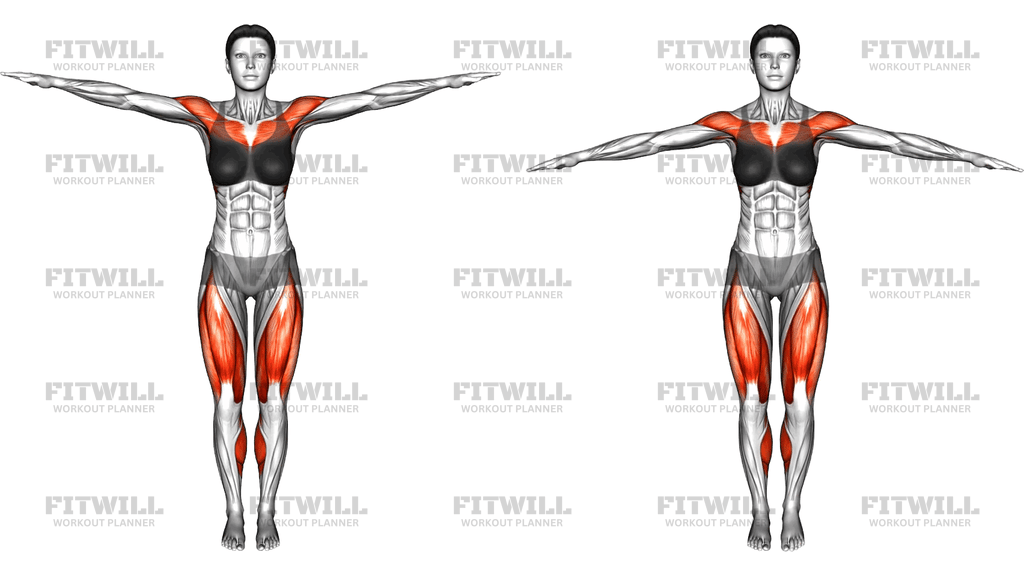
Walking Arms Circle is a simple dynamic drill that combines continuous forward walking with big, sweeping circles of both arms. You stand tall, extend your arms straight out to your sides at shoulder height, and rotate them in full circles while your legs keep moving one step at a time. It needs no equipment and no space beyond a hallway, yard, or open floor, which makes it one of the easiest ways to wake up the upper body while keeping the lower body active.
The movement mainly works the shoulders, especially the front and side deltoids that lift and rotate the arms, along with the chest muscles that help drive the arms through the top of the circle. Because you are walking at the same time, your calves and quads handle the steady stepping, and your core stays lightly engaged to hold your torso upright while your arms move. The real value, though, is coordination: your brain has to run two rhythms at once, which is exactly why this drill shows up in warm-ups for running, racquet sports, swimming, and general group training.
Setup matters more than it looks. If your arms drift below shoulder height or your elbows bend, the circles shrink and the shoulder work disappears. Keep the arms long, the palms relaxed, and the circles wide enough that your fingertips trace a path slightly wider than your shoulders. Your walking should stay normal and relaxed; the arms add the challenge, not the feet.
To execute it well, walk at a conversational pace and let each arm complete one smooth circle every two to three steps. Breathe steadily and avoid holding your breath as the arms come overhead. Most people perform the drill for 20 to 40 meters or 20 to 30 seconds forward, then reverse the circle direction on the way back if they want a balanced warm-up.
This is a go-to movement for warm-ups, active recovery days, and low-impact conditioning. If your shoulders feel pinched at the top of the circle, make the circles smaller rather than forcing the range. Keep your neck relaxed, your ribs stacked over your hips, and let the motion stay fluid rather than choppy, and the drill will do its job without stressing any joint.
[ Workout Log & Planner ]
Put your next workout in Fitwill
Keep your plan and training log ready when you are.


Instructions
- Stand tall with your feet hip-width apart and your arms extended straight out to both sides at shoulder height, palms facing down or relaxed.
- Pick a clear walking path of about 20 to 40 meters with no obstacles, and look straight ahead rather than down at your feet.
- Draw your belly button in slightly and stack your ribs over your hips so your torso stays upright while your arms move.
- Begin walking forward at a steady, comfortable pace, landing each step from heel to toe.
- At the same time, rotate both arms forward in large, smooth circles, keeping the elbows straight and the circles wide.
- Time the circles so each arm completes roughly one full rotation every two to three steps.
- Keep the arms at or near shoulder height throughout; do not let them sag toward your hips as they come around the bottom of the circle.
- Breathe in through your nose and out through your mouth in a steady rhythm instead of holding your breath when the arms pass overhead.
- Continue for 20 to 30 seconds or your chosen distance, then stop, lower your arms slowly, and shake out the shoulders before repeating backward circles if desired.
Tips & Tricks
- The most common mistake is bending the elbows, which quietly turns big arm circles into small hand circles; think about your fingertips drawing the widest possible ring.
- If your shoulders creep up toward your ears, consciously drop them between circles so the upper traps stop taking over from the deltoids.
- Many people slow their walking to concentrate on the arms; keep the step rhythm fixed first and fit the circles around it, not the other way around.
- Start with forward circles before trying backward ones, since the backward version tends to pull the chest tight and the shoulders forward if you rush it.
- If your shoulders pinch when the arms pass overhead, shrink the circle diameter rather than pushing through discomfort.
- Keep the palms loose and fingers soft; gripping your hands or clenching fists adds neck and forearm tension you do not need.
- Do this drill after a couple of minutes of easy walking, not as the very first movement of a cold workout, so the shoulders are ready for the full range.
- On uneven ground, shorten your stride and slow the circles slightly; coordination drills are where a distracted step most often turns into a rolled ankle.
Frequently Asked Questions
Which muscles does Walking Arms Circle work the most?
The shoulders take the main load, particularly the front and side deltoids that rotate and hold the arms up. The chest assists through the upper arc, while the calves and quads work continuously from the walking.
Is Walking Arms Circle a strength exercise or a warm-up?
It works best as a dynamic warm-up or light conditioning drill. Because there is no external load, it raises your heart rate and prepares the shoulder joints for harder work rather than building significant strength.
Should I do forward circles, backward circles, or both?
Both is ideal. Forward circles are usually easier to coordinate, so start there, then repeat the drill with backward circles to cover the shoulder range in the opposite direction.
Why do my arms drop below shoulder height during Walking Arms Circle?
This usually happens when fatigue sets in or the elbows bend without you noticing. Reset with the arms long and level with your shoulders, and if you cannot hold that position, shorten the set rather than letting the circles sag.
How long should each set of Walking Arms Circle last?
Around 20 to 30 seconds or 20 to 40 meters per set works well for a warm-up. If you are using it for low-impact conditioning, you can extend to a minute or more as long as your arm height and circle size stay consistent.
Can beginners do Walking Arms Circle?
Yes, it is one of the most beginner-friendly drills there is, since the only equipment is your own body and the pace is self-selected. Beginners should focus on smooth, medium-sized circles before making them bigger.
What can I use instead if I have no space to walk?
Standing arm circles give you nearly the same shoulder benefit if you march in place instead of traveling. You lose a little balance and rhythm work, but the movement pattern stays the same.
Is it a problem if I feel a pinch at the top of the circle?
A pinch is a signal to reduce the circle size, not to push through it. Make the rings smaller and keep the shoulders relaxed; if the sensation keeps appearing at any range, it is worth having a professional take a look.