Walking Front Side Top Punch
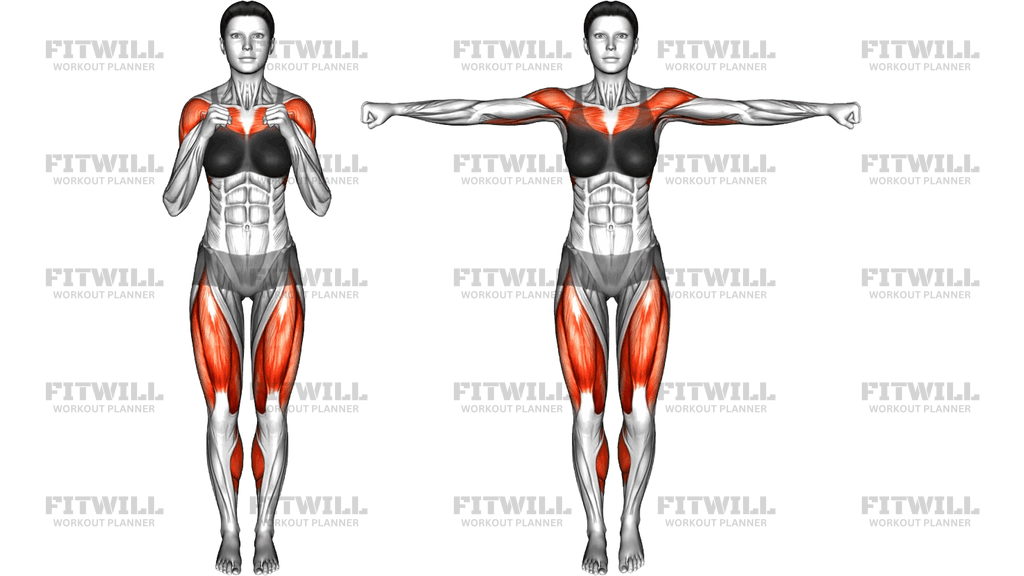
Walking Front Side Top Punch is a bodyweight conditioning drill that combines forward stepping with sharp, controlled punches extended out to the sides at shoulder height. You start with both fists tucked in at chest level in a guard position, then drive the arms outward into a wide T shape as you continue walking. Because the arms travel horizontally away from the body rather than straight ahead, the side shoulders and upper chest do most of the punching work while the legs keep you moving.
This movement suits anyone looking for a low-impact way to raise the heart rate while building shoulder endurance. It appears frequently in warm-ups, boxing-inspired cardio circuits, and group fitness classes because it needs no equipment and very little space — a short hallway or open floor area is enough. Beginners can use it to learn punch mechanics without impact, and more advanced trainees can speed up the pace or add light hand weights once the pattern feels automatic.
The setup matters more than most people expect. Standing tall with the feet hip-width apart, ribs stacked over the pelvis, and fists relaxed at the chest keeps the shoulders from shrugging upward as the arms extend. If you lean back or let the lower back arch when the arms reach shoulder height, the punch loses its crispness and the core stops doing its job of holding the trunk steady over each step.
To execute well, step forward with one foot and extend both arms out to the sides in one smooth, forceful motion, finishing at shoulder height with the palms facing down or forward. Pull the fists straight back to the guard position as the opposite foot steps through, and keep repeating that rhythm — step, punch, retract, step. The arms should feel snappy but controlled, never flung loosely, and the shoulders should stay down away from the ears throughout.
A common use case is metabolic conditioning: sixty-second blocks of Walking Front Side Top Punch paired with other walking strikes keep the pulse elevated without the joint stress of jumping. It is also a practical shoulder-endurance builder for combat sports training, since the lateral punching path challenges the deltoids differently than straight punches do.
For safety, keep the punches at or slightly below shoulder height rather than forcing the arms higher, and stop if you feel pinching at the front of the shoulders. Stay light on your feet, land each step softly from heel to toe, and breathe steadily instead of holding your breath during the punch.
Fitwill
Log Workouts, Track Progress & Build Strength.
Achieve more with Fitwill: explore over 9600 exercises with images and videos, access built-in and custom workouts, perfect for both gym and home sessions, and see real results.
Start your journey. Download today!




Instructions
- Stand tall with your feet hip-width apart, arms bent, and both fists held loosely at chest level in a guard position.
- Engage your core, draw your shoulder blades gently down, and look straight ahead so your neck stays neutral.
- Step forward with your right foot, keeping your weight balanced and your steps soft and controlled.
- As you step, extend both arms out to the sides simultaneously until they reach shoulder height, forming a wide T with your body.
- Squeeze briefly at the fully extended position with the palms facing down, arms straight but elbows not locked.
- Pull both fists back to the guard position at your chest as your left foot steps through to continue walking forward.
- Repeat the step-and-punch rhythm for your desired distance or time, alternating which foot leads each cycle.
- Exhale sharply as the arms extend, and inhale as you retract the fists to your chest.
- Keep your torso upright the whole time — avoid leaning back as the arms reach out to the sides.
- To finish, slow the pace, bring the fists back to the chest, and stop walking with your feet together.
Tips & Tricks
- If your shoulders creep up toward your ears as the arms extend, consciously press them down before each punch — shrugged shoulders shift the work to the upper traps and away from the side shoulders.
- A frequent mistake is overextending the arms above shoulder height; cap the punch at shoulder level to keep the deltoids, not the neck, doing the work.
- Keep the fists relaxed until the moment of extension. Clenching tightly for the entire set fatigues the forearms long before the shoulders tire.
- If your steps feel heavy, shorten your stride. Small, quick steps make it easier to keep the punch rhythm consistent while walking.
- Avoid letting the lower back arch when the arms reach the T position — brace the abs as if bracing for a light push to keep the ribs stacked over the pelvis.
- The return is just as important as the punch: pull the fists straight back along the same horizontal path instead of letting them drop or swing downward.
- If shoulder pinching occurs at full extension, reduce the range slightly or turn the palms to face forward, which is often more comfortable for tight shoulders.
- Match your breathing to the punch rather than breathing randomly — one sharp exhale per extension keeps the pace steady and the core engaged.
- Once you can maintain clean form for a full minute, increase intensity by speeding up the steps before adding any external weight to the hands.
Frequently Asked Questions
What muscles does Walking Front Side Top Punch work?
The side shoulders and chest drive the horizontal punch, while the triceps straighten the arms. Walking continuously keeps the quads, calves, and core active, and the abs work to hold the trunk steady as the arms extend.
Is Walking Front Side Top Punch suitable for beginners?
Yes. It is low-impact, needs no equipment, and the punching pattern is simple to learn. Beginners should start slowly and prioritize a controlled punch at shoulder height before increasing the pace.
Why do the arms extend to the sides instead of straight forward in this exercise?
The horizontal path targets the side shoulders more directly than a straight punch and stretches the chest on each extension. It also challenges the core to resist the outward pull of both arms at once.
How high should my arms be at the end of each punch?
Aim for shoulder height so the arms form a wide T. Punching higher than that usually causes shrugged shoulders and neck tension without adding benefit.
How long should I perform Walking Front Side Top Punch?
Thirty to sixty seconds per set works well for conditioning, or you can walk a fixed distance such as the length of a room and back. Rest briefly between sets and repeat for several rounds.
My shoulders fatigue before my legs — is that normal?
Yes, especially early on. The small shoulder muscles tire faster than the legs, so reduce the pace or shorten the set until your shoulder endurance improves.
Can I hold light dumbbells while doing Walking Front Side Top Punch?
You can, but only once your form is solid and you can complete a full set without shrugging. Start with very light weights, since the horizontal punching path puts extra demand on the shoulder joints.
What is a good substitute if I do not have space to walk?
Perform the same chest-high guard and side punch pattern while marching in place. You lose the forward travel but keep the arm path, timing, and cardiovascular demand.
Is this exercise safe for people with shoulder issues?
It is generally gentle because no load is involved, but anyone with a current or past shoulder injury should keep the range below the point of discomfort and check with a qualified professional first.
How does Walking Front Side Top Punch differ from a standard straight punch drill?
Straight punches emphasize the chest and front shoulders, while this lateral path shifts more work to the side shoulders. Combining both patterns in a circuit gives the shoulders more balanced work.