Walking Circle Draw
Walking Circle Draw is a simple but surprisingly demanding dynamic drill: you walk forward while your straight arms sweep through large, continuous circles at shoulder height. There is no equipment involved, which makes it easy to slot into a warm-up, a recovery day, or the opening minutes of a group class. Think of it as combining the shoulder mobility of arm circles with the rhythm of brisk walking, so your upper and lower body have to coordinate instead of working in isolation.
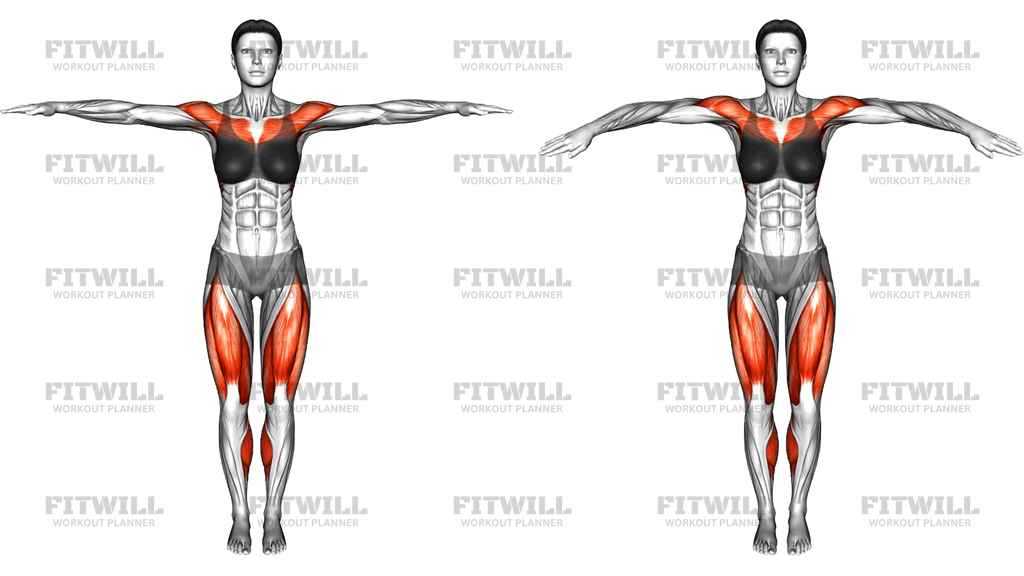
The main work happens in the shoulders. Holding your arms out in a T position and rotating them through big circles loads the deltoids through a long range, and the muscles around the shoulder blades have to keep working to hold the arms up against gravity for the duration of the set. Because the arms stay straight, the chest and upper back assist as the arms travel through the top and bottom of each circle, giving the whole shoulder girdle a smooth, controlled tour of its range.
Meanwhile, your legs handle the walking. The quads, calves, and hip flexors all contribute to steady forward steps, and keeping tall posture with arms elevated gently challenges your core to hold you upright without leaning back. This dual demand is exactly why the drill shows up in warm-ups: it raises your heart rate, warms the shoulder joints, and primes your coordination before heavier training.
Setup matters more than it looks. Stand tall with feet hip-width apart and raise both arms straight out to the sides until they sit level with your shoulders, forming a wide T. Palms can face the floor or turn slightly outward as the arms circle. Keep your ribs stacked over your pelvis and your neck relaxed; if you shrug or arch your lower back to hold the arms up, the circles will feel heavy in all the wrong places.
To execute well, start walking at an unhurried, natural pace and let both arms begin drawing large circles together, fingertips leading the way. Aim for circles roughly the diameter of your arm span's comfortable reach, staying at or just above shoulder height at the top. Match your arm tempo to your steps so the movement feels rhythmic rather than rushed, then reverse the circle direction halfway through the set so you cover the range in both rotational directions.
You will see this drill used as a warm-up before upper-body training, as a shoulder mobility reset for people who sit at a desk all day, and as a low-impact conditioning option for general fitness groups. Keep the pace conversational, stop if you feel pinching at the front of the shoulder, and shrink the circles before you lower them if the range feels uncomfortable.
[ Workout Log & Planner ]
Put your next workout in Fitwill
Keep your plan and training log ready when you are.


Instructions
- Stand tall with your feet hip-width apart and raise both arms straight out to your sides until they are level with your shoulders, forming a wide T with your body.
- Turn your palms to face the floor, or let them rotate slightly outward, and relax your shoulders down away from your ears.
- Brace your core lightly, soften your knees, and pick a focal point ahead of you so your head stays neutral while you move.
- Begin walking forward at an easy, natural pace, rolling from heel to toe with each step.
- Sweep both straight arms together in large forward circles, fingertips leading, so the hands rise up the front, out to the sides, and around.
- Keep the top of each circle at or just above shoulder height and the movement smooth and continuous rather than jerky.
- Synchronize your circles with your steps so one full circle takes roughly two to four strides, maintaining that rhythm throughout.
- Breathe steadily through your nose and mouth, letting the arm tempo set an even breathing cadence instead of holding your breath.
- After your set distance or time, reverse the circle direction so the arms travel backward, and walk through the same distance or time.
- To finish, gradually shrink the circles over a few rotations, lower your arms to your sides, and slow to a stop.
Tips & Tricks
- If your shoulders creep up toward your ears as the set goes on, that is fatigue in the upper traps taking over; consciously press your shoulder blades down and slightly shrink the circles instead of pushing through.
- Circles that drift above shoulder height usually mean you are arching your lower back to lift the arms. Keep the top of the arc near shoulder level and let the ribs stay stacked over your hips.
- Bent elbows are the most common form leak here. Straight arms keep the shoulders and chest doing the work, so if your elbows keep bending, make the circles a little smaller rather than easier to cheat.
- Match circle direction on both arms. When one arm lags, the movement turns into a winding pattern and the shoulders stop working symmetrically.
- Start with forward circles when you are cold and save backward circles for when the shoulders feel warm, since many people find the backward path tighter at first.
- Keep your steps slow enough that you never have to hold your breath. If you are gasping, your walk pace has overtaken your arm tempo.
- If you feel a pinch at the front of the shoulder during the top of the circle, lower the arc a few inches and let the hands pass slightly below shoulder line instead of forcing the full height.
- Look ahead, not down at your feet. Dropping the head while the arms are elevated rounds the upper back and makes the circles feel heavier.
- Use a hallway or open space with a clear return path so you can turn without dropping your arms mid-circle.
Frequently Asked Questions
What muscles does the Walking Circle Draw work?
The shoulders, especially the deltoids, do most of the work as your straight arms rotate through large circles, with the chest and upper back assisting. Your quads, calves, and hip flexors run the walking portion, and your core stabilizes you while your arms are held up.
Should I draw the circles forward or backward?
Both. Forward circles are usually more comfortable to start with, and reversing to backward circles partway through ensures your shoulders move through the range in each rotational direction.
How big should the circles be?
Aim for large, smooth circles with the top of the arc at or just above shoulder height, roughly as wide as your comfortable arm reach. If you feel pinching or your form breaks down, shrink the circle before you lower the height.
Is Walking Circle Draw suitable for beginners?
Yes. Because it uses only body weight and a natural walking pace, beginners can start with small circles for twenty to thirty seconds and gradually build the circle size and duration as shoulder endurance improves.
How long should one set last?
Thirty to sixty seconds per direction is a good starting point, long enough for the shoulders to feel warm and lightly fatigued without the arms dropping. In a warm-up, one set each direction is usually plenty.
Why do my arms feel so heavy even though there is no weight?
Holding straight arms at shoulder height against gravity for a continuous circle is a sustained isometric load on the deltoids and the muscles around the shoulder blades. Fatigue there is normal; let it, not shoulder pain, be the cue to end the set.
What is the most common mistake in this drill?
Shrugging the shoulders and arching the lower back to keep the arms elevated. Fix it by relaxing the neck, drawing the shoulder blades down, and keeping your ribs stacked over your pelvis as the arms circle.
Can I do it walking in place instead of moving forward?
Yes. Marching in place with the same arm circles is a fair substitute when space is limited, though you lose the heel-to-toe walking rhythm, so keep your knee lift deliberate to keep the legs involved.
Where does Walking Circle Draw fit in a workout?
It works best near the start of a session as a dynamic warm-up for the shoulders and a general pulse-raiser, or on easy days as low-impact movement. It is not a substitute for loaded shoulder training if strength is your goal.
Is it safe if I have a shoulder issue?
Reduce the circle size and keep the top of the arc below the point where you feel pinching, and stop entirely if you feel sharp pain. Check with a qualified professional before using it if you have a current or recent shoulder injury.