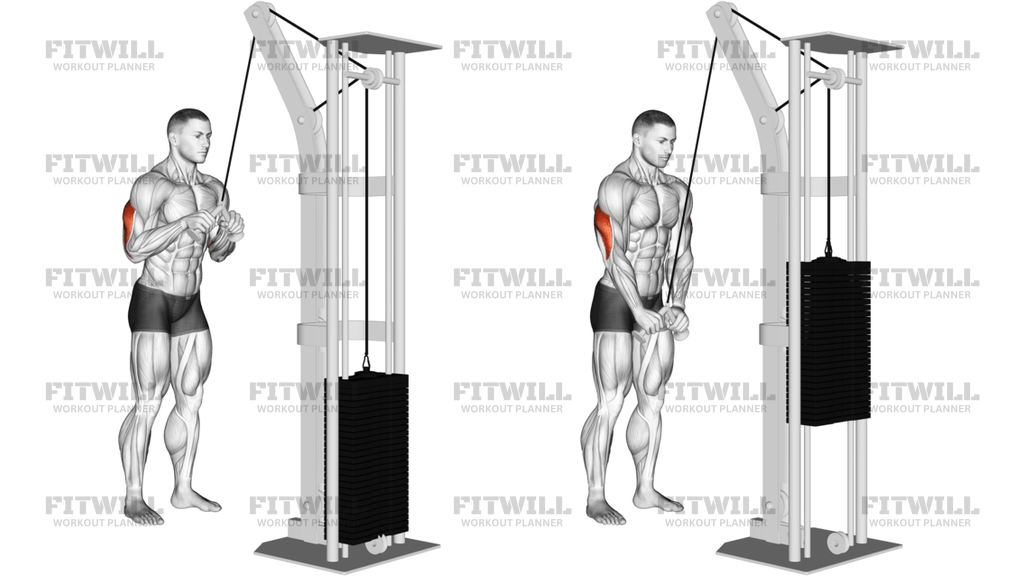
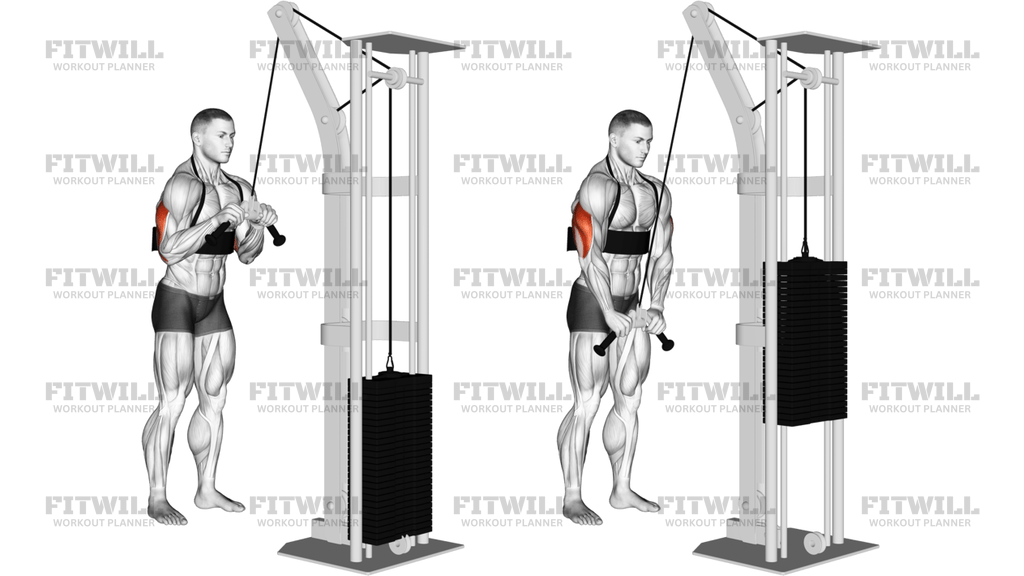
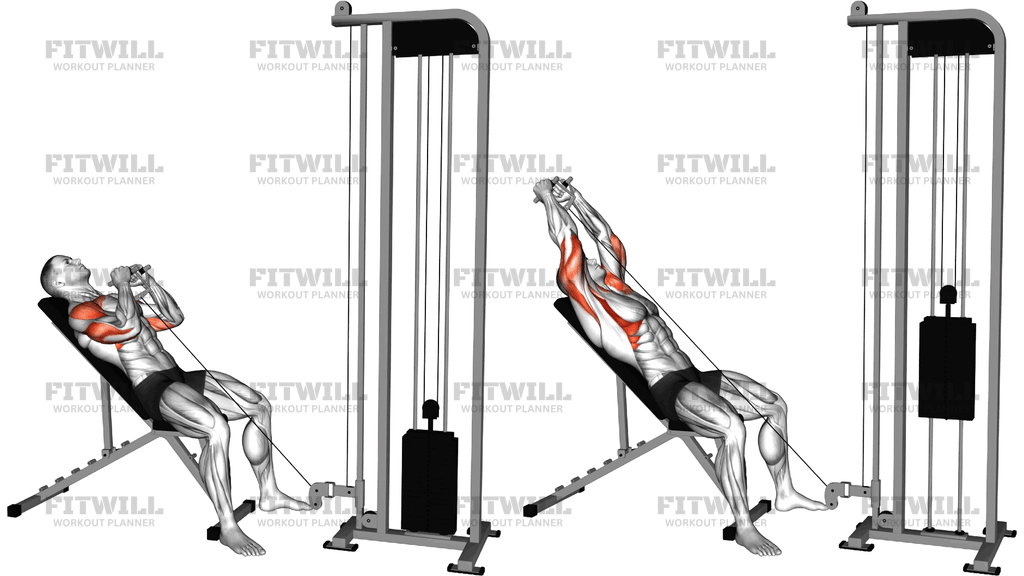
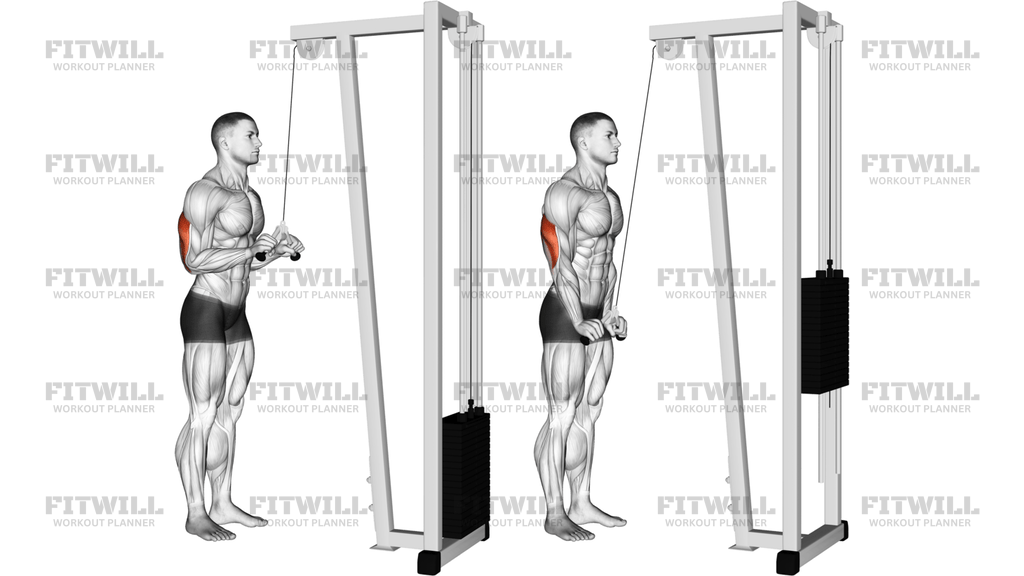
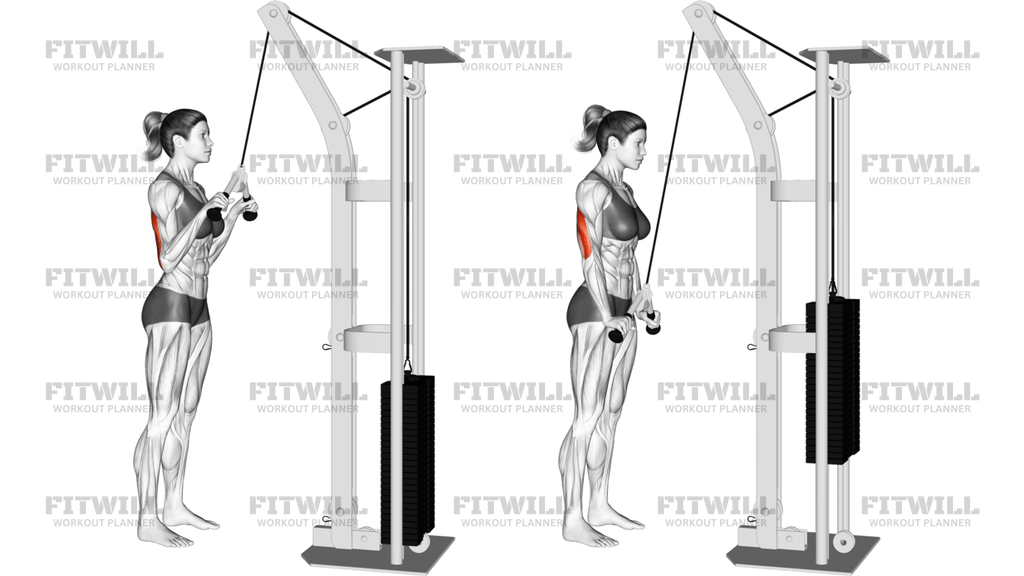
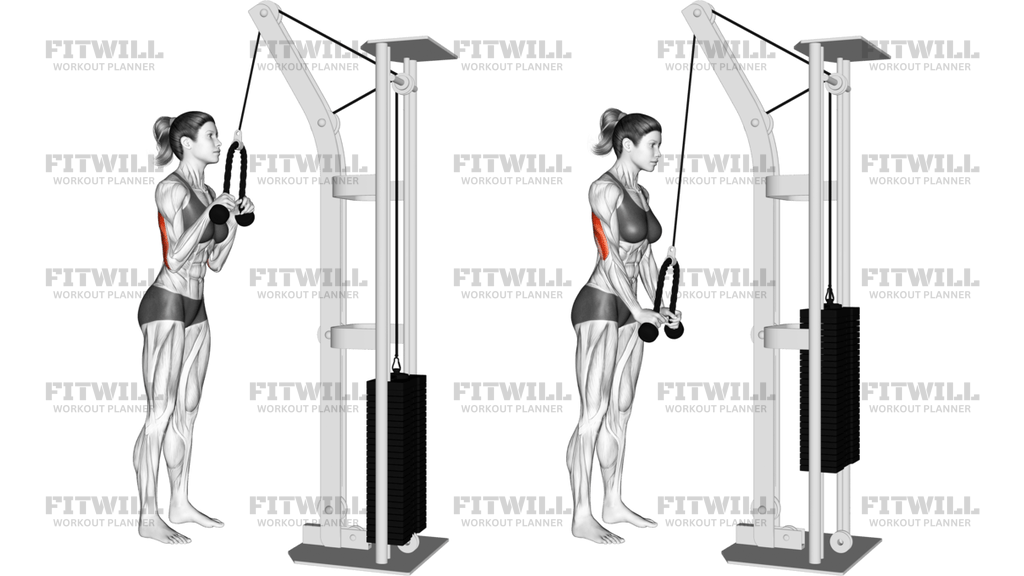
Cable Standing Tate Press (V Bar)
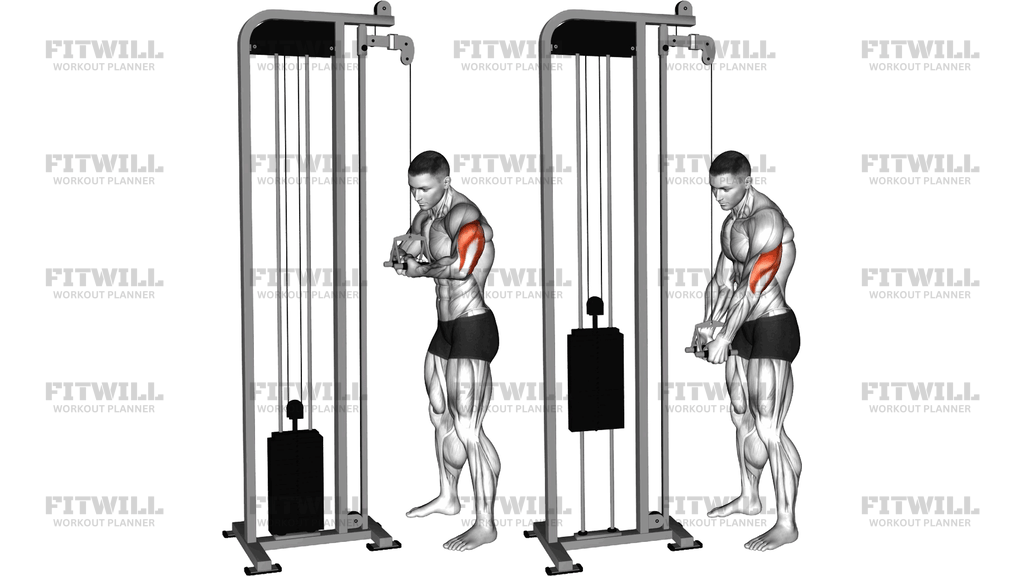
The Cable Standing Tate Press (V Bar) is a standing triceps exercise performed at a high cable pulley using a V-bar handle. Unlike a standard pushdown where the elbows stay tucked at your sides, the Tate variation keeps your upper arms raised and flared outward, so the elbows act as the pivot point while your forearms sweep the handle down and away from your torso. This changes the resistance angle on the triceps and places tension on the muscle from a shortened, elbow-out position that most pushdown variations never touch.
This movement is a solid choice for lifters who already handle basic pressdowns and want a new stimulus for the lateral and long heads of the triceps. Because the cable provides constant tension through the whole arc, the triceps stay loaded even at the top when the elbows are bent. It is also easier on the wrists than a fixed straight bar, since the V-bar lets your hands find a natural angle, and the standing position lets you absorb the load with your legs and core instead of forcing your shoulders to pin the weight.
Setup matters here more than with a regular pushdown. The pulley should be at the top of the machine, the V-bar held with a neutral grip, and your feet about hip-width apart with a slight forward lean from the hips. Your upper arms need to stay lifted and wide for the entire set; the moment they drop toward your ribs, the exercise turns into a generic pressdown and the intended triceps emphasis is lost.
To execute it well, start with elbows bent and hands near your upper chest, then press the handle down and slightly outward in a smooth arc until your arms are straight beside or just in front of your thighs. Squeeze the triceps hard at full extension, then let the handle travel back up under control until your forearms approach your upper arms. Keep the motion driven by the elbows, not by leaning your body weight onto the cable.
You will see this exercise used as an accessory movement after heavy compound pressing or close-grip work, typically for moderate weight and higher repetitions. The flared-elbow path makes it humbling compared to a standard rope or bar pushdown, so most lifters need less load here than they expect. If you have cranky elbows or shoulders, warm up thoroughly and start light; the stretched position at the top puts the triceps under meaningful tension and should not be forced with heavy loads before you own the pattern.
[ Workout Log & Planner ]
Put your next workout in Fitwill
Keep your plan and training log ready when you are.


Instructions
- Set the pulley of a cable machine to the highest position and clip a V-bar attachment onto the carabiner.
- Select a light starting weight, then take hold of the V-bar with both hands using a neutral grip so your palms face each other.
- Step back a short distance from the machine and stand with feet hip-width apart, knees softly bent, and a slight forward lean from the hips.
- Raise your upper arms out to the sides so your elbows are high and flared, with hands up near your upper chest and elbows bent around 90 degrees or more.
- Brace your core and pull your shoulder blades down so your shoulders are not shrugging up toward your ears.
- Press the V-bar down and slightly outward in an arc, pivoting only at the elbows, until your arms are fully straight with the handle near your thighs.
- Hold the locked-out position for a beat and consciously squeeze the triceps before reversing the motion.
- Let the handle rise back up with control until your forearms come close to your upper arms, keeping the elbows lifted and wide the entire time.
- Exhale as you press down and inhale as the handle returns to the start.
- Complete your repetitions, then step forward and let the stack return gently rather than releasing the handle under load.
Tips & Tricks
- The most common breakdown is the elbows sinking toward your ribs halfway through the set, which converts this into a regular pushdown. Cue yourself to keep the upper arms wide, and drop the weight if you cannot.
- Expect to use noticeably less load than on a rope or straight-bar pushdown. The flared-elbow path is a weaker angle for the triceps, and ego lifting here usually shows up as torso heaving.
- If your body is swinging into each rep, stand a little farther from the machine and let the cable pull slightly forward on you. That forward tension forces you to stay braced instead of leaning back.
- At the top of each rep, let the forearms rise until they nearly touch the upper arms, but do not let the weight stack slam down. The stretched position is where much of the benefit lives.
- The V-bar should rotate naturally in your hands. If you feel wrist discomfort, check that you are gripping through the handle body and not bending your wrists backward under load.
- Because you are standing and leaning slightly forward, fatigue often shows up in the lower back before the triceps quit. Keep the lean coming from the hips, not a rounded spine.
- Pair this with a heavy close-grip press or pushdown earlier in the session. As a first exercise it is hard to load productively, but as a second or third triceps movement it works very well.
- If your shoulders pinch when the elbows flare at the start, reduce the range at the top slightly and keep the elbows a touch lower while still clearly wider than a standard pushdown.
Frequently Asked Questions
What muscles does the Cable Standing Tate Press (V Bar) work?
The triceps are the primary movers, with all three heads contributing through the elbow extension. Because the elbows flare outward, the front shoulders and upper chest assist somewhat as the arms travel down, but the exercise should be felt in the back of the upper arms.
How is the Cable Standing Tate Press (V Bar) different from a regular cable pushdown?
In a standard pushdown the elbows stay pinned at your sides, while the Tate version keeps the upper arms raised and wide so the forearms sweep an arc away from the torso. This loads the triceps at a different angle and makes the movement considerably harder for the same weight.
Is the V-bar grip important, or can I use another attachment?
The V-bar gives a comfortable neutral hand position that suits the flared-elbow path and spares the wrists. A rope can work in a pinch, but the fixed angled handles of the V-bar make it easier to keep the arc consistent.
Can beginners do this exercise?
Beginners can learn it, but it is better introduced after they have mastered standard pushdowns, because the flared elbow position requires some coordination. Start with a very light weight and focus entirely on keeping the upper arms still and wide.
How many sets and reps should I use for the Cable Standing Tate Press (V Bar)?
It works best as an accessory movement in the 10 to 15 rep range for 2 to 4 sets, placed after heavier pressing or pushdown work. The constant cable tension and weaker leverage angle make very low-rep, heavy sets hard to control.
Why do I feel this more in my shoulders than my triceps?
Your elbows are probably dropping toward your ribs as you press, shifting the work away from the triceps. Keep the upper arms lifted and flared throughout, reduce the weight, and think of your elbows as hinges that stay fixed in space.
Should my torso move during the press?
Keep a slight forward lean from the hips, but hold it constant. Any rocking backward as you press down means you are using body English instead of triceps strength, so lighten the load.
What can I substitute if my gym has no V-bar attachment?
A rope or a straight bar from the same high pulley will replicate the movement closely. Adjust your grip so your hands stay roughly shoulder-width apart and keep the same flared-elbow path.
Is the Cable Standing Tate Press (V Bar) safe for the elbows?
It is generally joint-friendly because the cable gives smooth, constant resistance and the V-bar allows natural hand positioning. Still, warm up first, avoid bouncing out of the stretched position at the top, and stop if you feel sharp elbow pain.
How far back should I stand from the cable machine?
Stand far enough that the cable pulls slightly forward on the handle at the start, which helps keep tension on the triceps and discourages leaning back. If you are so close that the stack provides no resistance at the top, take a half step back.