Barbell Bench Squat
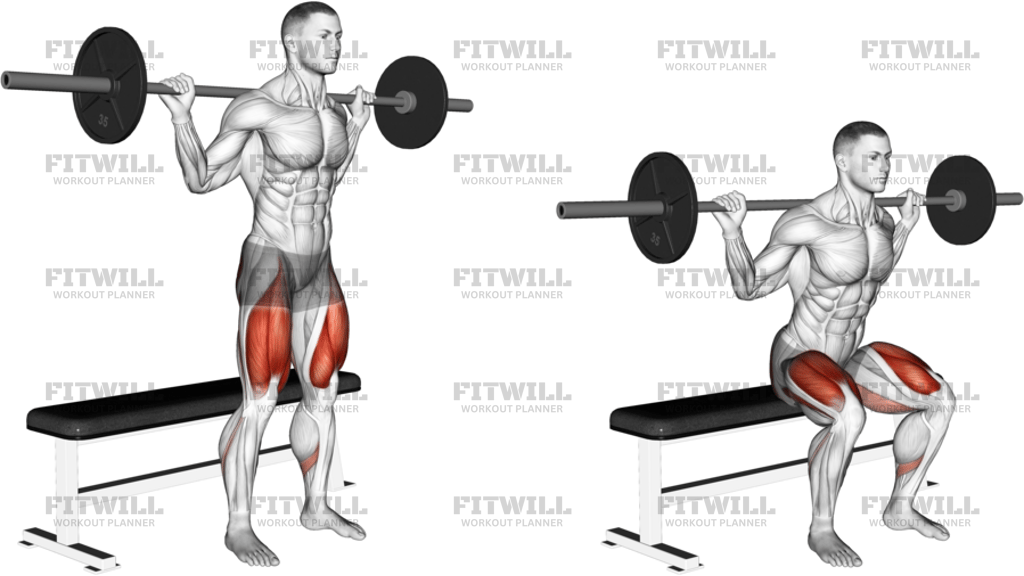
Barbell Bench Squat is a back-squat variation that uses a flat bench as a depth target. The bar rests across the upper back while you squat down until you lightly touch or approach the bench, then stand back up without relaxing onto it. The bench gives immediate feedback on depth and can help lifters learn a consistent bottom position.
The primary target is the quads, with the glutes, hamstrings, and core assisting through the squat. Because the bench is behind you, it is easy to mistake the exercise for sitting down; the goal is still to squat under control. The legs should stay active at the bottom so you can drive back up without rocking or bouncing.
Set the bench behind you at a height that allows a comfortable squat depth. Position the barbell across the upper back, stand with the feet about shoulder-width apart, and turn the toes slightly out. Brace the abs, keep the chest lifted, and make sure the bar stays over the middle of the feet before descending.
Lower by bending the knees and hips together, keeping the knees tracking in line with the toes. Lightly touch the bench or stop just above it, then drive through the feet to stand until the hips and knees are extended. Each touch should be quiet and controlled, not a drop onto the bench.
Barbell Bench Squat is useful for beginners learning depth, lifters rebuilding confidence, or anyone who needs a repeatable squat target. It can also be used as an accessory variation when you want controlled lower-body volume. Choose the bench height carefully: too high limits useful range, while too low may force rounding or loss of balance.
Common mistakes include sitting heavily, relaxing the brace, letting the knees cave inward, or shifting the weight back onto the heels at the bench. Keep tension through the legs and core from top to bottom. The bench should guide the squat, not do the work for you.
[ Workout Log & Planner ]
Put your next workout in Fitwill
Keep your plan and training log ready when you are.


Instructions
- Place a flat bench behind you and position a barbell across your upper back.
- Stand with your feet about shoulder width and your toes slightly turned out.
- Brace your core, keep your chest lifted, and look straight ahead.
- Bend your knees and hips to lower toward the bench under control.
- Keep your knees tracking in the same direction as your toes.
- Lightly touch or approach the bench without dropping your weight onto it.
- Drive through your feet to stand back up until your hips and knees are extended.
- Reset your brace at the top before beginning the next rep.
Tips & Tricks
- Use the bench as a depth target, not as a place to rest between reps.
- Keep tension through your legs and core when you reach the bottom.
- Avoid letting your knees collapse inward as you stand up.
- Keep the bar over the middle of your feet throughout the squat.
- Choose a bench height that allows a comfortable, controlled squat depth.
- Start light until you can touch the bench softly without losing posture.
- Keep your heels planted and avoid shifting onto your toes.
Frequently Asked Questions
What muscles does the Barbell Bench Squat work?
It primarily works the quads. The glutes, hamstrings, and core also assist during the squat.
Is the bench supposed to support my full weight?
No. Use the bench as a depth guide and touch it lightly, but keep your legs engaged throughout the rep.
Is Barbell Bench Squat good for beginners?
Yes, the bench can help beginners learn consistent squat depth. Start with a light weight and focus on control.
How high should the bench be?
Use a height that lets you reach a controlled squat depth without rounding your back or losing balance.
What are common mistakes in the Barbell Bench Squat?
Common mistakes include sitting down too hard, relaxing on the bench, letting the knees cave inward, and leaning too far forward.
Can I use this instead of a regular squat?
Yes, it can be used as a squat variation, especially when learning depth or working on control. Regular squats may still be useful once your technique is consistent.
Should I bounce off the bench in Barbell Bench Squat?
No. Touch the bench softly or pause with tension, then stand up. Bouncing makes the movement less controlled and can shift stress to the back or knees.