Barbell Jerk Dip Squat
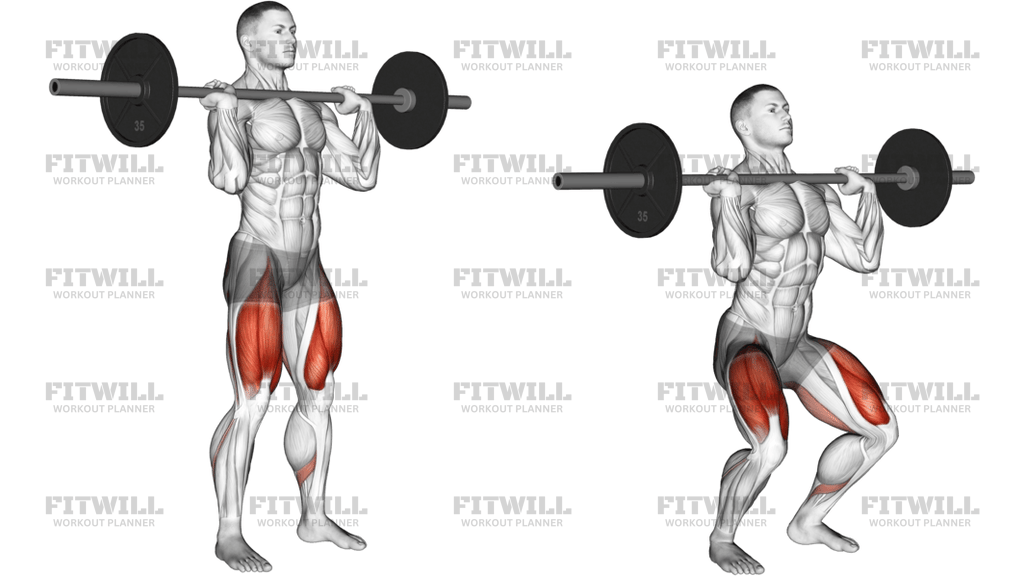
Barbell Jerk Dip Squat is the dip phase of the split or power jerk, performed with the barbell held in a front rack. It is not a full squat; the legs bend only a short distance while the torso stays tall so the lifter can store force in the legs and transfer it upward into the drive. In this position, the quads do most of the work, while the core, upper back, and stabilizers keep the bar steady and the trunk stacked under load.
This exercise is useful for weightlifters and anyone practicing the timing of the jerk because the quality of the dip directly affects the efficiency of the drive. A good dip is short, vertical, and controlled. If the knees travel too far forward, the hips drift back, or the chest collapses, the bar loses its stacked position and the push becomes less powerful. The goal is to keep the weight centered over the midfoot and the bar path almost perfectly vertical.
The front rack setup matters as much as the dip itself. Elbows stay up, the rib cage stays controlled, and the feet remain flat so the lifter can load the legs without tipping forward. The dip should feel like a quick, even descent of a few inches, followed by an immediate, forceful drive back to standing. This is one of the few strength exercises where less range is usually better, because the position has to match the receiving pattern of the jerk.
Use Barbell Jerk Dip Squat when you want to reinforce jerk mechanics, develop leg drive from a stacked torso, or warm up the nervous system before heavier Olympic lifting work. It also works as an accessory for athletes who need stronger quads and better posture under the bar. Because the movement is small and specific, control matters more than load, and the set should stop if the bar wobbles or the torso starts to fold.
Treat every repetition like practice for the jerk rather than like a generic leg exercise. The dip should be crisp, balanced, and repeatable, with the bar staying level across the shoulders and the heels planted. When the position is right, the exercise teaches force production without unnecessary motion, which is exactly what makes the jerk more stable and more powerful.
Fitwill
Log Workouts, Track Progress & Build Strength.
Achieve more with Fitwill: explore over 9600 exercises with images and videos, access built-in and custom workouts, perfect for both gym and home sessions, and see real results.
Start your journey. Download today!




Instructions
- Stand with your feet about hip-width apart and hold the barbell in a solid front rack across the front of your shoulders.
- Lift your elbows forward and slightly up so the bar sits on the shoulders, not in the hands, and keep your chest tall.
- Settle your weight over the middle of your feet with your heels flat and your knees soft.
- Take a breath and brace your trunk before each rep so the torso stays stacked under the bar.
- Dip straight down a few inches by bending the knees while keeping the torso nearly vertical.
- Keep the heels down and the bar path centered as the knees track forward over the toes without letting the hips drift back.
- Reverse the motion immediately and drive powerfully up through the legs until you return to the tall front-rack stance.
- Exhale as you stand back up and reset your brace before the next repetition.
- Repeat for smooth, consistent reps, stopping if the bar shifts, the elbows drop, or the dip becomes too deep.
Tips & Tricks
- Think of the dip as a vertical knee bend, not a squat or a hip hinge.
- Keep the chest and elbows up so the bar does not roll forward in the front rack.
- Let the knees travel forward slightly, but keep the heels planted and the pressure centered on the midfoot.
- Use only the depth you can control; a shallow dip with a stacked torso is better than a deep dip that breaks position.
- Move quickly on the way down, then reverse smoothly without bouncing or collapsing into the bottom.
- Keep the neck relaxed and look straight ahead instead of craning the head back.
- Choose a load that lets you hold the rack position for every rep without arm tension taking over.
- If the bar wobbles side to side, reset your stance before the next rep rather than forcing another dip.
- Practice the same foot pressure and torso angle each time so the jerk drive feels identical from rep to rep.
Frequently Asked Questions
What muscles work most during the Barbell Jerk Dip Squat?
The quads are the main movers, with the core, upper back, and shoulder girdle helping to keep the front rack stable.
Is this the same as a front squat?
No. The dip is much shorter and more vertical than a front squat, because it is meant to set up the drive for the jerk.
How deep should I dip?
Only a few inches, enough to load the legs without losing the stacked torso or letting the bar drift.
What is the most common mistake with the front rack?
Letting the elbows drop or the chest cave in, which shifts the bar forward and weakens the drive.
Should my heels stay down during the dip?
Yes. Keeping the heels grounded helps you stay balanced and lets the legs drive straight up instead of pitching forward.
Can beginners use this movement?
Yes, if they keep the load light and focus on posture, bar position, and a very small controlled dip.
What should I do if the bar shifts forward?
Reduce the load, bring the elbows higher, and shorten the dip until the bar stays stacked over the shoulders.
How is this usually used in training?
It is commonly used as an accessory or technique drill before jerk practice, or as a warm-up for explosive Olympic lifting work.
Do I need to bounce out of the bottom?
No. The transition from dip to drive should be quick and controlled, not a loose rebound that breaks position.