Barbell Seated Twist
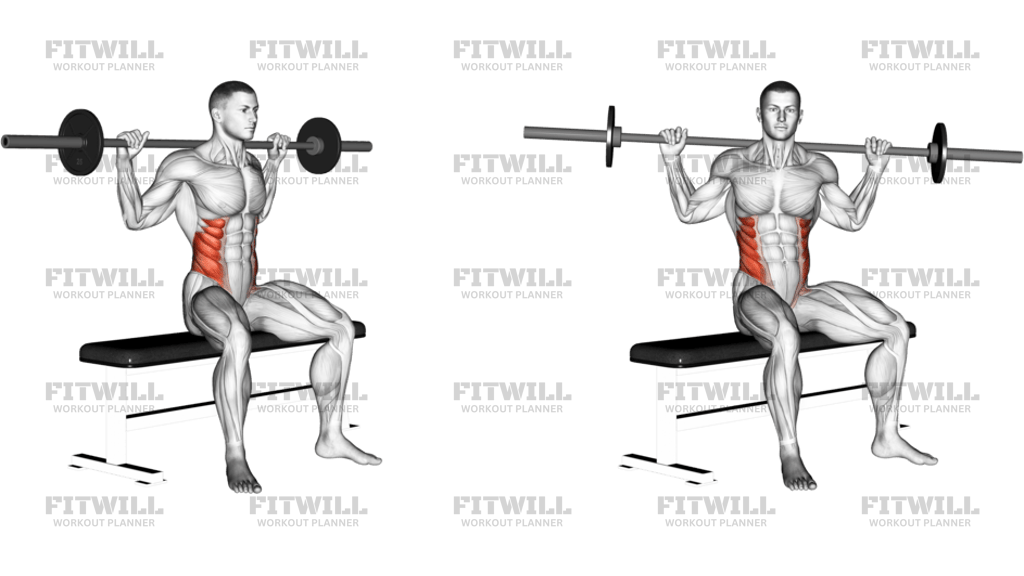
The Barbell Seated Twist is a controlled rotational core exercise done from a seated position with a barbell across the upper back. Sitting removes help from the legs and encourages you to move through the waist and rib cage, making the obliques the main driver while the shoulders and upper back hold the bar steady.
The exercise trains the obliques, rectus abdominis, lower back stabilizers, and the muscles around the shoulder blades. It is most useful when performed with a light bar and a deliberate tempo, because heavy or fast twisting can shift the stress from the side abs into the lumbar spine. The bench gives you a stable base, so quality comes from controlling the rotation rather than balancing.
Set up tall on the bench with both feet planted and the bar resting below the neck across the upper back. Keep the pelvis facing forward as you rotate the torso to one side, then return through center and rotate the other way. The movement should feel like your rib cage turning over steady hips, not your knees and hips swinging with the bar.
Use the Barbell Seated Twist after main strength work, in a core circuit, or as a warmup for sports that require controlled rotation. Keep the range comfortable and repeatable. If you feel pinching in the lower back, reduce the range, slow down, or switch to a lighter dowel until the movement feels clean.
[ Workout Log & Planner ]
Put your next workout in Fitwill
Keep your plan and training log ready when you are.


Instructions
- Sit near the middle of a flat bench with your feet flat on the floor and knees bent.
- Position the barbell across your upper back, below the neck, and hold it with a wide, even grip.
- Sit tall with your chest lifted, shoulders relaxed, and pelvis facing forward.
- Brace lightly, then rotate your ribs and shoulders toward one side while keeping both hips on the bench.
- Stop before your lower back has to arch, lean, or twist sharply to create more range.
- Return to the center under control and re-stack your ribs over your hips.
- Rotate to the opposite side with the same smooth tempo and bar position.
- Alternate sides for the planned reps, exhaling during each twist and inhaling through center.
Tips & Tricks
- Treat the bar mostly as a posture guide; an unloaded bar is enough for many lifters.
- Keep both sit bones heavy on the bench so the pelvis does not spin with each rep.
- If one end of the bar travels much farther than the other, slow down and square your shoulders before the next rep.
- Avoid bouncing at the end of the twist, where the spine is most vulnerable to sloppy momentum.
- Use a range that lets you keep your chest tall instead of collapsing forward.
- Keep your grip relaxed enough that the arms do not yank the bar through the movement.
- Pair the twist with anti-rotation work if you want a more complete core session.
- Skip heavy loading; precision and repeatable rotation matter more than bar weight.
Frequently Asked Questions
What muscles does the seated twist work?
It mainly works the obliques, with support from the abs, lower back, shoulders, and upper back.
Where should I place the barbell?
Rest it across the upper back and rear shoulders, below the neck. Do not let it sit directly on the cervical spine.
How far should I rotate?
Rotate only as far as you can control without pain or lower-back strain.
Should my hips turn during the Barbell Seated Twist?
Keep the hips mostly facing forward and both sides of your pelvis on the bench. The rotation should come mainly from the trunk.
Is this exercise good for beginners?
Beginners can use a dowel or very light bar if they can sit tall and control the range. Anyone with back discomfort should choose a gentler core drill.
Why use a bench instead of standing?
The bench limits lower-body contribution, so it is easier to focus on torso rotation and oblique tension.
Should I twist quickly for more burn?
No. Fast twisting usually adds momentum and can irritate the lower back. Use a slow, even pace.
What is a good substitute for the barbell?
A wooden dowel, body bar, or cable seated rotation can work well if you want less load or smoother resistance.