Barbell Seated Twist On Stability Ball
The Barbell Seated Twist on Stability Ball is a rotational core exercise performed while sitting on an unstable surface with a bar across the upper back. The stability ball forces you to control your pelvis and rib cage while the barbell gives the shoulders a fixed reference point, making the obliques work through a deliberate left-to-right rotation.
This movement mainly targets the obliques, with the rectus abdominis, lower back, deep trunk stabilizers, and shoulders helping you stay tall on the ball. Because the seat can shift under you, the exercise should feel controlled and measured rather than forceful. The goal is not to twist as far as possible, but to rotate the torso while the hips, feet, and ball stay steady.
Set up by sitting near the top of the ball with both feet planted wide enough to create a stable base. Keep the barbell resting across the meaty part of the upper back, not on the neck, and hold it with both hands. From there, brace lightly, lift the chest, and rotate from the waist while keeping your knees and hips quiet.
Use this exercise as an accessory core movement after heavy lifting, in a rotational training circuit, or as a controlled alternative to faster twisting drills. Start with a very light bar or dowel if balance is the limiting factor. Stop the set if the ball begins rolling, your lower back takes over, or you need to swing the bar to create range.
Fitwill
Log Workouts, Track Progress & Build Strength.
Achieve more with Fitwill: explore over 9600 exercises with images and videos, access built-in and custom workouts, perfect for both gym and home sessions, and see real results.
Start your journey. Download today!




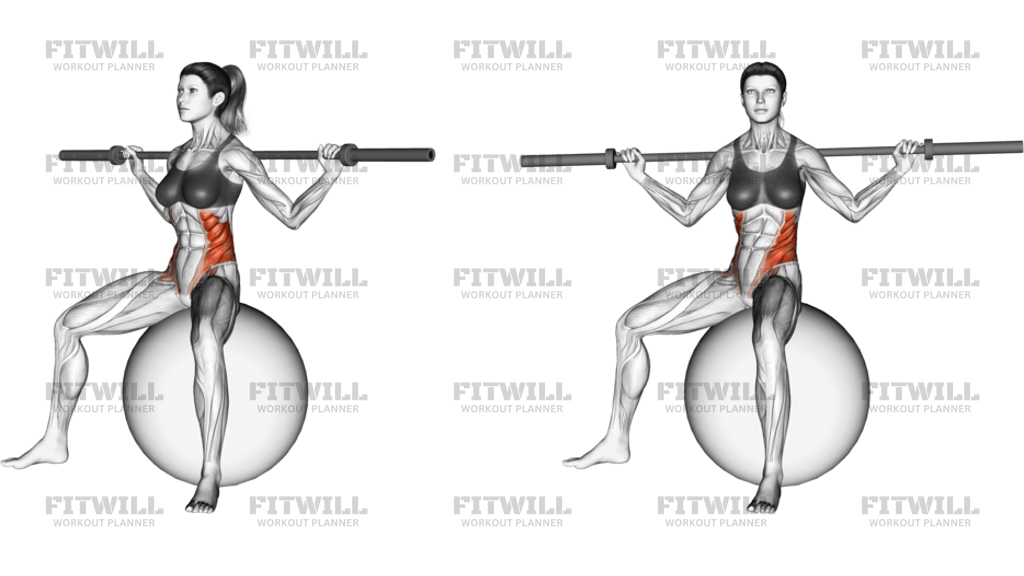
Instructions
- Sit on top of a stability ball with your feet flat on the floor and slightly wider than hip width.
- Rest the barbell across your upper back, below the neck, and hold both ends or the bar shaft with a wide grip.
- Sit tall, lift your chest, and brace just enough to keep the ball from shifting under you.
- Keep your knees pointing forward as you rotate your ribs and shoulders toward one side.
- Pause briefly when you feel the obliques working without your hips turning with the bar.
- Rotate back through the center with control instead of bouncing off the end range.
- Turn to the opposite side using the same slow tempo and steady foot pressure.
- Continue alternating sides, breathing out during the twist and resetting tall through the center.
Tips & Tricks
- Use an unloaded bar, body bar, or dowel first; the ball already makes this harder than a regular seated twist.
- Plant your whole foot on each side of the ball so the rotation comes from your trunk, not from sliding feet.
- Keep the bar level across your shoulders; one end dipping usually means you are side bending instead of rotating.
- Think of turning your rib cage over a quiet pelvis rather than swinging the bar with your arms.
- Limit the range if you feel compression in the low back at the end of the twist.
- Choose a slower tempo than you would on a bench because the ball can roll if you rush the reversal.
- Keep your gaze moving with your chest so the neck does not crank separately from the torso.
- Leave this exercise out if you cannot sit steadily on the ball before adding the bar.
Frequently Asked Questions
What does the stability ball add?
It adds a balance challenge that makes the core work harder to stabilize the body.
Where should the barbell sit during the stability ball twist?
Keep it across the upper back and rear shoulders, below the neck. If it presses into your neck, move it lower or use a lighter body bar.
Should my hips move with the bar?
Only slightly. The purpose is to rotate the rib cage while the hips, knees, feet, and ball stay as steady as possible.
Is the Barbell Seated Twist on Stability Ball beginner friendly?
It is better for people who already balance comfortably on a stability ball. Beginners should learn the same twist on a bench or with a dowel first.
How far should I twist on the ball?
Rotate only until you feel the obliques working and can still sit tall. Do not chase extra range by arching or yanking the bar.
What muscles does this exercise train?
It targets the obliques, with the abs, lower back, deep core stabilizers, and shoulders helping keep the bar and ball controlled.
Can I use a heavy barbell for this movement?
Heavy loading is not recommended because the ball makes the setup unstable and the spine is rotating. Use light load and precise control.
What should I do if the stability ball rolls?
Widen your feet, slow the rep down, and reduce the twist range. If it still rolls, switch to a bench version.