Barbell Standing Twist
The Barbell Standing Twist is a rotational core exercise performed with a barbell across the upper back. The bar gives the shoulders a long reference line while the torso rotates left and right, making the obliques control the turn and the return through center.
This exercise trains the obliques, rectus abdominis, lower back stabilizers, and shoulders. It should be performed with a light bar because the spine is rotating and the bar can create momentum quickly. The purpose is controlled trunk rotation, not heavy loading or swinging the bar side to side.
Set up with the feet planted, hips mostly forward, and the bar resting below the neck across the upper back. Rotate the ribs and shoulders toward one side while keeping the pelvis relatively quiet, then return through center before rotating the other way. A small amount of hip movement is normal, but the knees should not twist aggressively.
Use Barbell Standing Twists as a light core accessory, warmup drill, or rotational-control exercise. Keep the range pain-free and symmetrical. If the lower back feels strained, shorten the range or choose a cable or seated variation with more control.
Fitwill
Log Workouts, Track Progress & Build Strength.
Achieve more with Fitwill: explore over 9600 exercises with images and videos, access built-in and custom workouts, perfect for both gym and home sessions, and see real results.
Start your journey. Download today!




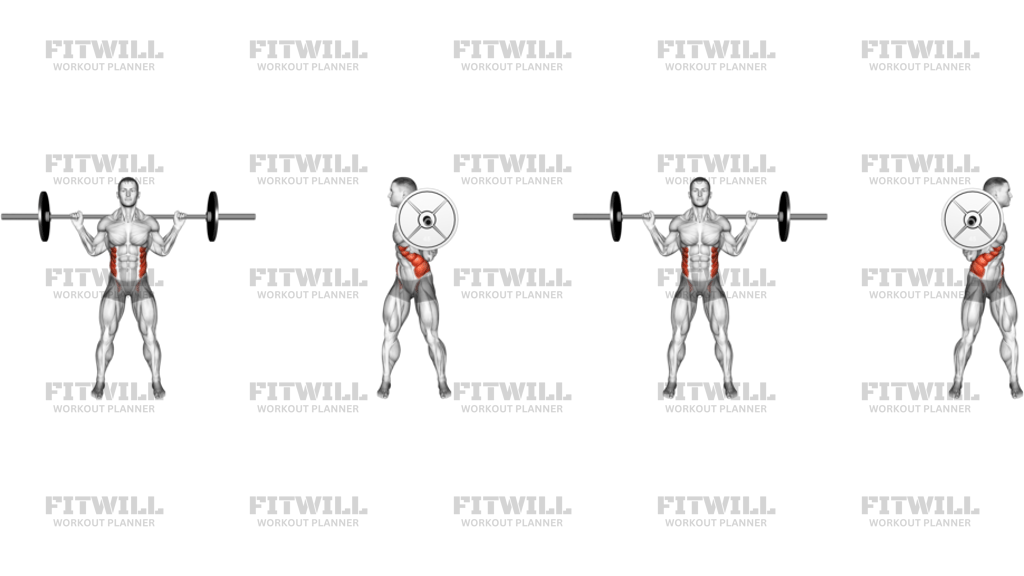
Instructions
- Stand with your feet about shoulder width and place the barbell across your upper back below the neck.
- Hold the bar with a wide, even grip and keep your chest lifted.
- Brace lightly and keep your knees soft but steady.
- Rotate your ribs and shoulders toward one side while your hips stay mostly forward.
- Stop before the rotation pulls your knees or lower back into a strained position.
- Return through center slowly and re-stack your ribs over your pelvis.
- Rotate to the opposite side with the same range and tempo.
- Continue alternating sides while keeping the bar level and controlled.
Tips & Tricks
- Use an unloaded bar, body bar, or dowel before adding weight.
- Keep both feet planted so the twist does not come from spinning the knees.
- Think rib cage rotation over quiet hips rather than arm swing.
- Move slowly through the center to avoid using the bar like a pendulum.
- Keep the bar below the neck and level across the shoulders.
- Limit the range if one side feels tighter or if the lower back starts to pinch.
- Exhale gently as you rotate and inhale as you return through center.
- Do not use this as a heavy strength lift; it is a controlled core drill.
Frequently Asked Questions
What muscles does the standing twist work?
It mainly works the obliques, with support from the abs, lower back, and shoulders.
Should this exercise be heavy?
No. It is best performed light and controlled because the spine is rotating.
How far should I rotate?
Rotate only as far as you can stay tall, controlled, and pain-free.
Where should the barbell sit?
Rest it across the upper back below the neck. Do not let it press directly into the cervical spine.
Should my hips rotate too?
Keep them mostly forward. A little natural movement is fine, but the main rotation should come from the torso.
Is this good for beginners?
Beginners can use a dowel or unloaded bar if the movement is pain-free and controlled.
Why should I avoid fast twisting?
Fast reps can let the bar create momentum and shift stress into the lower back instead of the obliques.
What can I do instead?
Cable rotations, seated twists, or anti-rotation presses are good alternatives if the standing barbell version feels uncomfortable.