Cable Lateral Raise
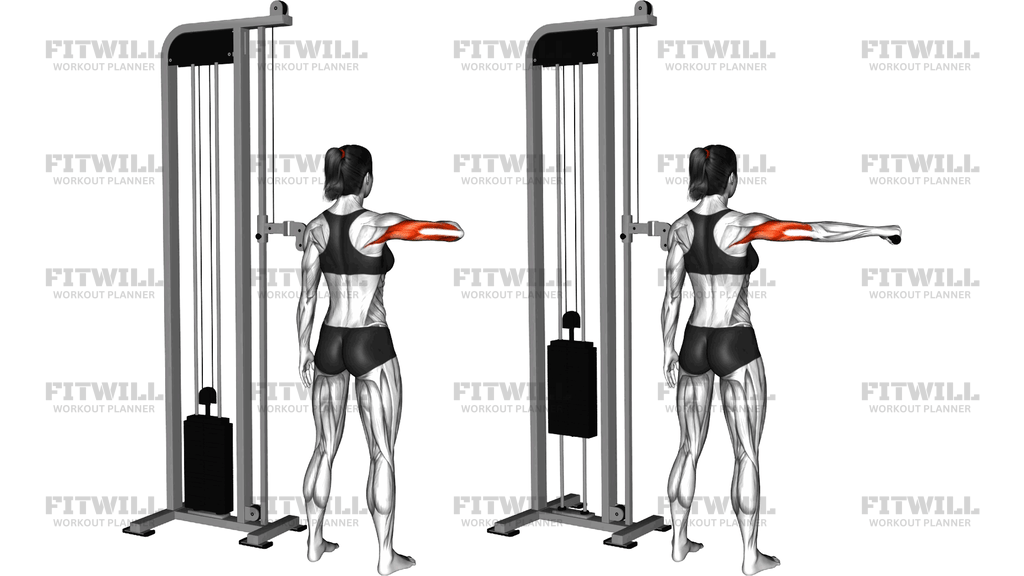
Cable Lateral Raise is a shoulder isolation exercise that trains arm abduction with constant cable tension. The cable keeps the side delt working through the whole rep, which often makes the bottom and middle range feel more loaded than a dumbbell version and gives very clear feedback when the body starts to cheat.
The exercise is most effective when the torso stays still and the shoulder moves the arm rather than the trap lifting the shoulder blade. That keeps the emphasis on the lateral deltoid while the upper traps and core only help stabilize the body. Cable Lateral Raise is useful for building the rounded look of the shoulders, improving side-delt endurance, and giving a clean single-arm stimulus that is easy to scale.
Set a low pulley with a single handle and stand side-on to the stack, holding the handle on the side farthest from the machine so the cable pulls across the body at the start. Keep a soft elbow bend, the ribs stacked, and the shoulder slightly lowered before you begin. Lift the arm out to the side in a smooth arc until it reaches around shoulder height or a pain-free top range, then lower slowly so the cable never gets the chance to yank the arm back down.
Cable Lateral Raise works well as an accessory after pressing, as part of a shoulder-focused session, or as a lighter hypertrophy movement when you want to isolate the middle delt without relying on momentum. Because the cable angle can be adjusted by stepping farther from or closer to the stack, it is easy to find a line of pull that feels natural. Good reps look quiet through the torso and deliberate at the top, with no shrugging and no curl-like elbow bend.
If the upper trap starts taking over, shorten the range a little and lighten the load. The goal is a smooth side raise that feels like the shoulder is lifting the arm outward, not like the torso is muscling the weight up.
[ Workout Log & Planner ]
Put your next workout in Fitwill
Keep your plan and training log ready when you are.


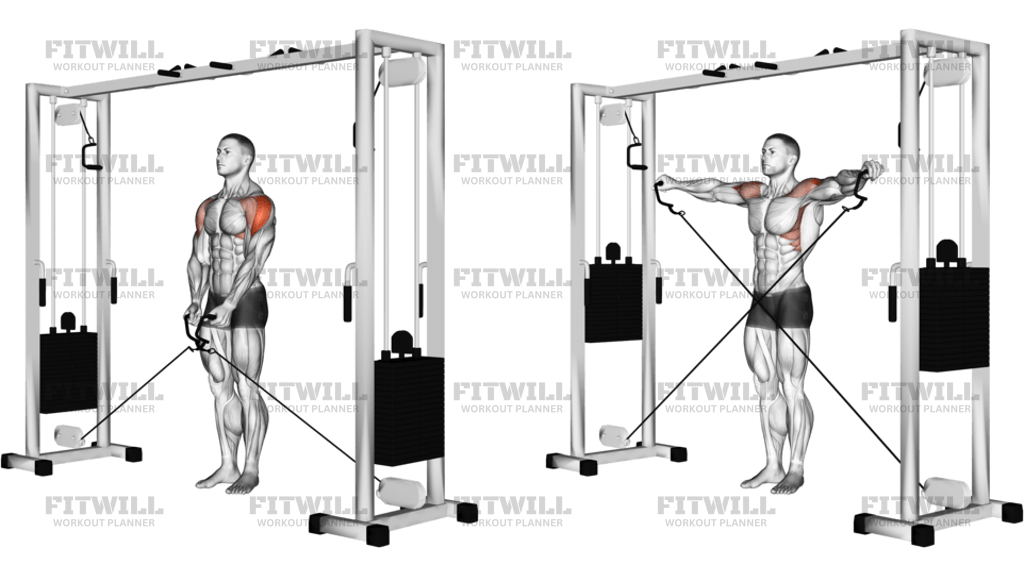
Instructions
- Set a low pulley with a single handle and stand side-on to the machine with the cable on the side farthest from the working arm.
- Hold the handle with a soft elbow bend and let the arm rest slightly in front of the thigh before the first rep.
- Stack your ribs over your pelvis, brace your core, and keep the shoulder slightly down.
- Lift the arm out to the side in a smooth arc without turning it into a curl or leaning the torso.
- Bring the hand to around shoulder height or the highest pain-free point where the shoulder still feels in control.
- Pause briefly at the top without shrugging, then lower the handle slowly back to the start.
- Keep the descent controlled so the stack does not pull the arm down quickly.
- Repeat for the set, then switch sides and match the same range and tempo.
Tips & Tricks
- If the torso starts leaning, step a little farther from the stack and use less weight before adding range.
- Keep the elbow bend consistent; if it turns into a curl, the biceps and front delt are taking over.
- A slight forward angle in the arm is usually kinder to the shoulder than lifting perfectly straight out to the side.
- The top of the rep should feel like a delt contraction, not like the trap is dragging the shoulder upward.
- Use the cable tension to control the lowering phase instead of dropping the handle back to the start.
- If one side looks higher than the other, match the lower side's range rather than chasing extra height.
- Keep the wrist neutral and the hand relaxed so grip tension does not hijack the raise.
- A cleaner medium-weight set beats a heavy set that turns into a torso swing.
Frequently Asked Questions
What muscles does Cable Lateral Raise work?
It mainly works the lateral deltoid, with the upper traps and core helping stabilize the movement.
How high should I raise the handle in Cable Lateral Raise?
Usually to shoulder height or the highest pain-free point where the shoulder still feels controlled.
Why use a cable for lateral raises?
The cable keeps tension on the side delt through more of the range than many dumbbell setups do.
Should I do Cable Lateral Raise one arm at a time?
Yes, single-arm reps are common and make it easier to control the shoulder path and the torso.
What is the most common mistake in Cable Lateral Raise?
Shrugging the shoulder or swinging the torso to get the handle higher.
Is Cable Lateral Raise good for shoulder width?
Yes, side-delt work is one of the main movements people use for broader-looking shoulders.
Can I go above shoulder height?
Only if it still feels smooth and pain-free; most people get better results staying near shoulder height.