Dumbbell Deadlift
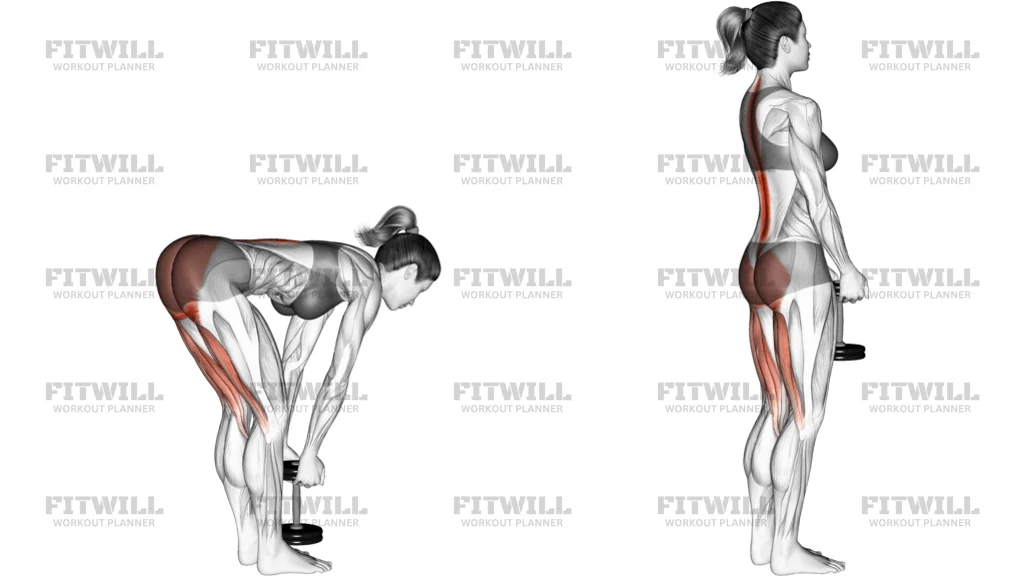
Dumbbell Deadlift is a hip-hinge strength exercise performed with dumbbells held at your sides. It trains the glutes and hamstrings hardest, while the back, core, grip, and upper back work to keep the torso organized as the weights travel down and back up close to the legs. The movement should look like a controlled lift from the floor, not a squat or a swing.
The setup matters because the dumbbells need to start over the midfoot and stay near the shins and thighs through the whole rep. When the feet, knees, hips, and shoulders are lined up well, the load stays on the posterior chain instead of drifting into the lower back. A clean hinge also keeps the arms long and relaxed so the hands act like hooks rather than pulling with the biceps.
On the way down, send the hips back first, then let the knees bend enough for the dumbbells to pass the shins. Keep the chest long, ribs stacked, and spine neutral as the weights descend. On the way up, press through the floor and drive the hips forward until you are tall and stacked, finishing with the glutes, not by leaning back.
This exercise is useful for building basic lower-body strength, improving hinge mechanics, and teaching the body to keep the dumbbells close instead of letting them drift away from the center of mass. It works well as a main lift for moderate reps or as accessory work after squats, split squats, or posterior-chain training.
Keep the range and load honest. If the back rounds, the dumbbells move forward, or you have to jerk the weights off the floor, the set is too heavy or the start position is too low for your current mobility. Pause, reset the feet, and keep every rep crisp and symmetrical.
[ Workout Log & Planner ]
Put your next workout in Fitwill
Keep your plan and training log ready when you are.


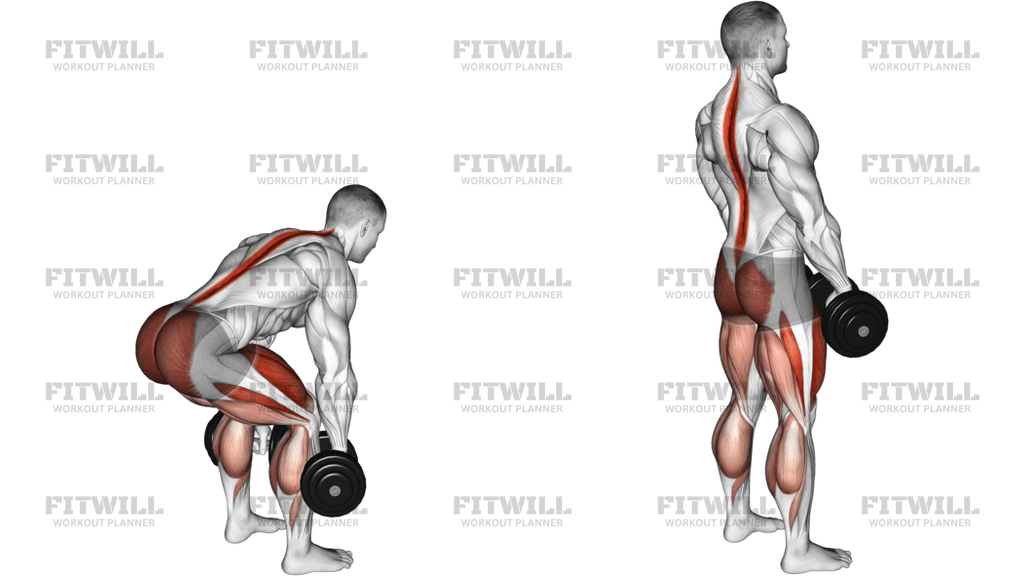
Instructions
- Stand with your feet about hip-width apart and place the dumbbells just outside your shoes over the midfoot.
- Softly bend your knees, hinge your hips back, and take a neutral grip on the dumbbell handles.
- Set your chest long, keep your ribs stacked, and let your shoulders sit slightly in front of the weights.
- Brace your core before the first pull so your torso stays fixed as you move.
- Press through the floor and stand up by driving your hips forward, keeping the dumbbells brushing close to your shins and thighs.
- Finish tall with the glutes squeezed, the shoulders level, and no backward lean at the top.
- Lower the dumbbells by sending the hips back first, then bending the knees enough for the weights to clear the shins.
- Bring the dumbbells back to the floor under control, reset your brace, and repeat for the next rep.
Tips & Tricks
- Start the dumbbells over the middle of your foot so each rep begins in balance, not out in front of you.
- Think "hips back" before "knees down"; if the knees shoot forward first, the movement turns into a squat.
- Keep the dumbbells close enough to graze the legs. If they swing away from you, the lower back has to fight the load longer.
- Keep your arms straight and relaxed. You are holding the weights, not curling them off the floor.
- Stop the descent when your spine can stay neutral. Range is only useful if you can keep the hinge position.
- Use a dead-stop reset between reps if the set gets sloppy. That keeps each pull honest and removes bounce.
- Exhale near the top, then re-brace before the next descent so the torso does not leak tension.
- Choose a weight that lets you stand up smoothly without jerking the dumbbells or leaning back at lockout.
Frequently Asked Questions
What muscles does Dumbbell Deadlift work?
Dumbbell Deadlift mainly targets the glutes and hamstrings. The lower back, upper back, core, forearms, and grip help keep the dumbbells and torso stable through the hinge.
Is Dumbbell Deadlift good for beginners?
Yes, as long as you start light and keep the dumbbells close to your legs. It is a useful way to learn the hip hinge before moving to heavier barbell pulling.
Where should the dumbbells stay during the rep?
They should stay close to the shins on the way down and close to the thighs on the way up. If the dumbbells drift forward, you usually lose tension in the hips and load the lower back more.
Should Dumbbell Deadlift look like a squat?
No. The knees bend, but the main action is the hips moving back and then driving forward. If your torso stays too upright and the knees do most of the work, you are drifting toward a squat pattern.
How low should I lower the dumbbells?
Lower them only as far as you can keep a neutral spine and a strong hinge. For most people that means the weights move down near the shins, but the exact depth depends on your hamstring and hip mobility.
What is the most common mistake in Dumbbell Deadlift?
Letting the dumbbells move away from the body is the most common mistake. That makes the lift feel harder on the back and less effective for the glutes and hamstrings.
Can I use Dumbbell Deadlift if my hamstrings are tight?
Yes, but shorten the range and keep the knees softly bent. Tight hamstrings often improve when the hinge is controlled instead of forced into a deeper position.
How heavy should I go on Dumbbell Deadlift?
Use the heaviest load you can lift without rounding the back, losing the dumbbell path, or finishing with a backward lean. If the start position breaks down, the weight is too heavy.
How do I progress Dumbbell Deadlift?
Progress by first making every rep symmetrical and controlled, then add load or reps in small jumps. You can also slow the lowering phase once the hinge stays solid.