Dumbbell Deadlift Bent-Over Row
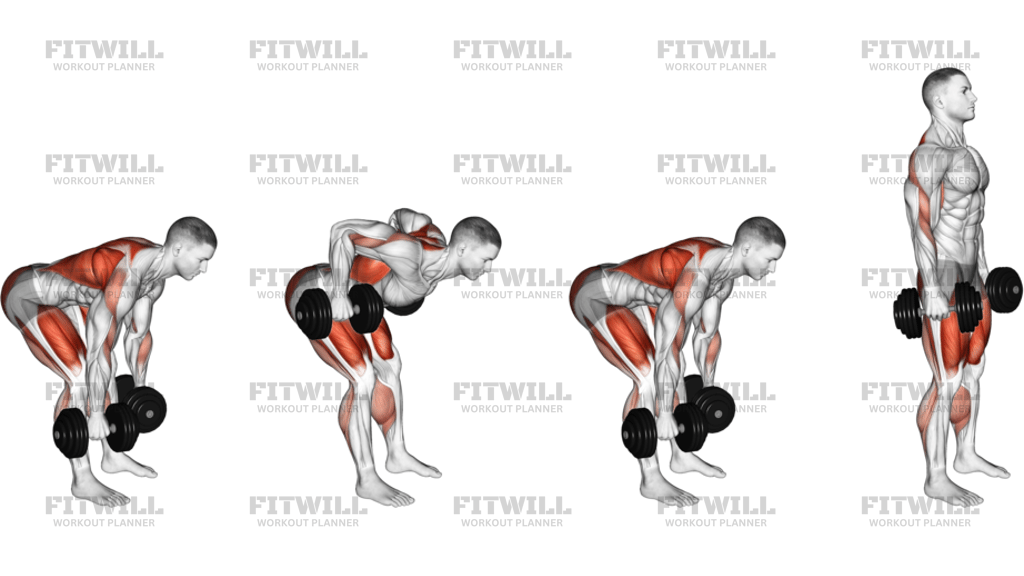
Dumbbell Deadlift Bent-Over Row is a hybrid hinge-and-row exercise that links the posterior chain with the upper back in one controlled repetition. The image shows the lifter starting from a standing position with the dumbbells at the sides, hinging the hips back until the torso is nearly parallel to the floor, then rowing the weights toward the lower ribs before returning to standing. That makes the setup important: the hinge angle, spine position, and dumbbell path all determine whether the movement trains the back cleanly or turns into a rounded, swinging pull.
This exercise primarily loads the back, especially the lats, rhomboids, and mid traps, while the hamstrings, glutes, spinal erectors, rear delts, and grip work to hold the hinge and control the row. Because the torso stays pitched forward, the core also has to resist extension and rotation so the trunk does not twist as the dumbbells move. The result is a practical strength pattern for people who want a back movement that also challenges hip stability and posture under load.
The deadlift portion is not a floor pull here. Instead, you hinge from standing, soften the knees, and let the dumbbells travel close to the legs as the hips go back. From that strong bent-over position, the row should finish with the elbows tracking back and the dumbbells moving toward the lower rib cage, not up toward the shoulders. A short pause at the top helps you feel the back work without jerking the weight.
Use this movement when you want a compound accessory lift that fits a dumbbell-only session, full-body day, or back-focused workout. It is especially useful for training posture, hip hinge control, and upper-back strength together. Keep the reps smooth, the neck long, and the dumbbells close to the body. If your lower back starts doing all the work, the load is too heavy or the hinge is losing position.
[ Workout Log & Planner ]
Put your next workout in Fitwill
Keep your plan and training log ready when you are.


Instructions
- Stand tall with a dumbbell in each hand, feet about hip-width apart, and let the arms hang at your sides.
- Soften your knees and push your hips back into a long hip hinge until your torso is nearly parallel to the floor and your back stays flat.
- Keep the dumbbells close to your shins and let them hang beneath your shoulders without rounding your lower back.
- Brace your torso, then pull the dumbbells toward the lower ribs by driving your elbows back.
- Squeeze your shoulder blades together at the top without shrugging your shoulders toward your ears.
- Lower the dumbbells under control until your arms are straight and your shoulders are set again.
- Drive your hips forward to return to standing while keeping the weights close to your legs.
- Exhale as you row and stand up, then reset your hinge before the next repetition.
Tips & Tricks
- Think of the lift as one hinge plus one row, not a squat with a curl at the top.
- Keep the dumbbells brushing close to the thighs and shins so the lower back does not take over.
- If your torso keeps rising during the row, shorten the range or lighten the load.
- Row to the lower ribs, not high into the chest, to keep tension on the lats and mid-back.
- Keep your neck in line with your spine and look a few feet ahead of you on the floor.
- Use a load you can lower slowly; the return from the row is where most form breaks down.
- Do not let the knees turn this into a squat. The hips should travel back first.
- Pause briefly at the top of the row to remove momentum and make the back do the work.
Frequently Asked Questions
What muscle does Dumbbell Deadlift Bent Over Row target most?
It mainly targets the back, especially the lats, rhomboids, and mid traps, while the hamstrings, glutes, and spinal erectors help hold the hinge.
Can beginners perform this exercise?
Yes, if they can hold a neutral spine in a bent-over hinge. Start light and master the hip hinge before adding more load.
Where should the dumbbells travel during the row?
Pull them toward the lower ribs or upper waist. If they drift toward the shoulders, the row usually turns into a shrug.
Should I keep my torso fixed or move through the hinge every rep?
Both happen in sequence. Hinge into the bent-over position, row from there, then stand back up with control before the next rep.
What is the biggest form mistake with this movement?
Rounding the lower back or swinging the dumbbells. The torso should stay braced and the weights should move close to the body.
Can I use this instead of a regular bent-over row?
Yes, but the deadlift-to-row style adds more hip hinge and full-body tension. It is a little more demanding than a supported row.
How should my knees and hips move?
Keep a soft knee bend and send the hips back. The knees should not turn it into a squat.
What breathing pattern works best here?
Brace before the hinge, exhale as you row or stand, and reset your breath before each rep so the torso stays stable.