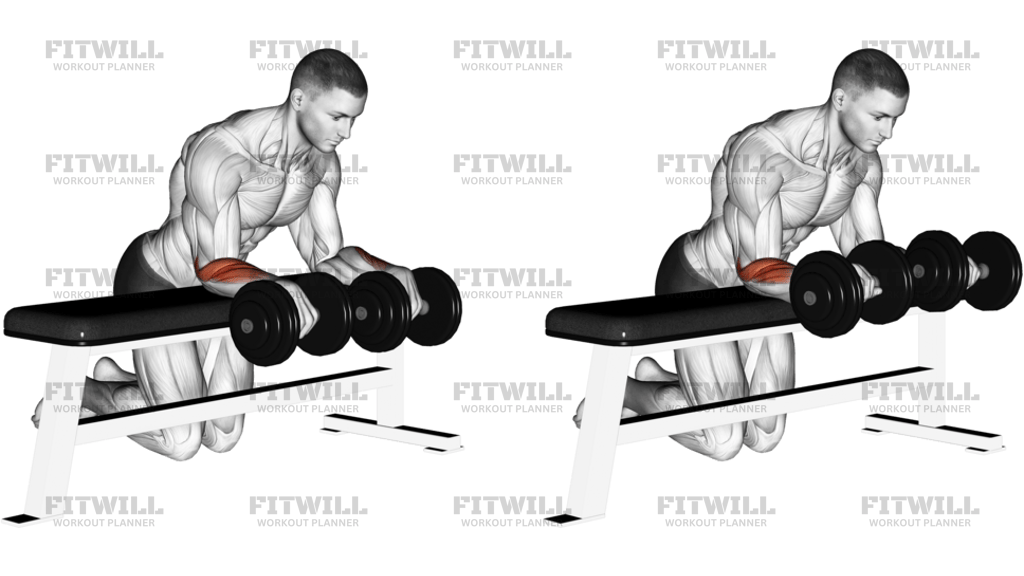
Dumbbell Lying Pronation
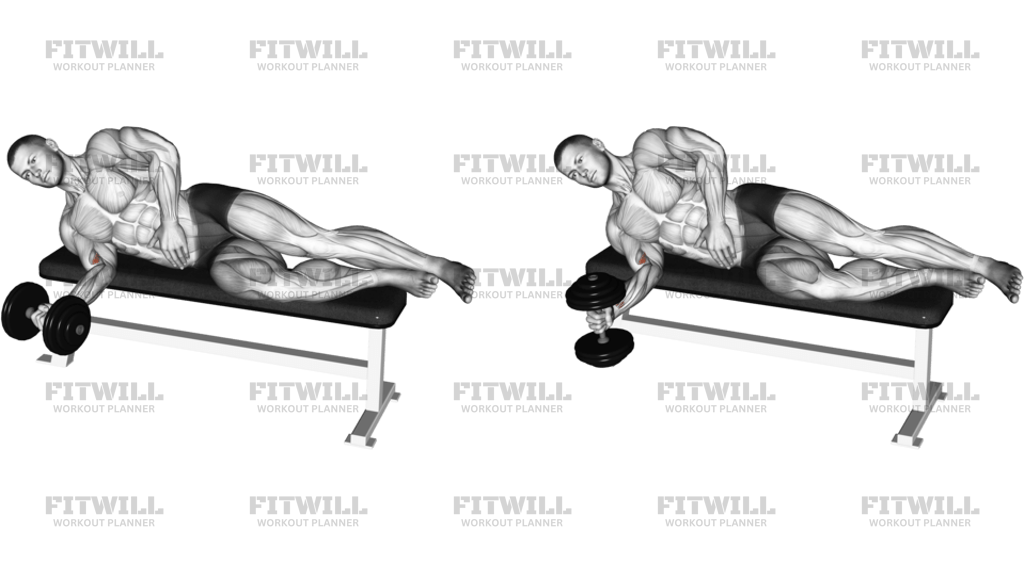
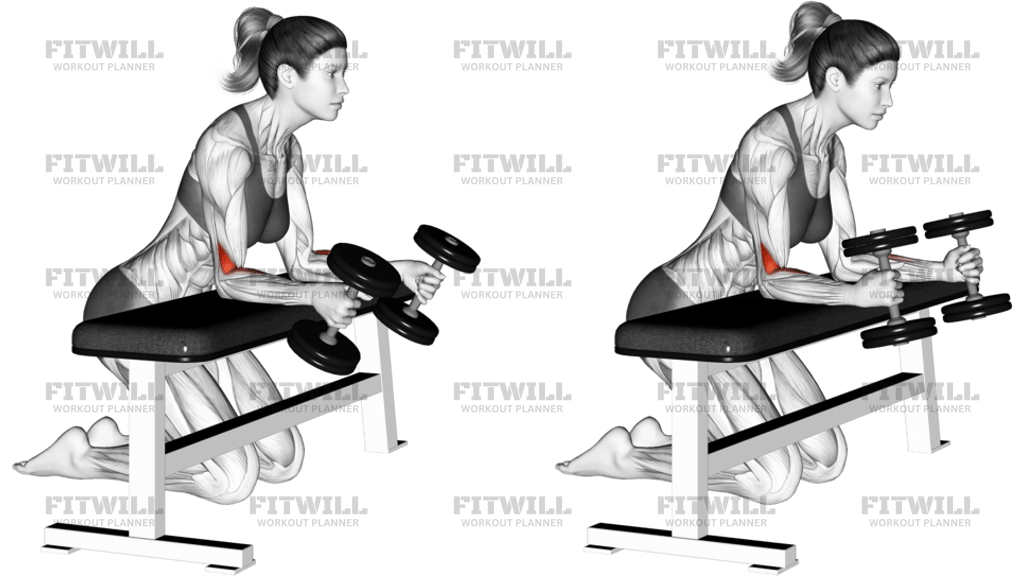
Dumbbell Lying Pronation is a small-range forearm rotation exercise performed while lying side-on across a bench. One upper arm is supported on the bench, the elbow hangs just off the edge, and the dumbbell moves through a controlled twist instead of a press or curl. That setup makes the forearm do the work while the shoulder and torso stay quiet.
The movement is useful when you want to strengthen the muscles that turn the forearm and stabilize the wrist under load. Because the arm is supported, you can keep the motion precise and focus on clean rotation rather than using momentum. It is also a good accessory choice for lifters who want more durable wrists and better control in pressing, pulling, racket, or grappling work.
Set the bench so your side can lie comfortably on it with the working shoulder stacked over the pad and the elbow free at the edge. Use a very light dumbbell and hold it with the wrist straight enough that the handle stays aligned with the forearm. The non-working hand and the rest of the body should stay relaxed so the rotation comes from the forearm only.
Each rep should travel through a short, deliberate arc. Turn the dumbbell slowly into pronation, stop before the wrist dumps or the shoulder rolls forward, then reverse under control to the start. The goal is steady rotation, not speed, and the load should be light enough that the elbow stays planted and the forearm tracks the same path every time.
This exercise is best used as accessory work after your main upper-body lifts or on a day when you want to train the forearms without heavy loading. It is a better match for careful, higher-rep work than for ego lifting. If the elbow, wrist, or thumb side of the forearm starts to complain, shorten the range, reduce the load, or stop the set before the position gets sloppy.
Fitwill
Log Workouts, Track Progress & Build Strength.
Achieve more with Fitwill: explore over 9600 exercises with images and videos, access built-in and custom workouts, perfect for both gym and home sessions, and see real results.
Start your journey. Download today!




Instructions
- Lie on your side across a flat bench and place the working upper arm on the pad so the elbow can hang just off the edge.
- Hold a very light dumbbell in the lower hand with the wrist straight and the forearm free to rotate.
- Keep the shoulder stacked and let the elbow act as the fixed pivot point for the movement.
- Start with the dumbbell in the easier end of the rotation and the forearm relaxed but controlled.
- Turn the forearm slowly into pronation until you reach the end of the comfortable arc.
- Pause briefly at the end range without letting the wrist fold or the shoulder twist forward.
- Rotate the dumbbell back to the start under control, keeping the same elbow position.
- Keep the upper arm and torso quiet for every repetition, then switch sides after the set.
Tips & Tricks
- Choose a dumbbell that feels almost too light at first; this drill is about rotation quality, not loading the whole arm.
- Keep the elbow planted on the bench edge so the movement does not turn into a shoulder roll or a body twist.
- Let the forearm rotate around the long axis instead of bending the wrist to fake more range.
- If the dumbbell pulls your hand off line, shorten the lever by using a lighter load before you chase more reps.
- A smooth turnaround is more useful than a hard pause at the bottom, especially when the wrist starts to drift.
- Keep the non-working shoulder relaxed so you do not brace so hard that the working side loses rotation.
- Stop the set if the thumb side of the forearm cramps or the elbow starts to pinch against the bench.
- Match the same tempo on both sides so one forearm does not get extra momentum from a looser setup.
Frequently Asked Questions
What muscles does Dumbbell Lying Pronation work?
Dumbbell Lying Pronation mainly trains the forearm rotators and wrist stabilizers, with the grip and brachioradialis helping keep the dumbbell controlled. The shoulder and torso mostly act as support.
Is Dumbbell Lying Pronation good for beginners?
Yes, if you use a very light dumbbell and keep the elbow fixed on the bench. Beginners usually need less range than they expect, especially if the wrist feels unstable.
Where should my elbow be during Dumbbell Lying Pronation?
Your elbow should sit just off the edge of the bench so the forearm can rotate freely. If the elbow slides around, the shoulder usually takes over and the rep stops being a true pronation drill.
How much range of motion should I use?
Use the shortest range that lets you rotate cleanly without the wrist folding or the shoulder rolling. For this exercise, a controlled partial arc is often better than forcing a bigger twist.
Should I hold the dumbbell like a normal curl grip?
Use a secure but relaxed grip, because crushing the handle can stiffen the wrist and reduce rotation quality. The dumbbell should stay controlled without turning the set into a forearm squeeze test.
What is the most common mistake in Dumbbell Lying Pronation?
The biggest mistake is using too much weight and letting the shoulder or torso help the turn. This exercise works best when the elbow stays anchored and the dumbbell rotates by itself.
Is Dumbbell Lying Pronation the same as a wrist curl?
No. A wrist curl bends and extends the wrist, while Dumbbell Lying Pronation rotates the forearm around its long axis. The elbow stays more fixed here than it would in a curl variation.
How can I progress Dumbbell Lying Pronation?
Add reps, slow the lowering phase, or increase the dumbbell only after the elbow stays quiet and the rotation looks identical on both sides. Small jumps work better than chasing a big load.
Should Dumbbell Lying Pronation hurt my wrist or elbow?
No. You should feel forearm work and maybe a mild burn, but sharp pain at the wrist or elbow means the load, range, or setup needs to change.