Dumbbell Seated One-Arm Kickback
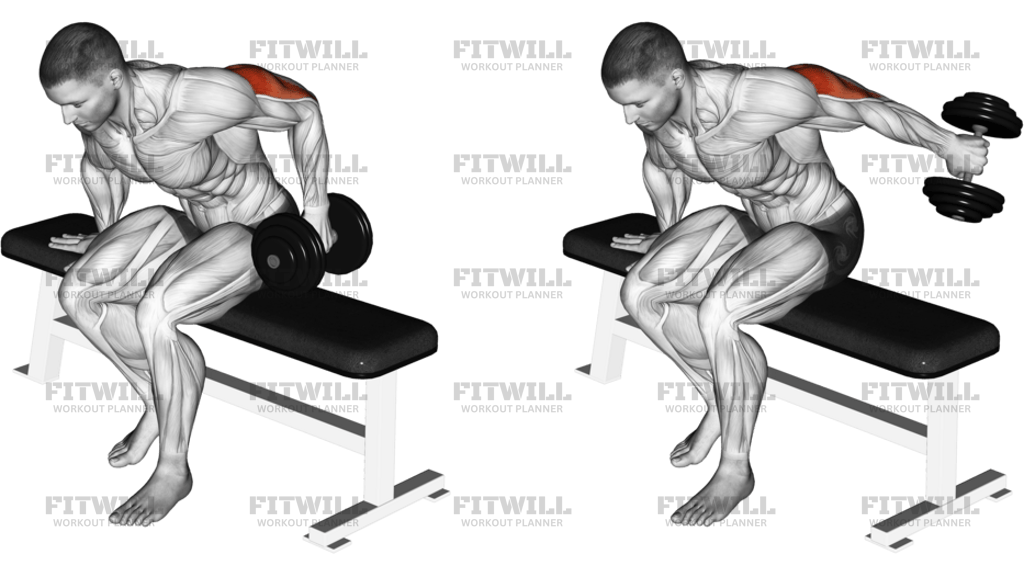
Dumbbell Seated One-Arm Kickback is a triceps isolation exercise built around a very specific arm path: the upper arm stays fixed while the forearm swings from a bent position to a straight line behind the body. In this seated version, the bench support helps reduce body English so the triceps, elbow stabilizers, forearms, and shoulder stabilizers have to do the work cleanly.
This movement is useful when you want direct triceps work without loading the shoulders or chest the way a press does. It also teaches you to control the elbow joint through a small, precise range, which is why the setup matters more than the load. If your torso is loose or your upper arm keeps drifting, the exercise stops feeling like a kickback and turns into a swing.
The best setup is steady and simple. Sit near the edge of a flat bench, plant the nonworking hand on the bench for support, place both feet flat on the floor, and hinge the torso forward until the working upper arm can stay close to the side of the body. Keep the wrist straight and the elbow slightly behind the torso so the dumbbell starts under control rather than hanging away from the line of pull.
From there, extend the elbow until the arm is straight behind you and the dumbbell finishes level with or just behind the torso. The movement should come from the triceps, not from shrugging the shoulder or swinging the whole arm backward. Lower the dumbbell slowly, keep the upper arm quiet, and use a smooth rhythm so each rep starts from the same stable position.
Dumbbell Seated One-Arm Kickback works well as a lighter accessory after pressing work, during an arm session, or whenever you want triceps volume with minimal joint noise. Keep the range honest, choose a load you can control for every rep, and stop the set if the elbow drifts wide, the shoulder rolls back, or the torso starts rocking to finish the lift.
Fitwill
Log Workouts, Track Progress & Build Strength.
Achieve more with Fitwill: explore over 9600 exercises with images and videos, access built-in and custom workouts, perfect for both gym and home sessions, and see real results.
Start your journey. Download today!




Instructions
- Sit near the edge of a flat bench with one dumbbell in the working hand, the other hand braced on the bench, and both feet flat on the floor.
- Hinge your torso forward until your chest is angled over your thighs and your working upper arm can stay tucked close to your side.
- Set the dumbbell under your shoulder with the palm facing in and keep your wrist straight.
- Pin the upper arm in place and brace your midsection before you start the rep.
- Extend the elbow to drive the dumbbell straight back until the arm is nearly straight and the triceps are fully squeezed.
- Pause briefly at the back of the rep without letting the shoulder roll open or the elbow drift away from your torso.
- Lower the dumbbell slowly until the forearm hangs under control and the elbow returns to the same bent starting angle.
- Reset your shoulder, keep your breathing steady, and repeat for the next rep before switching arms.
Tips & Tricks
- Choose a load that lets you keep the upper arm still for the entire set; if the elbow starts wandering, the dumbbell is too heavy.
- Keep the nonworking hand firmly on the bench so the torso does not twist when the working arm reaches the top.
- Think about moving the forearm, not the shoulder; the shoulder should stay packed instead of swinging backward to fake a longer range.
- A straight wrist keeps tension on the triceps and reduces strain through the forearm.
- Stop the rep just before the elbow snaps hard into lockout; a smooth finish keeps tension on the target muscles.
- If your torso rocks to lift the weight, shorten the range and slow the lowering phase.
- Use a slightly smaller range if the dumbbell drops too far and pulls the shoulder forward at the bottom.
- Keep the elbow line consistent from rep to rep so each side gets the same amount of work.
- If the back of the shoulder takes over, bring the chest a little lower and tuck the upper arm more tightly against the ribcage.
Frequently Asked Questions
What does Dumbbell Seated One-Arm Kickback train?
It mainly trains the triceps, with the forearms, shoulder stabilizers, and core helping keep the arm and torso steady during the rep.
Why do I need to sit on a bench for Dumbbell Seated One-Arm Kickback?
The bench gives you a stable support point for the nonworking hand, which makes it easier to keep the torso still and isolate the triceps.
How far should I extend the dumbbell back?
Extend until the arm is almost straight and the triceps are fully contracted, but do not let the shoulder roll open just to chase extra distance.
Should my elbow move during Dumbbell Seated One-Arm Kickback?
The elbow should stay mostly fixed in space. If it drifts forward or flares out, the shoulder is taking over and the set gets less effective.
Is Dumbbell Seated One-Arm Kickback good for beginners?
Yes, if the dumbbell is light and the bench setup is stable. It is a good way to learn elbow extension without needing heavy loads.
What is the most common mistake with Dumbbell Seated One-Arm Kickback?
The most common mistake is swinging the upper arm or torso to move the dumbbell. Keep the upper arm pinned and let only the elbow open and close.
What if I feel Dumbbell Seated One-Arm Kickback more in my shoulder than my triceps?
That usually means the upper arm is drifting or the shoulder is rolling back. Lower the weight, tuck the elbow closer to the ribs, and keep the torso braced on the bench.
Can I use both arms at once instead of doing Dumbbell Seated One-Arm Kickback one side at a time?
You can, but the one-arm version usually makes it easier to keep the torso fixed and the elbow path clean. Use one arm at a time if symmetry or control is the priority.