Dumbbell Standing Calf Raise
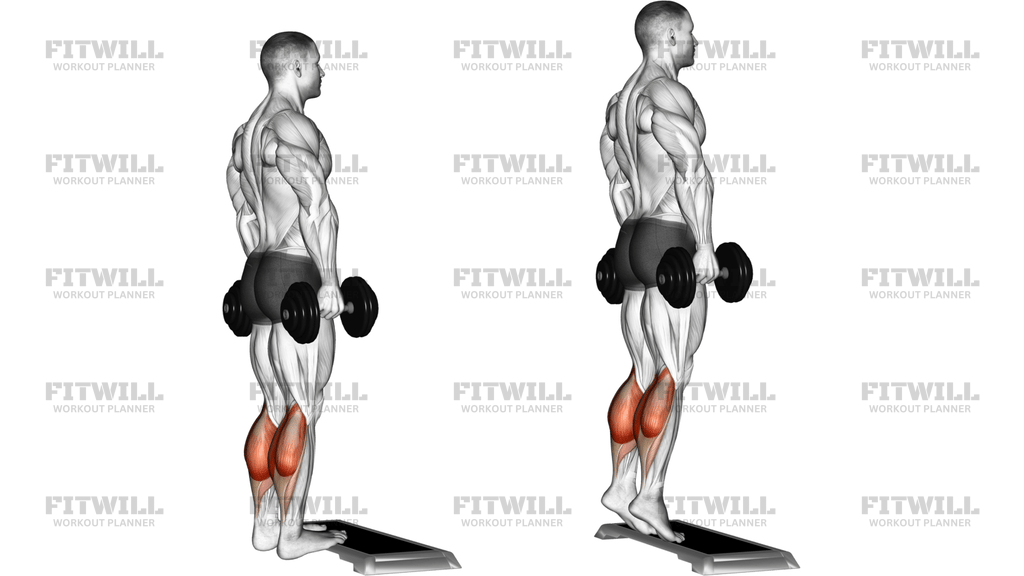
Dumbbell Standing Calf Raise is a bilateral standing lower-leg exercise that loads the calves while you hold dumbbells at your sides. The straight-knee stance places the greatest demand on the gastrocnemius, while the soleus, foot muscles, and ankle stabilizers help control the rise, balance, and descent. The raised edge in the image is important because it lets the heels travel below the forefoot for a fuller stretch and a cleaner calf contraction.
The exercise is simple, but the setup determines whether it actually trains the calves or turns into a balance drill. Stand tall with both feet on a step or block, balls of the feet supported and heels free to move. Keep the dumbbells quiet at your sides, stack the ribs over the pelvis, and keep the knees mostly straight without locking them hard. That position lets the ankle do the work instead of borrowing motion from the hips or lower back.
On the lowering phase, let the heels travel down slowly until you feel a controlled stretch through the calves and Achilles tendon. From there, drive through the big toe and second toe to raise the heels as high as possible, then pause briefly at the top and squeeze the calves. The lift should feel vertical and steady, not bouncy. If the ankles roll outward, the knees drift forward, or the torso starts to sway, the load is too heavy or the range is too aggressive.
This movement is useful for calf size, ankle strength, and lower-leg endurance, especially for athletes and lifters who need stronger push-off in running, jumping, and loaded carries. It also works well as accessory volume after squats, deadlifts, or leg presses. Keep the tempo controlled, use the edge of the platform for a clear stretch, and stop the set when you can no longer keep the heels moving through the same path rep after rep.
[ Workout Log & Planner ]
Put your next workout in Fitwill
Keep your plan and training log ready when you are.


Instructions
- Stand tall on a step or raised platform with the balls of both feet on the edge and the heels hanging free.
- Hold a dumbbell in each hand at your sides and let the arms hang long without shrugging the shoulders.
- Set your feet about hip-width apart and keep the knees mostly straight with only a soft bend.
- Brace the torso so the ribs stay stacked over the pelvis and the body does not tip forward.
- Lower both heels slowly until you feel a controlled stretch in the calves and Achilles tendons.
- Drive through the big toe and second toe to raise both heels as high as you can.
- Pause at the top and squeeze the calves before lowering again.
- Lower back to the start under control and repeat for the chosen number of reps.
Tips & Tricks
- Keep the knees mostly straight; a bigger knee bend shifts some of the work away from the gastrocnemius.
- Use a step or block that lets your heels drop below toe level so the bottom stretch is real, not shortened.
- Keep the dumbbells still at your sides instead of letting them swing as you rise.
- Press through the big toe and second toe so the weight stays centered instead of rolling to the outside edge of the foot.
- Pause briefly at the top to avoid turning the movement into fast ankle bounces.
- Lower for two to three seconds on every rep so the calves stay under tension.
- If balance is the limiter, touch a wall or rack lightly rather than shortening the calf range.
- Reduce the load if the torso leans, the heels shift unevenly, or the ankles cannot move straight up and down.
Frequently Asked Questions
What muscles does Dumbbell Standing Calf Raise work?
It primarily trains the calves, especially the gastrocnemius, with the soleus, foot muscles, and ankle stabilizers assisting.
Is Dumbbell Standing Calf Raise beginner-friendly?
Yes, if you start light and keep the movement strict. Beginners may need a wall or rack touch for balance until the heel path feels steady.
Should my knees stay straight or bent?
Keep them mostly straight with only a soft bend. A deeper knee bend turns the movement into more of a soleus-focused calf raise.
Why stand on a step or platform?
The edge lets the heels drop below the forefoot, which gives you a better calf stretch and a more complete rep.
How do I know if the weight is too heavy?
If you have to bend the knees a lot, bounce out of the bottom, or wobble through every rep, the dumbbells are too heavy.
Can I do it on flat ground instead of a step?
Yes, but the range of motion is shorter. A raised surface is better when you want the heels to move through a full stretch and finish.
What mistake should I avoid?
Avoid rocking the hips, letting the dumbbells swing, or letting the ankles collapse outward as you rise.
What if my Achilles tendon feels tight?
Use a smaller bottom range at first, move slowly, and do not force a deep bounce. The stretch should be controlled, not sharp.
How should I progress Dumbbell Standing Calf Raise?
Add reps, a longer pause at the top, a slower lowering phase, or more load only after you can keep the same heel path on every rep.