Front Plank
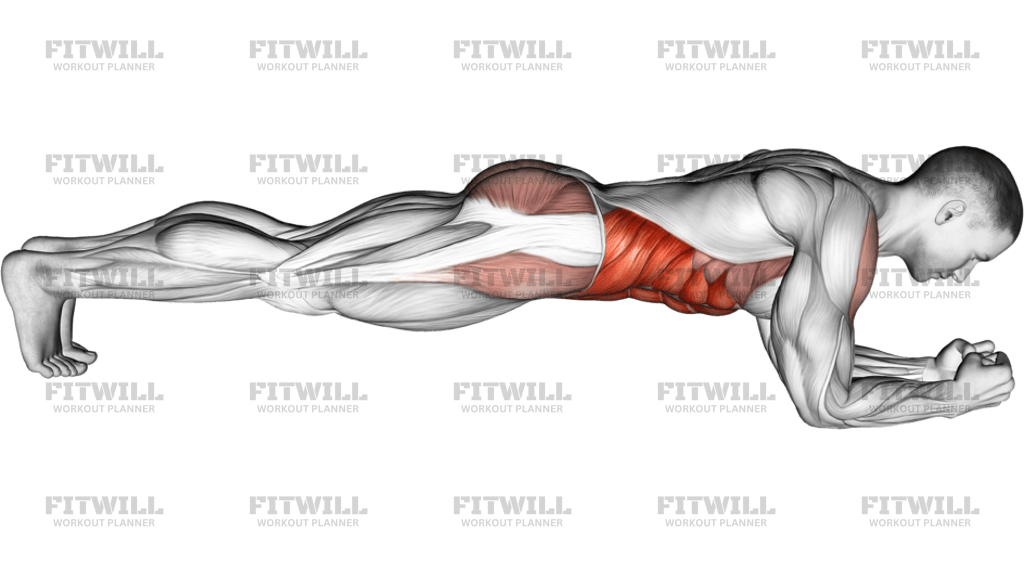
Front Plank is a forearm-supported anti-extension hold that trains the abs, obliques, deep core, glutes, and shoulder stabilizers. The body stays long and rigid while the trunk resists sagging through the low back, rib flare, or hip piking. The image shows the classic forearm version, so the setup should start with the elbows under the shoulders, the forearms planted, and the feet driving back into a straight line from head to heels.
This exercise is less about duration and more about position. A strong plank comes from stacking the elbows, shoulders, ribs, pelvis, and ankles so the torso does not fold at the middle. The abs work hardest when the pelvis stays tucked just enough to keep the low back neutral and the glutes stay active enough to keep the legs long. If the shoulders drift forward, the neck cranes up, or the hips sink, the hold turns into a survival posture instead of a controlled core drill.
Use the plank to build foundational trunk stiffness for lifting, running, calisthenics, and general conditioning. It is useful when you need better force transfer between the upper and lower body, because the torso has to stay braced while breathing stays quiet and controlled. That makes it a good choice for beginners learning core control and for advanced lifters who need a clean, low-load way to challenge anti-extension endurance.
The most important coaching point is to keep the plank short enough that you can maintain position from the first second to the last. A 15-second plank with a hard brace and a flat back is more useful than a 60-second hold that sags through the lumbar spine. If the hold becomes shaky, shorten the set, elevate the forearms, or drop to a knee-supported version before the form breaks down.
Front Plank should feel like a steady whole-body brace, not a hanging stretch through the low back or shoulders. When the elbows stay directly under the shoulders and the ribs stay stacked over the pelvis, the abs, obliques, and glutes can do their job without compensation. Keep the hold crisp, breathe behind the brace, and finish the set before your position changes.
[ Workout Log & Planner ]
Put your next workout in Fitwill
Keep your plan and training log ready when you are.


Instructions
- Set your forearms on the floor with your elbows directly under your shoulders and your hands relaxed or lightly clasped.
- Plant your toes, lift your knees, and walk your feet back until your body forms a straight line from head to heels.
- Squeeze your glutes and gently tuck your pelvis so your low back stays flat instead of arching.
- Press the floor away through your forearms so your shoulders stay stacked over the elbows.
- Keep your neck long and look at the floor a few inches ahead of your hands.
- Brace your abs hard as if you are preparing for a light punch to the stomach.
- Breathe in small controlled breaths without letting your ribs pop up or your hips drop.
- Hold the position for the target time, then lower your knees and relax before the next set.
- Stop the set as soon as your lower back sags, your shoulders collapse, or your body starts to shake uncontrollably.
Tips & Tricks
- Think about pulling your elbows toward your toes without actually moving them; that cue often turns on the deep abs and keeps the torso tight.
- If your shoulders feel cramped, move the elbows slightly farther forward or backward until the forearms feel vertical and stable.
- A hard glute squeeze helps keep the pelvis from dumping forward and protects the low back from over-arching.
- Keep your feet about hip-width apart if a narrow stance makes you twist or wobble.
- Do not let your head lead the hold; a chin jut will usually make the rib cage flare and the neck tense up.
- Short, quiet breaths are better than large chest breaths that lift the ribs and reduce trunk tension.
- If the forearms slide, use a mat or choose a less slippery surface so you can focus on the brace instead of fighting friction.
- Quality matters more than time: end the set when the pelvis, ribs, or shoulders can no longer stay in line.
- For a harder version, extend the lever by tightening the whole body before moving to longer holds or unstable surfaces.
Frequently Asked Questions
What muscles does Front Plank work?
Front Plank mainly trains the rectus abdominis, obliques, transverse abdominis, and glutes. The shoulders and upper back also work hard to keep the forearms anchored and the body aligned.
Why is this done on the forearms instead of the hands?
The forearm version lowers the leverage on the shoulders and makes the core do more of the anti-extension work. It is a common starting point when the goal is torso stiffness rather than wrist loading.
How do I know if my plank is set up correctly?
Your elbows should sit under your shoulders, your forearms should be planted, and your body should look like one straight line. If your low back sags or your hips pike, the setup needs adjustment.
What is the most common mistake in a Front Plank?
Letting the ribs flare and the low back arch is the biggest error. That usually means the abs and glutes are no longer holding the pelvis and trunk in a stacked position.
Should I hold my breath during the plank?
No. Take small controlled breaths while keeping the brace on, otherwise the hold turns into a panic breath pattern and the ribs lose position.
Is Front Plank safe for beginners?
Yes, if the hold is short enough to keep a neutral spine and solid shoulder position. Beginners can shorten the time or drop to the knees before the form breaks.
How can I make the plank easier?
Shorten the hold, widen the feet, or use a knee-supported plank while you learn how to keep the ribs and pelvis stacked.
How can I make the plank harder without losing form?
Increase the hold time only if the body stays rigid, or progress to longer lever variations such as a body saw or forearm plank with feet farther back.
Why do my shoulders shake in a Front Plank?
Usually the upper back and shoulder stabilizers are getting tired while they support the forearm position. If the shake comes with a sagging midsection, the set should end.