Front Plank
Front Plank is a forearm-based bodyweight hold that teaches the trunk to resist extension, rotation, and side-to-side drift. In the image, the elbows are stacked under the shoulders, the forearms are planted, and the body stays in one long line from the head through the heels. That setup matters because the goal is not simply to survive the hold, but to create tension through the abs, glutes, quads, and shoulder girdle without letting the lower back take over.
Front Plank is especially useful when you want a simple test of core endurance that carries over to pressing, squatting, running, and nearly any movement where the torso has to stay organized under load. The rectus abdominis, obliques, and transversus abdominis work hard to keep the ribs from flaring and the pelvis from tipping forward, while the shoulders and upper back keep the chest from collapsing toward the floor. The exercise looks static, but the real work comes from maintaining full-body tension.
The setup should be deliberate. Elbows should be directly below or slightly in front of the shoulders, forearms flat, fists relaxed, and feet set about hip width apart for balance. Once you lift into the plank, squeeze the glutes, lightly draw the ribs down, and keep the neck long so the head stays aligned with the spine. If the hips rise too high or sag too low, the hold stops being a clean Front Plank and becomes a compensation pattern.
Breathing is part of the rep. Take short, controlled breaths without losing abdominal pressure, and avoid letting every exhale dump the torso into the floor. A strong Front Plank should feel demanding in the midsection, not pinchy in the low back or shoulders. If the position cannot be held with steady tension, shorten the set, widen the feet, or regress to the knees until posture stays intact.
Use Front Plank in warm-ups, core circuits, rehab-style trunk work, or as a finisher when you want quality tension rather than speed. It is one of the most practical anti-extension drills you can use, but only when the line from shoulders to ankles stays organized and the hold ends the moment form starts to break.
[ Workout Log & Planner ]
Put your next workout in Fitwill
Keep your plan and training log ready when you are.


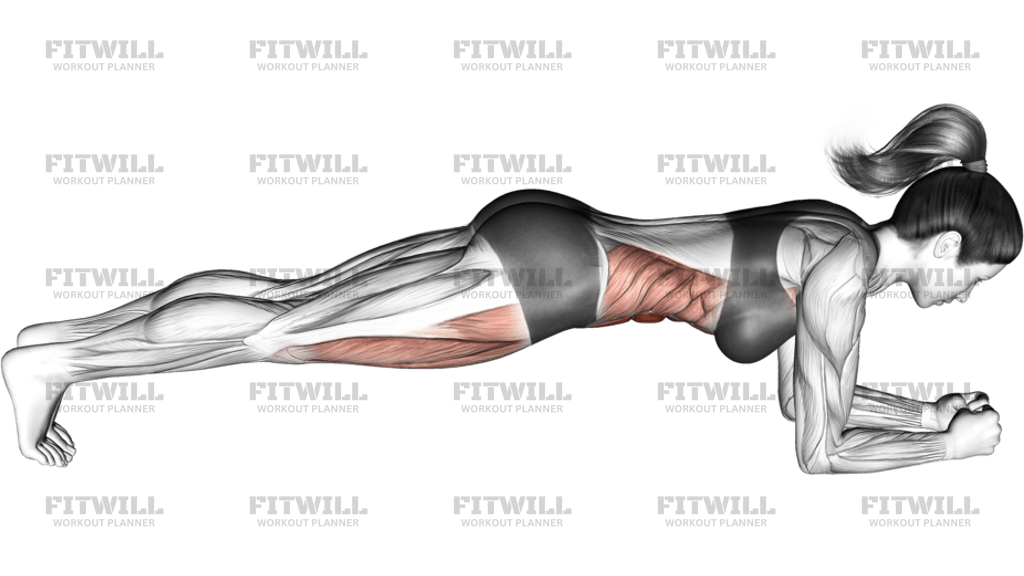
Instructions
- Place your forearms on the floor with your elbows under your shoulders and your hands relaxed or lightly clasped.
- Set your feet back until your body forms a straight line from head to heels.
- Tuck your chin slightly so your neck stays long and your gaze stays a few inches ahead of your hands.
- Squeeze your glutes and quads to keep the pelvis from tipping forward.
- Draw your ribs down and brace the abs before you lift your hips into the plank.
- Press the forearms into the floor and keep the shoulders strong without shrugging.
- Hold the position while taking short, controlled breaths through the brace.
- Keep the hips level and the lower back quiet for the full hold.
- Lower to the floor or drop to the knees when you can no longer keep the line clean.
- Rest, reset your alignment, and repeat for the next set.
Tips & Tricks
- If the low back feels like the limiter, think about pulling the pubic bone slightly toward the ribs and tightening the glutes harder.
- Keep the elbows close to shoulder height; letting them drift too far forward usually turns the hold into a shoulder grind.
- A slight forearm squeeze into the floor can make the torso feel more stable without changing the exercise.
- Widening the feet a little reduces wobble and is often better than letting the hips twist or sway.
- Do not push the head forward to chase a longer hold; a long neck keeps the spine stacked and the ribs calmer.
- If the shoulders burn before the core does, check that you are not collapsing between the shoulder blades.
- Shorter, harder holds are better than long sloppy ones when the pelvis starts to sag.
- Breath-holding too long can make the ribs flare, so take small breaths that do not break the brace.
- Stop the set as soon as the hips start dipping or rotating instead of fighting through a broken position.
- For easier sets, lower to the knees before form breaks rather than waiting until the back arches.
Frequently Asked Questions
What muscles does Front Plank work?
Front Plank mainly trains the rectus abdominis, obliques, and transversus abdominis, with the glutes, quads, shoulders, and upper back helping hold alignment.
Is Front Plank good for beginners?
Yes, as long as the person can keep the elbows under the shoulders and hold a neutral spine. A knee plank is a smart starting regression.
How long should I hold Front Plank?
Start with 10 to 20 seconds of perfect posture and build from there. Longer holds only help if the ribs, pelvis, and shoulders stay stacked.
Why are the elbows under the shoulders in Front Plank?
That position gives the shoulders a better base and makes it easier to keep the torso rigid. If the elbows drift too far forward, the hold gets harder on the shoulders and less clean for the core.
Why do my hips sag in Front Plank?
Usually the abs and glutes are losing tension before the set is over. Shorten the hold, widen the feet, and stop the set before the lower back starts to arch.
Should I hold my breath during Front Plank?
No. Brace firmly, but keep taking small controlled breaths so the ribs do not flare and the neck does not tense up.
What is the difference between Front Plank and a knee plank?
A knee plank reduces the lever arm and makes it easier to keep the pelvis tucked. Front Plank is the full version with the body balanced on the forearms and toes.
Can Front Plank hurt my shoulders or lower back?
It should not if the position is set correctly. Shoulder pain usually means the elbows are too far forward or the chest is collapsing, while low-back pain usually means the ribs are flaring and the hips are dropping.
How do I make Front Plank harder?
Make the hold longer only after you can keep a straight line, or progress to a stricter version like feet closer together, a longer lever, or an unstable surface if appropriate.