Hanging Leg Raise
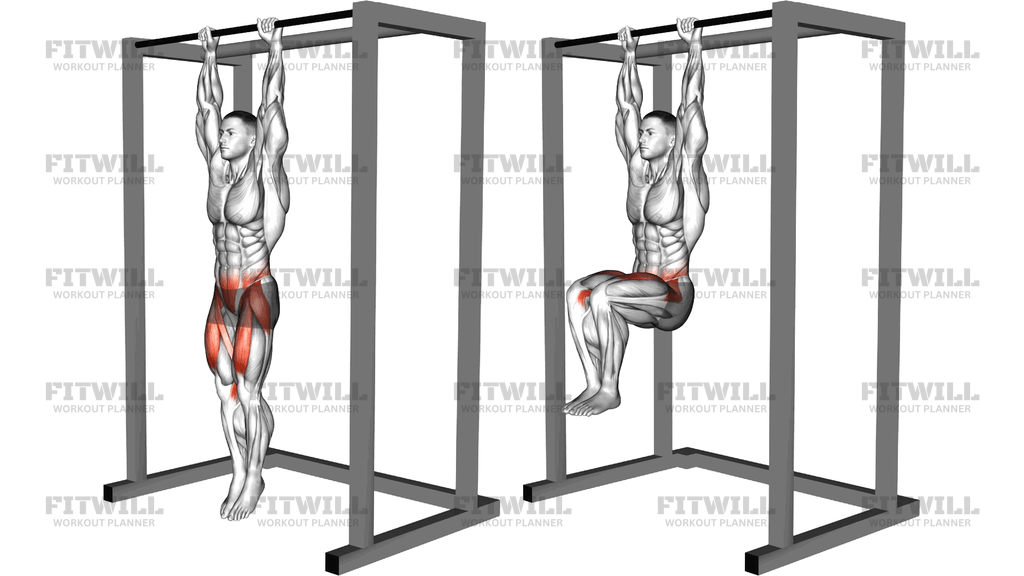
Hanging Leg Raise is a suspended core exercise where you hang from an overhead bar and lift the knees or legs with the trunk held quiet. In the image, the movement is shown as a bent-knee raise, which shortens the lever and makes the exercise easier to control than a straight-leg variation. The hanging position adds a strong grip and shoulder-stability demand, so the value of the drill is not only the abdominal work but also the ability to keep the upper body organized while the lower body moves.
This exercise mainly trains the abdominals, hip flexors, and deep core, with the obliques helping prevent unwanted sway or rotation. The lats, forearms, and shoulder stabilizers keep the body hanging in a solid line. That combination makes the movement useful when you want a strict bodyweight core exercise that also exposes weak control around the pelvis and rib cage.
Setup matters more here than in many floor exercises. Start from a dead hang or an active hang on a secure bar, then gently set the shoulders down away from the ears before the first rep. Keep the ribs stacked over the pelvis, avoid arching the lower back, and let the legs hang still long enough that the first raise begins from control rather than momentum. If you cannot keep the torso quiet, bend the knees and use a smaller range.
Each repetition should look deliberate: lift the knees toward the chest or toward the elbows, pause briefly at the top without shrugging, and lower under control until the legs are quiet again. Do not swing, kip, or throw the legs upward. A clean hanging raise is defined by the path of the pelvis and legs, not by how high the body can be hurled. Breathing should stay controlled, with a firm exhale during the lift and a reset at the bottom.
Use Hanging Leg Raise in a core strength block, after pulling work, or as part of a bodyweight conditioning session. It is especially useful when you want to train anti-swing control, pelvic position, and lower-abdominal strength together. Treat it as a quality movement: keep the range pain-free, reduce the lever before chasing reps, and stop the set as soon as the hang turns into a swing.
Fitwill
Log Workouts, Track Progress & Build Strength.
Achieve more with Fitwill: explore over 9600 exercises with images and videos, access built-in and custom workouts, perfect for both gym and home sessions, and see real results.
Start your journey. Download today!




Instructions
- Grip a secure overhead bar with both hands and hang with your arms straight.
- Set your shoulders down and slightly back so you are in an active hang, not a shrugged dead hang.
- Let your legs hang still, then brace your abs and keep your ribs stacked over your pelvis.
- Start the rep by curling the pelvis slightly and lifting the knees toward your chest or elbows.
- Keep the torso quiet as the legs rise; do not kick, swing, or lean back hard to create momentum.
- Pause briefly at the top with control, then lower the legs slowly until the body is still again.
- If you use the straighter-leg version, keep the knees extended only as far as you can control without arching.
- Reset the hang between reps and stop the set when you can no longer lift without swinging.
Tips & Tricks
- A bent-knee raise is the easiest way to keep the pelvis from tipping forward and the set from turning into a swing.
- Think about lifting your belt buckle toward your ribs instead of just moving your feet upward.
- If your shoulders creep toward your ears, re-set the hang before the next rep so the grip and lats can help stabilize you.
- Do not chase height by arching hard through the lower back; the torso should stay mostly quiet while the hips flex.
- A short pause at the top makes the abs do the work instead of letting momentum bounce the legs back down.
- Lowering slowly is important because the return phase often reveals whether you are actually controlling the pelvis.
- If the grip gives out before the abs do, stop the set or use fewer reps rather than letting the body swing.
- Keep the neck neutral and look forward rather than tucking the chin aggressively toward the chest.
Frequently Asked Questions
What muscles does Hanging Leg Raise work?
Hanging Leg Raise mainly works the abs and hip flexors, with the obliques helping control sway and rotation. The grip, lats, and shoulder stabilizers also work hard to keep you hanging still.
Is Hanging Leg Raise good for beginners?
Yes, if you start with the bent-knee version shown in the image and keep the range small enough to stay strict. Beginners usually need that shorter lever before they can control a straight-leg raise.
Should I raise my knees or keep my legs straight?
Knees bent is the safer and more controllable option for most people. Straight legs make the exercise much harder because the lever is longer and the lower back tends to arch sooner.
How high should the knees come up?
Bring them up as high as you can without swinging or losing the stacked ribs-over-pelvis position. In practice that usually means toward the chest or lower ribs, not a violent kick upward.
What is the biggest mistake in this exercise?
Using momentum from the hips and shoulders instead of controlled abdominal flexion. Once the bar starts to swing, the set stops being a strict core raise.
Why does my lower back arch during the raise?
That usually means the hip flexors are pulling the pelvis forward faster than the abs can control it. Shorten the range, bend the knees more, and keep the ribs down before trying again.
How do I make Hanging Leg Raise harder?
Straighten the knees more, slow the lowering phase, add a pause at the top, or raise the legs higher only if the hang stays still. Each step should make the movement stricter, not swingier.
What if I cannot grip the bar for long?
Use fewer reps, shorter sets, or a version with knees bent so the grip fails after the abs, not before them. Grip fatigue is common because this is a hanging movement, not just a core drill.