Hyperextension
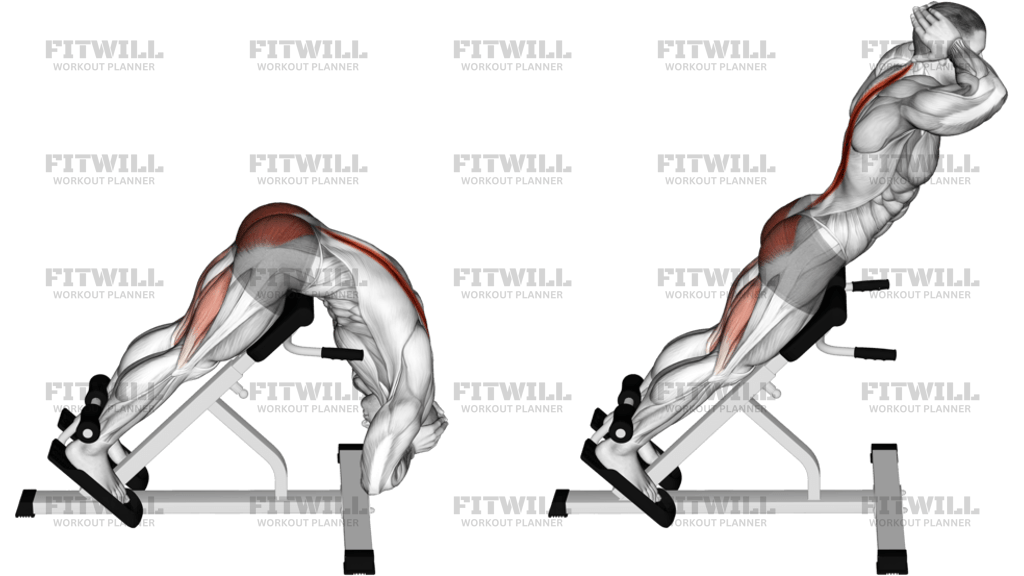
Hyperextension is a bodyweight back-extension on a Roman chair or similar hip pad, with the torso moving around the hips rather than collapsing through the lower back. In the image, the hips are supported on the pad and the ankles are locked in place, which is the setup that lets the spinal erectors, glutes, and hamstrings work through a controlled range. The exercise is useful when you want to train posterior-chain strength without needing a barbell or machine.
The most important detail in Hyperextension is where the pad sits and how the spine stays organized around it. The support should sit across the front of the hips, not the stomach, so the torso can hinge freely while the pelvis stays anchored. That setup lets the movement stay focused on hip extension instead of turning into a sloppy back bend.
When the rep is done well, the body lowers as one long line from the head through the heels, then rises only until the torso reaches neutral. The finish should feel like the hips are driving the chest up, not like the lower back is being cranked past its natural position. That distinction matters because the goal is strong hip extension with clean spinal control, not extra height.
Hyperextension is useful as a warm-up, a strength accessory, or a higher-rep posterior-chain drill. It can complement squats, deadlifts, running, jumping, and field sports because it trains the trunk to resist collapse while the hips extend. If bodyweight reps are already crisp, the exercise can be made harder with a plate, a dumbbell, a slower tempo, or a pause at the top.
This movement should feel demanding but predictable. A good set creates work in the glutes and hamstrings with the back staying long and controlled, while a bad set usually turns into neck pulling, bouncing, or overextending at the top. Hyperextension is most valuable when the setup stays fixed, the range stays honest, and the last rep looks as clean as the first.
Fitwill
Log Workouts, Track Progress & Build Strength.
Achieve more with Fitwill: explore over 9600 exercises with images and videos, access built-in and custom workouts, perfect for both gym and home sessions, and see real results.
Start your journey. Download today!




Instructions
- Set the Roman chair pad across the front of your hips and hook your ankles securely under the rollers.
- Stand on the foot platform, fold forward, and lower your torso so your hips rest on the pad and your upper body can hinge freely.
- Place your hands behind your head or lightly across your chest, tuck your chin, and look at the floor.
- Brace your midsection before you move and let your torso hang from the hips with a long neutral spine.
- Lower your chest under control until you feel a stretch in your hamstrings and lower back without rounding the spine.
- Drive your hips into the pad and raise your torso until your body forms one straight line from head to heels.
- Stop as soon as you reach neutral instead of leaning back past it.
- Exhale as you come up, pause briefly at the top, and lower back down with the same control.
- Reset your brace before the next rep and step out of the machine carefully after the set.
Tips & Tricks
- Keep the pad on the front of the hips; if it sits on the stomach, the hinge gets blocked and the rep turns into a back bend.
- Think about lifting with the glutes at the top instead of yanking the chest higher with the lower back.
- If your neck gets tired with hands behind the head, cross your arms over your chest and keep the chin tucked.
- A slower 2- to 3-second descent makes it easier to feel the hamstrings and prevents bouncing off the bottom.
- Do not chase extra height above neutral; the cleanest Hyperextension stops when the torso and legs line up.
- Keep the ankles pinned under the rollers so the pelvis stays fixed and the rep does not turn into a slip-and-slide.
- If the lower back dominates the set, shorten the range and focus on a smoother hip hinge before adding depth.
- Add load only after bodyweight reps stay strict, because a plate held to the chest makes balance and bracing much harder.
Frequently Asked Questions
What muscles does Hyperextension work?
Hyperextension mainly trains the spinal erectors, glutes, and hamstrings. The upper back and abs help hold the torso steady while the hips move.
Is Hyperextension good for beginners?
Yes, if the bodyweight version stays controlled and the pad is set correctly across the hips. Beginners should start with a short range and stop at neutral.
Where should the pad sit on Hyperextension?
The pad should sit across the front of the hips or upper thighs, not on the stomach. That placement leaves room for a clean hip hinge.
How high should I come up on Hyperextension?
Come up only until your body is in a straight line from head to heels. Leaning back farther than that shifts stress away from the hip extension pattern.
Should I round my back on the way down?
No. Lower by hinging at the hips while keeping the spine long and the chin tucked. If rounding starts, shorten the range.
Are hands behind the head harder than arms crossed on Hyperextension?
Yes. Hands behind the head increase the lever on the neck and upper torso, while arms crossed over the chest make the movement easier to control.
Can I hold weight during Hyperextension?
Yes, a plate or dumbbell held to the chest is a common progression. Keep the load close to the body so you can still reach a neutral finish without twisting.
Why do I feel Hyperextension mostly in my lower back?
Usually the rep is coming up too high, the pad is too low, or the glutes are not finishing the lift. Reset the pad, stop at neutral, and drive the hips into the pad on the way up.