Leg Bench Side Bridge
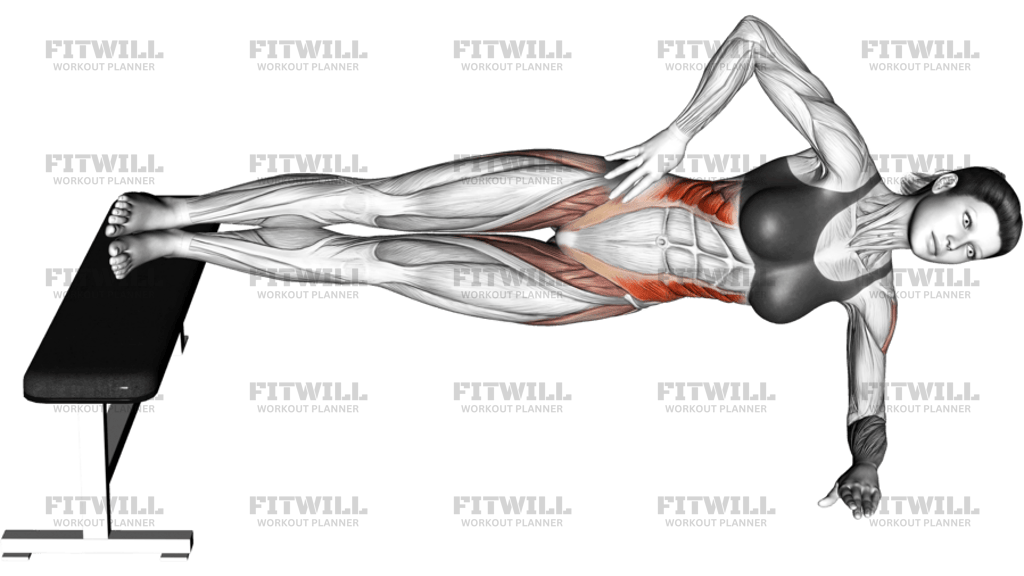
Leg Bench Side Bridge is a bodyweight side-plank variation with the lower legs and feet supported on a bench. The elevated foot position makes the side chain work harder than a floor side bridge because the body has to resist gravity from a longer lever while the hips stay stacked and the torso stays rigid. It is mainly used to train the obliques, but it also asks a lot from the glute medius, quadratus lumborum, shoulder stabilizers, and the deep abdominal wall that keeps the ribs from flaring.
The bench changes the exercise from a simple hold into a more demanding anti-lateral-flexion and anti-rotation drill. If the shoulder is not directly under the elbow, or if the pelvis rolls forward or backward, the load shifts away from the side waist and into the shoulder or lower back. A clean position starts with the elbow planted under the shoulder, the forearm angled forward enough to feel stable, the body in one line, and the feet firmly stacked on the bench without sliding.
When the bridge is performed well, the hips rise as one unit and the ribs stay tucked instead of opening toward the ceiling. The top hand can rest on the hip to help you feel whether the torso is twisting, or it can reach upward if the shoulder stays comfortable. At the top, the body should look long and straight from head to heels, with no sag at the waist and no bend at the hips. Lower under control until the side of the hip just brushes down, then drive back up without bouncing.
This exercise fits well in core training, accessory work, athletic warm-ups, and trunk-stability circuits where quality matters more than speed. It is especially useful for people who need better side-to-side control for running, cutting, lifting, or contact sports. Because the feet are elevated, the movement is more challenging than a standard side bridge, so the setup and body line matter more than the number of reps. If the shoulder, elbow, or low back starts to feel compressed, reduce the hold time or switch to a floor version before form breaks down.
Fitwill
Log Workouts, Track Progress & Build Strength.
Achieve more with Fitwill: explore over 9600 exercises with images and videos, access built-in and custom workouts, perfect for both gym and home sessions, and see real results.
Start your journey. Download today!




Instructions
- Lie on your side with your lower legs and feet resting on the bench, and place the forearm of the bottom arm on the floor directly under the shoulder.
- Stack the feet, keep both legs straight, and set the top hand on the hip or reach it toward the ceiling if the shoulder feels stable.
- Tighten the glutes and draw the ribs down before you lift so the torso starts in a stacked position.
- Press the forearm and the side of the lower foot into the floor and bench, then lift the hips until the body forms one straight line.
- Keep the chest open and the pelvis stacked as you rise, avoiding any twist toward the floor or ceiling.
- Hold the top position briefly while breathing under control and keeping the neck long.
- Lower the hips slowly until they lightly touch down without collapsing at the waist.
- Repeat for the planned number of reps or seconds, then switch sides and match the same setup.
Tips & Tricks
- Place the elbow directly below the shoulder; if the hand is too far forward, the shoulder takes over and the side of the waist loses tension.
- Keep both feet stacked on the bench and avoid letting the top foot drift forward, which usually starts a twist through the pelvis.
- Squeeze the glutes before every lift so the hips rise together instead of the lower back arching first.
- Think about lifting the bottom ribs away from the floor to stop the torso from sagging at the midsection.
- Use the top hand on the hip during practice sets to feel whether the pelvis is rotating or staying square.
- Breathe behind the brace; short, quiet breaths are better than holding your breath for the whole set.
- If the bench position is too hard, shorten the hold before you add reps, because sloppy reps on this movement usually come from fatigue in the side of the trunk.
- Stop the set when the hips stop rising to the same height or the shoulder starts to shrug toward the ear.
Frequently Asked Questions
What muscle does Leg Bench Side Bridge target most?
The obliques are the main target, with the glute medius and deep trunk muscles helping keep the body stacked.
What makes this different from a regular side plank?
The feet are elevated on a bench, which lengthens the lever and makes the side of the torso work harder to keep the body level.
Where should my elbow and shoulder be during the setup?
Set the elbow directly under the shoulder so the forearm can support the body without the shoulder drifting forward.
Should my top hand stay on my hip or reach upward?
Either option works, but keeping the hand on the hip usually makes it easier to notice if the pelvis is rotating.
Is this exercise done for reps or for time?
It is commonly programmed as a hold, but you can also use slow controlled repetitions if the goal is trunk endurance and control.
What should the body line look like at the top?
The shoulders, hips, knees, and ankles should stay stacked in one line without sagging at the waist or twisting open.
Can beginners use this variation?
Yes, but many beginners should start with a floor side bridge or a shorter hold before moving to the bench version.
What should I do if I feel it in my shoulder instead of my waist?
Check the elbow position, keep the shoulder packed down, and shorten the hold if the shoulder starts taking over.