Monster Walk
Monster Walk is a bodyweight hip-control drill that keeps constant tension on the glutes while you travel in short, deliberate steps. It is used to wake up the hips, improve lateral stability, and teach the pelvis and knees to stay organized while the legs are moving. The goal is not speed or distance. The goal is to stay low, stay balanced, and make every step look the same.
The main training effect comes from the glutes, especially the outer hip muscles that help keep the femur centered and the pelvis level. The hamstrings help hold the hinge, the core keeps the torso from swaying, and the lower back works only as a stabilizer. In anatomy terms, the primary work centers on the Gluteus maximus, with help from Biceps femoris, Rectus abdominis, and Erector spinae. Because this is a bodyweight drill, the value comes from position, angle, and control rather than load.
A good setup starts in a soft athletic stance with the feet a little wider than hip width, knees slightly bent, and the ribs stacked over the pelvis. Sink just enough to keep tension in the hips without turning it into a squat. Keep the chest tall, the feet grounded, and the knees pointed in the same direction as the toes. If the stance is too narrow, the hips lose tension; if it is too wide, the movement turns into a forced side step instead of a controlled monster walk pattern.
Each repetition should feel like a deliberate travel step with the hips staying quiet. Step diagonally and under control, then bring the trailing foot in without bouncing or standing all the way up. Keep the stance low enough that the glutes stay engaged and the torso does not rock from side to side. Breathe steadily through the set, exhaling as you step and inhaling as you reset your balance. If the knees collapse inward or the torso starts leaning, shorten the step and reduce the range.
Monster Walk fits well in warm-ups, activation work, accessory circuits, and rehab-style lower-body sessions because it teaches repeatable hip position without heavy fatigue. It is also useful before squats, deadlifts, lunges, and running sessions when you want the hips awake and the knees tracking cleanly. Beginners can use it right away as long as they stay patient with the stance and keep the steps small. Advanced lifters usually get more out of slower, cleaner reps than from chasing extra speed or distance.
[ Workout Log & Planner ]
Put your next workout in Fitwill
Keep your plan and training log ready when you are.


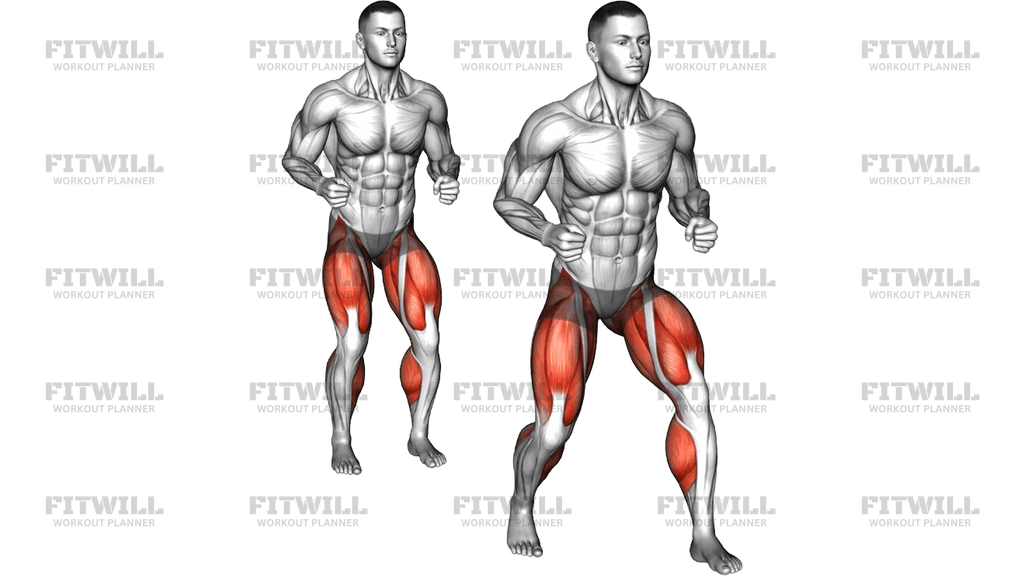
Instructions
- Stand in a soft athletic stance with your feet slightly wider than hip width and your hands on your hips or held in front of your chest for balance.
- Bend your knees a little, hinge your hips back slightly, and keep your chest stacked over your pelvis instead of leaning forward.
- Set your feet so the toes point mostly forward or just slightly out, and keep your weight centered through the middle of each foot.
- Brace your midsection lightly so your ribs and pelvis stay aligned before you start moving.
- Step one foot diagonally forward and out with a short, controlled stride while keeping the hips level.
- Bring the trailing foot in under your body without letting your stance pop up or your knees knock together.
- Continue the diagonal steps for the planned distance, keeping constant tension in the glutes and outer hips.
- Breathe out as you step and breathe in as you stabilize each position, then reset and repeat in the opposite direction if needed.
Tips & Tricks
- Keep the stance low enough that your glutes stay loaded; standing too tall turns the drill into a casual walk.
- Shorter steps usually create better hip tension than large steps that force you to shift side to side.
- Track each knee in the same direction as its toes so the hips do the work instead of the knees collapsing inward.
- Press through the whole foot, especially the heel and outer edge, so you do not drift onto the toes.
- Avoid crossing your feet; the trailing foot should follow, not swing across your midline.
- If your torso starts rocking, slow the pace and make the steps smaller until your pelvis stays quiet.
- Use the drill as a control exercise, not a conditioning race, because speed usually makes the hips lose tension.
- Stop the set if you feel the effort move into the low back or knees instead of the outer hips.
Frequently Asked Questions
What muscle does Monster Walk target most?
The glutes are the main target, especially the outer hip muscles that help control pelvic and knee position.
Can beginners perform this exercise?
Yes. It is a beginner-friendly drill as long as the stance stays low, the steps stay short, and the torso does not sway.
Do I need a band for the Monster Walk in this version?
No. This payload is written as a bodyweight drill, so the challenge comes from stance, control, and step quality rather than external resistance.
How is Monster Walk different from a lateral lunge?
A monster walk keeps you moving continuously with smaller diagonal steps, while a lateral lunge usually drops into one side at a time with a deeper load shift.
Where should I feel the exercise working?
You should feel it most in the glutes and outer hips, with some help from the hamstrings and core to keep you stable.
What is the most common technique mistake?
Most people either stand too tall or let the knees cave inward, which reduces hip tension and shifts stress away from the glutes.
When should I use Monster Walk in a workout?
It works well in a warm-up or accessory block before squats, deadlifts, lunges, or running work.
How do I make it harder without adding weight?
Lower your stance slightly, slow the steps, or travel farther while keeping the hips level and the knees aligned.