Muscle Up
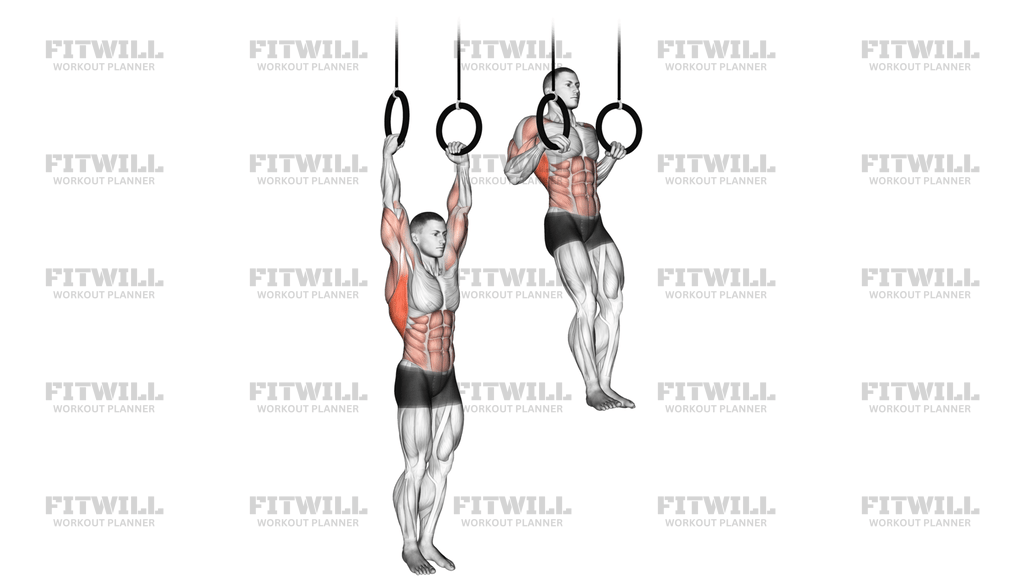
Muscle Up is a demanding ring-based bodyweight exercise that combines a powerful pull, a fast turnover, and a strong dip lockout. It starts in a dead hang and finishes with the hands fully supporting the body above the rings. That means the rep trains pulling strength, transition control, and pressing strength in one pattern instead of treating them as separate skills.
The main drivers are the lats, upper back, biceps, forearms, chest, shoulders, and triceps, with the core working hard to keep the body from swinging away from the rings. In a strict version, the goal is to stay organized through the pull and make the transition with the rings close to the torso so the body can travel around the hands instead of flaring away from them.
Setup matters a lot on this movement. The rings should hang freely with enough clearance for a full pull and a stable top support. Start from a controlled dead hang, keep the ribs down, and make every rep begin with the shoulders engaged rather than relaxed. Small changes in grip, body tension, or ring path can decide whether the turnover feels smooth or stuck.
During the pull, think about bringing the rings to your lower ribs or upper abdomen rather than simply yanking yourself upward. As you rise, lean the chest slightly forward over the rings and turn the elbows over fast enough to catch the top position without losing body tension. The finish should look like a solid ring dip lockout with the arms straight and the shoulders stacked over the hands.
Muscle Up is best used as a skill-strength exercise when you already have a solid pull-up base and can control ring dips. It can be trained strict for strength and technique or with a small kip for more advanced performance work, but either version should stay smooth and repeatable. If the turnover gets sloppy, the rep usually needs better tension, cleaner ring path, or a lower level of assistance before load or volume increases.
[ Workout Log & Planner ]
Put your next workout in Fitwill
Keep your plan and training log ready when you are.


Instructions
- Hang from the rings with straight arms, the rings just outside shoulder width, and your body tight in a hollow position.
- Set your shoulders before the first pull, keep your legs together, and avoid any initial swing.
- Pull the rings down toward your lower ribs while driving your elbows back and keeping the rings close to your body.
- As your chest reaches ring height, lean the torso slightly forward over the rings and begin turning the wrists and elbows over.
- Pull the chest through the transition so your shoulders travel above the rings instead of drifting behind them.
- Press the rings down to finish in a tall support with straight elbows and the chest lifted.
- Lower slowly by reversing the path, keeping control through the transition and the descent.
- Reset to a dead hang before the next rep, and stop the set if you lose control of the turnover or support.
Tips & Tricks
- Use chalk and a secure grip; slippery hands make the turnover and support much harder to control.
- Keep the rings close to your torso during the pull so the transition stays compact.
- If you cannot get above the rings, build more chest-to-ring pull-up and ring dip strength before chasing extra reps.
- A small kip can help in dynamic work, but a strict muscle up should not depend on leg kick or hip throw.
- Aim your pull toward the lower ribs, not the chin, so the body can travel into the turnover.
- Keep the core and glutes tight so your feet do not swing behind you on the descent.
- Turn the rings out only after you reach a stable support; forcing the turn too early can stall the transition.
- Use low reps and longer rests if technique is the priority, because fatigue usually breaks the transition first.
Frequently Asked Questions
What muscles does a ring Muscle Up work?
It heavily involves the lats, upper back, biceps, forearms, chest, shoulders, triceps, and core.
Is this the same as a bar muscle-up?
No. Rings move and rotate, so the transition and top support demand more shoulder and wrist control than a fixed bar.
Do I need a false grip?
A false grip helps many athletes keep the rings close through the turnover, but some lifters can still do the movement with a regular grip if they have enough strength and control.
What is the hardest part of the exercise?
The transition is usually the hardest part because you have to pull high enough to get your chest over the rings before pressing out.
Can beginners learn it?
Not usually as a first bodyweight skill. Build pull-ups, chest-to-ring pull-ups, ring dips, and transition drills first.
How should the rings be set up?
They should hang freely with enough clearance for a full pull and a stable top support without hitting the floor or ceiling.
Why do I get stuck halfway up?
Most often the pull is too low or the rings drift away from the body, so the transition loses leverage.
What is a good regression?
Use band-assisted reps, low-ring transition drills, or separate pull-up and ring dip work until the whole path is smooth.