Push-Up Inside Leg Kick
Push-Up Inside Leg Kick is a body-weight floor exercise that combines a push-up with an inside knee or leg drive from a high plank. It asks you to keep the upper body rigid while one leg moves dynamically, so the exercise trains pressing strength, trunk control, hip stability, and glute activation in the same rep. The visible pattern is not just a standard push-up with extra motion; the leg action is part of the challenge, and the torso has to stay organized while the body shifts.
The main training effect comes from the chest, triceps, and shoulders doing the push-up while the glutes, hamstrings, abs, and obliques resist rotation and help control the leg drive. In anatomy terms, the primary work centers on the Gluteus maximus, with assistance from Biceps femoris, Rectus abdominis, and Erector spinae. That makes the exercise useful when you want a pressing drill that also demands athletic core tension rather than a purely upper-body rep.
Setup matters because the movement becomes sloppy very quickly if the plank is loose. Start in a high plank with your hands under your shoulders, arms straight, legs long, and feet set a little wider than a narrow push-up stance so you can balance the leg lift. Before the first rep, set your ribs down, tighten your glutes, and keep your neck long so the whole body stays in one line instead of sagging through the lower back.
From there, lower into the push-up under control while one knee drives inward toward the inside line of the body or toward the same-side elbow, depending on how the rep is programmed. The goal is to keep the pelvis mostly square and avoid swinging the hips open as the leg moves. Press back to the plank with the foot active, then return both feet to a stable base before changing sides or starting the next rep.
This exercise fits well in a warm-up, accessory block, or conditioning circuit when you want total-body tension without heavy equipment. It is also a useful regression-to-progression bridge between a plain push-up and more advanced plank or crawling drills. Keep the rep quality high, move with a controlled rhythm, and stop the set when the push-up depth, hip position, or leg path starts to lose precision.
Fitwill
Log Workouts, Track Progress & Build Strength.
Achieve more with Fitwill: explore over 9600 exercises with images and videos, access built-in and custom workouts, perfect for both gym and home sessions, and see real results.
Start your journey. Download today!




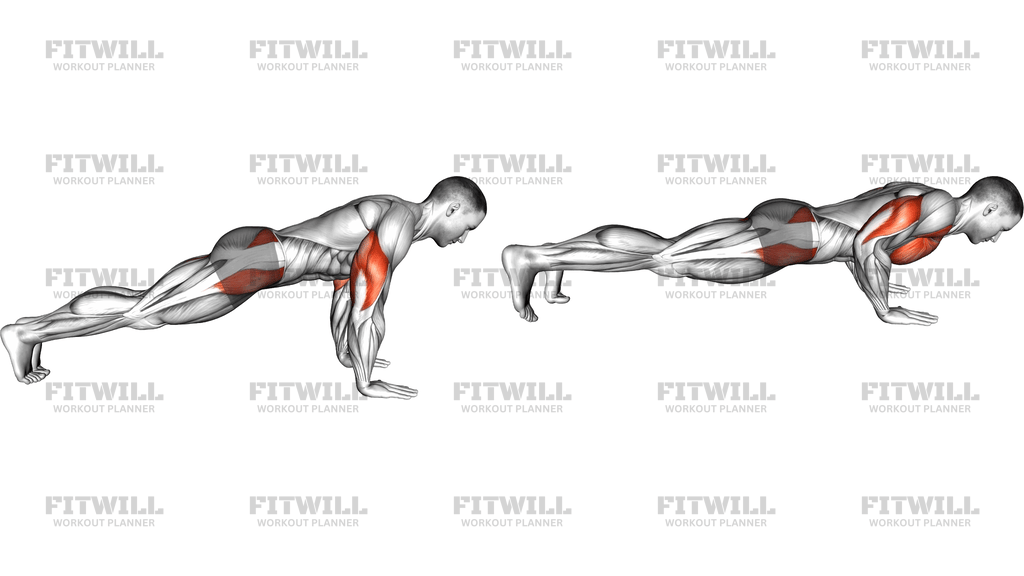
Instructions
- Start in a high plank with your hands under your shoulders, arms straight, legs extended, and feet set slightly wider than a narrow push-up stance.
- Stack your shoulders over your wrists, keep your head in line with your spine, and lightly squeeze your glutes before the first rep.
- Lower your chest between your hands by bending your elbows back at about 30 to 45 degrees, keeping your torso firm.
- As you descend or drive back up, bring one knee inward toward the same-side elbow or inside line of the body without letting the hips swing open.
- Press the floor away to return to the top plank and keep the lifted leg active instead of letting it drop loosely.
- Re-square your hips and reset your feet on the floor before the next repetition.
- Alternate sides rep to rep or follow the programmed side sequence if the workout calls for one leg at a time.
- Finish the set by stepping back to the floor or lowering the knees with control if your plank position starts to break down.
Tips & Tricks
- Use a stance that is wide enough to keep the pelvis steady; a narrow base usually makes the inside leg kick wobble.
- Think about lowering the chest between the hands instead of diving the head forward, so the shoulders and triceps stay in control.
- Keep the knee drive compact and deliberate; a big swinging leg usually means the low back and hip flexors are taking over.
- If the hips open up, slow the rep down and shorten the leg path until you can keep the torso square.
- Exhale as you press up and drive the knee inward, then keep the ribs down instead of flaring through the bottom.
- Keep both hands rooted hard into the floor so the shoulder blades can move without the upper body collapsing.
- If the bottom position is too deep, raise your hands on a bench or box before chasing more range.
- Stop the set when the lifted foot lands late, the hips twist, or the push-up turns into a partial rep.
Frequently Asked Questions
What muscles does Push-Up Inside Leg Kick work?
It works the chest, triceps, shoulders, glutes, hamstrings, obliques, and deep core muscles.
Is this more of a push-up or a core exercise?
It is both, but the alternating leg drive adds a strong core and glute stability demand to the push-up.
Do I need to keep my hips square during the leg kick?
Yes. The best reps keep the pelvis mostly level while the knee travels inward in a controlled line.
Should the knee go all the way to the elbow?
Only if you can do it without twisting or losing the push-up. A smaller, cleaner inward drive is better than a forced reach.
Can beginners do this exercise?
Yes, but many beginners should start on an incline or remove the leg kick until the basic push-up is solid.
What is the most common form mistake?
Letting the lower back sag and swinging the leg instead of controlling the knee drive and torso position.
How can I make this easier?
Raise your hands on a bench, shorten the push-up range, or do a plain plank-to-push-up pattern before adding the kick.
How can I make this harder?
Slow the lowering phase, pause briefly at the bottom, or keep the leg drive precise while maintaining a strict plank.