Rolling Bridge
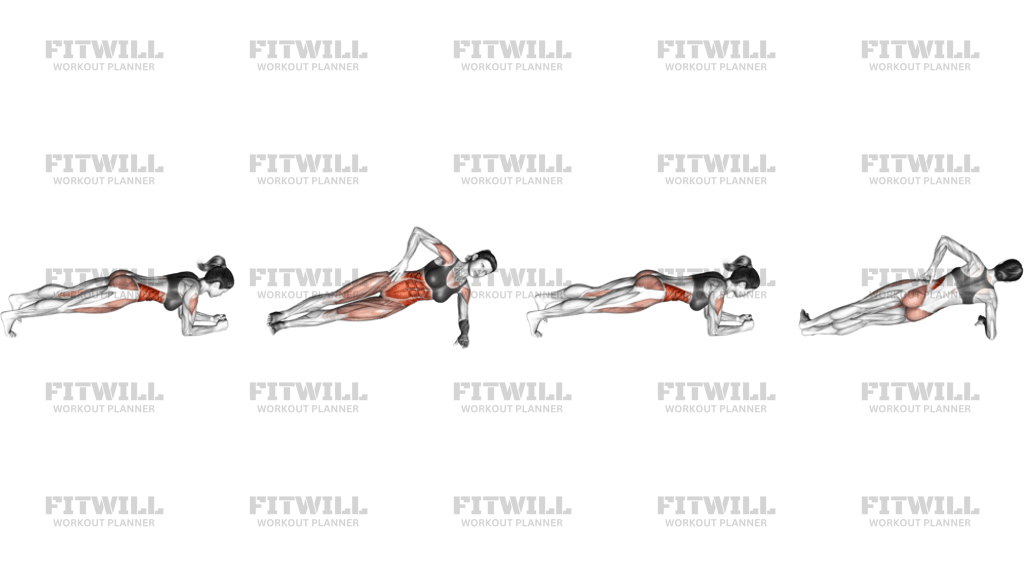
Rolling Bridge is a body-weight core drill that rolls from a forearm plank into a side plank and back again while the hips stay lifted. It trains the trunk to resist unwanted extension and rotation, so the abs, obliques, and shoulder stabilizers have to stay organized through every transition. Because the movement is self-limiting, the quality of each rep matters more than the number of reps you finish.
The main job is not to twist wildly from side to side. The goal is to keep the body long from head to heel, then rotate the torso as a single unit while the supporting forearm and outer foot take most of the load. That is why the Rectus abdominis, External obliques, and Transversus abdominis all contribute, with the shoulders and hips helping to hold the bridge position steady.
Setup makes the exercise either smooth or messy. Start with the elbows under the shoulders, forearms planted firmly, legs straight, and feet together or slightly staggered if you need more balance. From there, brace the ribs down, squeeze the glutes, and keep the neck in line with the spine so the lower back does not take over when you roll.
Each repetition should travel through a clean arc: center plank, side plank, center plank, then the other side. Open the chest enough to stack the shoulders, but do not let the hips drop or the low back pinch during the turn. If the rep turns into a quick flop instead of a controlled roll, shorten the range and slow the transition until the trunk can keep tension the whole way through.
Rolling Bridge fits well in core circuits, warmups, and accessory work when you want more than a static plank but less load than a weighted core exercise. It is especially useful for beginners learning how to control the torso during rotation, and for experienced lifters who want stronger side-body tension without needing equipment. Keep the movement crisp, symmetrical, and pain-free so every rep builds control instead of momentum.
Fitwill
Log Workouts, Track Progress & Build Strength.
Achieve more with Fitwill: explore over 9600 exercises with images and videos, access built-in and custom workouts, perfect for both gym and home sessions, and see real results.
Start your journey. Download today!




Instructions
- Start in a forearm plank with your elbows under your shoulders, forearms parallel, legs straight, and feet together or slightly apart for balance.
- Press your forearms into the floor, squeeze your glutes, and pull your ribs down so your torso stays long before you begin the roll.
- Shift onto one forearm and rotate your chest open into a side plank, stacking the shoulders and keeping both hips lifted.
- Keep the supporting elbow under the shoulder and the body in one line from head to heels as you hold the side position.
- Roll back through the center plank with control instead of letting the hips drop toward the floor.
- Continue the rotation to the opposite side, opening the chest again and keeping the neck relaxed and neutral.
- Breathe out as you rotate and inhale as you pass through the center plank, using the breath to keep the trunk braced.
- Lower the knees or return both forearms to the floor when the set is finished, then reset before the next rep.
Tips & Tricks
- Stacking the feet makes Rolling Bridge harder; stagger them slightly if you cannot keep the hips level through the turn.
- Keep the elbow directly under the shoulder so the front of the shoulder does not get yanked forward during the roll.
- If your low back sags at center, shorten the range and keep the ribs pulled down before you rotate again.
- Think about lifting the bottom hip toward the ceiling, not just turning the chest open, so the side body stays active.
- A slow three-count roll usually works better than a fast swing because it keeps tension on the abs and obliques.
- If the shoulder tires before the core, widen your feet and reduce how long you hold each side plank position.
- Keep the free hand either on the hip or reaching toward the ceiling, but do not let the top shoulder collapse forward.
- Stop the set when the forearms start sliding or the hips can no longer stay above the line of the shoulders and heels.
Frequently Asked Questions
What muscles does Rolling Bridge work most?
It mainly trains the abs and obliques, with the shoulders and glutes helping to hold the bridge position while you rotate.
Is Rolling Bridge basically a moving side plank?
Yes. It rolls from a forearm plank into one side plank, back through center, then to the other side while keeping the hips lifted.
Should my feet stay stacked during Rolling Bridge?
Stacked feet make the movement more demanding. If balance is the limiting factor, stagger the feet slightly so you can keep the hips from dropping.
Why do my shoulders burn before my abs do?
The supporting shoulder is working hard to keep the body lifted. If it burns too early, reduce the hold time in side plank and make the roll slower.
Can beginners do Rolling Bridge?
Yes, but start with short holds and a staggered stance. Beginners often do better with a slower roll and fewer reps per side.
How high should my hips be in the side plank position?
High enough that your body stays in a straight line from head to heels. If the hips sink, the roll becomes a low-back twist instead of a core drill.
What is the biggest mistake in Rolling Bridge?
Letting the hips drop during the transition is the main one. The roll should stay controlled, with the torso moving as one unit.
How can I make Rolling Bridge easier on my shoulders?
Widen your feet, shorten the side-plank hold, and keep the free hand on the hip instead of reaching overhead.