Squat Jerk
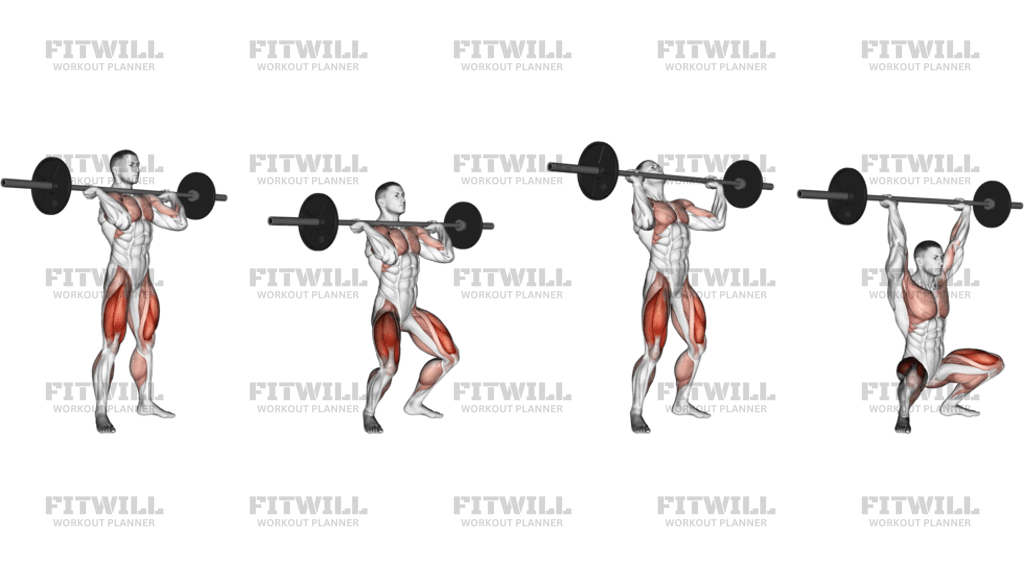
Squat Jerk is a barbell overhead lifting variation that uses a quick dip, explosive leg drive, and a deep receiving position to get the bar from the shoulders to locked-out overhead. It is an advanced strength and skill movement, but the lower-body drive is what makes it useful for training power through the thighs, hips, and trunk while demanding strong overhead stability.
The exercise is more technical than a standard press or front squat because the bar must travel straight up while your body drops under it fast enough to catch it in a solid overhead squat. That means the setup matters: the feet need to be planted, the torso stacked, the bar racked securely on the shoulders, and the elbows slightly forward so the dip stays vertical instead of drifting into a press-out.
Squat Jerk places the biggest load demand on the quads during the dip, drive, and recovery, with the glutes, calves, upper back, shoulders, triceps, and trunk working to stabilize the bar overhead. The movement rewards crisp timing more than brute force. If the dip is shallow, forward, or rushed, the bar path usually leaks forward and the catch becomes unstable.
A good rep starts by settling the bar in the front rack and creating tension through the whole body before the dip. From there, the knees bend straight down, the torso stays tall, and the heels remain grounded until the drive finishes. The goal is to transfer force into the bar, then quickly move under it and receive it with the arms locked and the chest under the load.
Use Squat Jerk when you want to build overhead receiving strength, jerk speed, leg drive, and coordination under a barbell. It fits best in technical lifting sessions, power blocks, or advanced lower-body work, not as a casual conditioning exercise. Keep the load light enough that you can recover each rep cleanly and reset the rack position before the next attempt. If overhead mobility, ankle depth, or shoulder control breaks down, reduce the weight and shorten the set instead of forcing sloppy catches.
Fitwill
Log Workouts, Track Progress & Build Strength.
Achieve more with Fitwill: explore over 9600 exercises with images and videos, access built-in and custom workouts, perfect for both gym and home sessions, and see real results.
Start your journey. Download today!




Instructions
- Set the bar in the front rack across the shoulders with your elbows slightly forward, feet about hip-width, and your weight balanced through the whole foot.
- Stand tall with your chest lifted, ribs stacked over your pelvis, and your gaze forward before starting the dip.
- Take a short, straight dip by bending the knees a few inches while keeping your torso vertical and your heels flat.
- Drive hard through the floor and finish the leg extension fast enough to send the bar straight up from the shoulders.
- As the bar rises, drop your body under it and punch the arms to full lockout overhead.
- Receive the bar in a deep overhead squat with the bar over midfoot, elbows locked, and shoulders active.
- Stabilize at the bottom until the bar feels fixed overhead and your knees track over your toes.
- Stand up from the overhead squat under control without letting the bar drift forward or behind your base.
- Lower the bar back to the shoulders and reset your stance before the next repetition.
Tips & Tricks
- Keep the dip vertical; if your hips slide back, the bar usually drifts forward and the catch gets soft.
- Use the front rack only as a launch position, not a place to press the bar upward with the arms.
- Think 'jump and drop' rather than 'dip and push' so the bar receives leg drive instead of a slow press.
- If you cannot reach a stable overhead squat, reduce the load and work the receiving position before adding weight.
- Lock the elbows before your feet settle so the bar is already fixed when you land in the squat.
- Keep the bar over the middle of your foot; a bar that lands in front of you usually means the dip was too forward or the drive finished early.
- Use a smooth reset between reps because a sloppy front rack makes the next dip inconsistent.
- Stop the set if your overhead position starts wobbling or your heels pop up during the catch.
Frequently Asked Questions
What muscles does the Squat Jerk work most?
It heavily uses the quads and glutes for the dip, drive, and stand, while the shoulders, triceps, upper back, and core stabilize the bar overhead.
Is the Squat Jerk a beginner exercise?
Not usually. Most beginners should learn the front rack, overhead squat, and split or power jerk first before trying the deeper receiving position.
How deep should I catch the Squat Jerk?
Catch it as deep as needed to get under the bar with solid lockout and balance. If the bottom position forces you to fold forward or lose the bar, the load is too heavy or the mobility is not ready.
What is the biggest mistake in the Squat Jerk?
A forward dip is one of the most common problems. It sends the bar in front of the midfoot and forces a chase instead of a clean overhead catch.
Should the bar be pressed or pushed in the Squat Jerk?
Neither. The legs drive the bar and the body drops under it; pressing usually makes the rep slower and harder to stabilize.
What stance works best for the Squat Jerk?
Start with a stance similar to your jerk setup, then land with the feet just wide enough to support the overhead squat. The exact width depends on your squat depth and how stable you are overhead.
Can I use the Squat Jerk instead of a split jerk?
Yes, if your mobility and timing support it. It is a good alternative when you want a stronger overhead receive in a squat rather than a split stance.
What should I do if the overhead position feels unstable?
Use a lighter bar, shorten the set, and practice the overhead squat receive separately. The bar should feel stacked over the shoulders and midfoot before you start adding load.