Standing Single Leg Curl
Standing Single Leg Curl is a bodyweight hamstring exercise done one leg at a time while you stay upright and balance on the opposite foot. The working knee bends to bring the heel toward the glute, which makes this a useful drill for knee-flexion strength, hamstring control, and single-leg stability. It fits well in warm-ups, activation work, accessory blocks, or lower-body sessions where you want the hamstrings to do the work without heavy spinal loading.
The standing position matters because the exercise is not just a curl. Your pelvis, trunk, and support leg have to stay quiet while the working leg moves. If the hips twist, the low back arches, or the standing knee locks out, the hamstrings lose tension and the set turns into a balance drill. A tall posture, level hips, and a soft standing knee keep the repetition focused on the back of the thigh instead of on momentum.
To perform it well, begin with the feet under control, one leg rooted into the floor and the other ready to curl behind you. Keep the thighs mostly in line and let the lower leg move by bending the knee. The heel should travel toward the back of the thigh or glute without kicking the leg back. At the top, the hamstrings should feel tight, but the pelvis should still face forward.
Lower the foot slowly and keep tension through the return so each rep has a clean start and finish. Exhale as you curl, inhale as you lower, and stop the set if you start swaying or using the lower back to help the lift. If balance is the limiter, a light fingertip support on a wall, rack, or bench is fine as long as it does not turn into a push-off.
This is a practical exercise for athletes, runners, and lifters who want better hamstring awareness and side-to-side control. It can also be a beginner-friendly introduction to isolated hamstring work because the bodyweight resistance is easy to scale. Keep the range smooth, keep the hips square, and make every repetition look the same from one side to the other.
[ Workout Log & Planner ]
Put your next workout in Fitwill
Keep your plan and training log ready when you are.


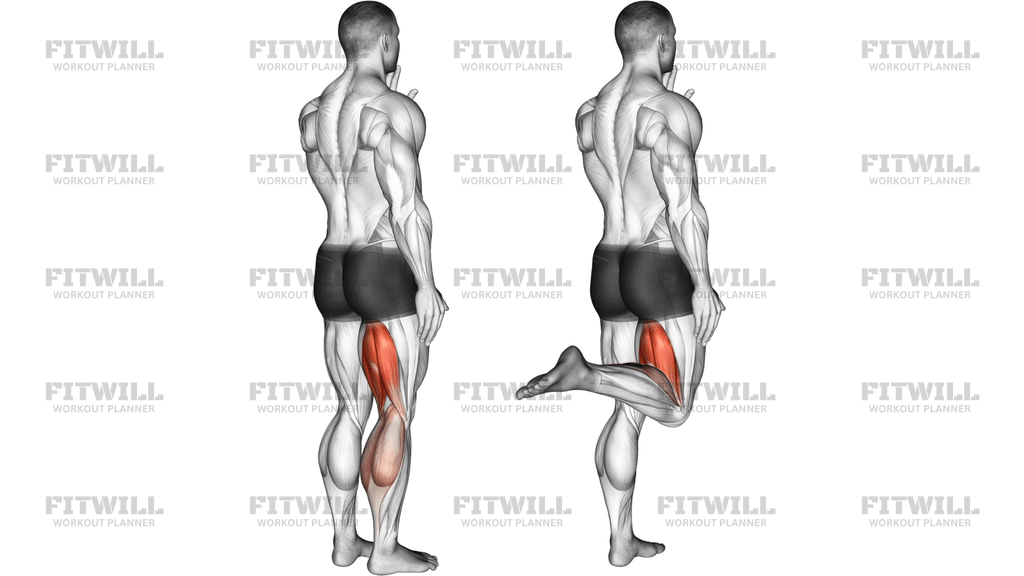
Instructions
- Stand tall on one leg with the working leg slightly behind you, hips facing forward, and the standing knee softly unlocked.
- Keep your torso upright and your ribs stacked over your pelvis before you start the curl.
- Brace lightly, then bend the working knee to bring the heel toward your glute without letting the thigh swing backward.
- Keep the standing leg still and the pelvis level as the lower leg folds up behind you.
- Pause briefly when the hamstring is fully shortened and the knee has curled as far as you can control.
- Lower the foot slowly back toward the floor while keeping the thigh quiet and the trunk tall.
- Reset your balance between reps if needed, but do not push off the floor with the curling leg.
- Repeat for the planned reps, then switch sides and match the same range and tempo.
Tips & Tricks
- Think about pulling the heel toward the back of the thigh, not kicking the foot straight up.
- Keep the working thigh mostly in line with the standing thigh so the curl comes from knee flexion instead of hip swing.
- A small fingertip touch on a wall or rack is better than leaning your body weight into support.
- If your hips open or rotate, shorten the range until you can keep both hip bones pointing forward.
- Lower the foot under control for two to three seconds; the return phase should be as clean as the curl.
- Stop the set if the standing foot starts to roll, because that usually means balance has become the limiter.
- Keep the standing knee soft so the glute and hamstring can stabilize the leg instead of locking out the joint.
- If the hamstring cramps, reduce the curl height and slow the tempo before adding more reps.
- Use the same tempo on both sides so you can tell whether one hamstring is weaker or less coordinated.
- This movement works best with a strict bodyweight tempo; adding speed usually just turns it into a balance swing.
Frequently Asked Questions
What muscle does Standing Single Leg Curl target most?
The hamstrings are the main target, especially the knee-flexion function of the back of the thigh.
Can beginners perform this exercise?
Yes. Beginners usually do best with a light fingertip support and a shorter curl until balance and control improve.
Do I need to hold onto something for balance?
No, but a wall, rack, or bench is a good option if balance limits the hamstring work. Use it lightly, not as a push-off point.
Should my thigh move backward during the curl?
Only a little, if at all. The main action should come from bending the knee while the hips stay square and the trunk stays tall.
Why do I feel this in my calves or lower back?
That usually means the curl is too fast, the range is too big, or the pelvis is rotating. Shorten the rep and keep the ribs stacked over the pelvis.
Is this better before or after squats and deadlifts?
It works well before lower-body lifting as an activation drill, or later in the session as a lighter accessory movement.
How can I make the exercise harder without equipment?
Use a slower lowering phase, pause longer at the top, or add more controlled reps per side before you increase difficulty.
What is the most common mistake here?
Swinging the leg backward or twisting the hips to fake a bigger curl. The set should look quiet from the waist up.
Where should I feel the working side?
You should feel the back of the thigh on the curling leg, with some help from the standing leg and hip stabilizers.