Dumbbell Swing
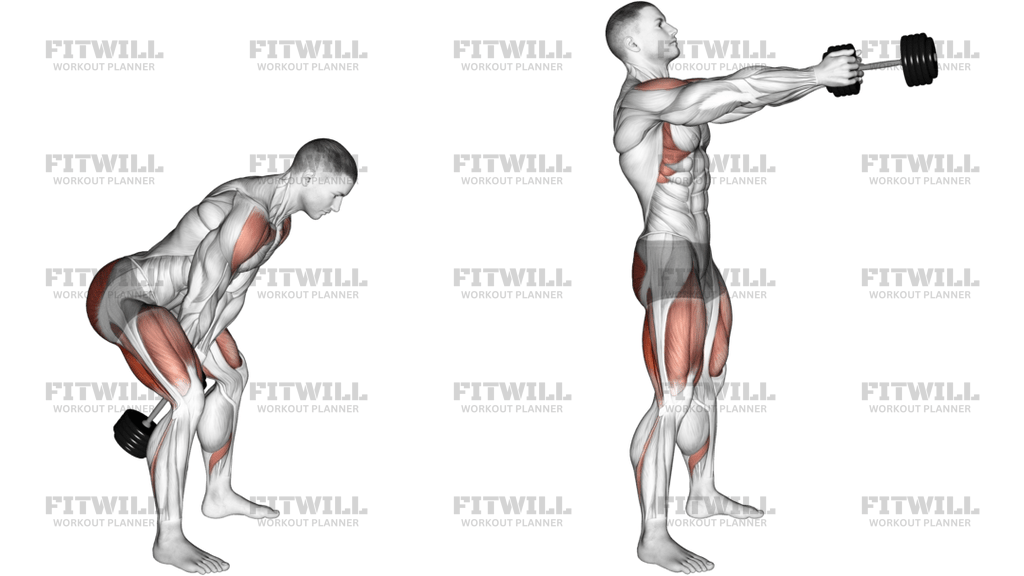
Dumbbell Swing is a dynamic hip-hinge exercise performed with a dumbbell held in both hands. The weight starts between the legs, then travels forward and upward from a forceful hip drive until the arms are roughly parallel to the floor. It trains power, timing, and trunk control more than pure arm strength, so the setup matters as much as the swing itself.
The main work comes from the hips and posterior chain: glutes, hamstrings, and core create the force, while the shoulders, upper back, and arms keep the dumbbell on a clean arc. In this record, the delts are listed as the primary muscle because they help control the top position, but the movement should still feel like an explosive hinge rather than a shoulder raise.
The best reps begin with a balanced stance, a long spine, and a loaded hip hinge before the dumbbell ever leaves the floor line. The backswing should stay tight to the body, with the weight passing between the thighs instead of drifting forward. That close path makes the bell easier to accelerate and keeps the low back from taking over.
At the top, the hips finish hard, the ribs stay down, and the arms stay relaxed enough that the dumbbell floats rather than being lifted. If you feel yourself curling the bell up, squatting too much, or leaning back at the top, the load is too heavy or the timing is off. The return should be a controlled hinge back into the next rep, not a dead stop or a rounded collapse.
Use Dumbbell Swing when you want an athletic hinge pattern that can fit into warmups, conditioning blocks, or lower-body accessory work. It is useful for learning hip snap, reinforcing posture under speed, and building repeatable power output. Keep the reps crisp and stop the set as soon as the bell gets sloppy, the arc changes, or the hips stop driving the movement.
[ Workout Log & Planner ]
Put your next workout in Fitwill
Keep your plan and training log ready when you are.


Instructions
- Stand with your feet about shoulder-width apart and hold one end of the dumbbell with both hands in front of your thighs.
- Hinge your hips back with a slight bend in the knees and send the dumbbell down between your legs while keeping your chest long and spine neutral.
- Load the backswing by letting the weight travel close to the inner thighs, with your shins mostly vertical and your weight centered through the midfoot and heels.
- Drive your hips forward explosively to swing the dumbbell up until your arms are about parallel to the floor; keep the elbows straight but not locked stiff.
- At the top, squeeze your glutes, brace your abs, and keep your ribs from flaring or your lower back from arching.
- Let the dumbbell descend on its own arc as you hinge back again, guiding it between the legs rather than pulling it with the shoulders.
- Keep the neck neutral and breathe out on the upward drive, then reset your brace as the weight comes back down.
- Continue for the planned reps, then finish the set once the swing slows, turns into a squat, or the dumbbell drifts away from your body.
Tips & Tricks
- Choose a dumbbell you can snap with the hips, not one that forces you to bend the elbows to get it moving.
- Think hinge, then drive; if your knees are shooting forward and your torso stays upright, you are squatting instead of swinging.
- Keep the dumbbell close to the body on the backswing so the weight loads the hips instead of pulling your shoulders forward.
- Do not let the bell rise higher by reaching with the arms; the top position should come from hip extension and momentum.
- Keep your ribs stacked over your pelvis at the top so the movement finishes in the glutes, not in the low back.
- A sharp exhale on the drive helps you brace without holding your breath for the whole set.
- If your shoulders are burning before your hips, reduce the load and shorten the set until the hinge pattern feels natural.
- Stop the set when the arc becomes inconsistent, because a sloppy swing usually means the hips have stopped producing power.
Frequently Asked Questions
What muscle does Dumbbell Swing target most?
It mainly targets the glutes, hamstrings, and core, with the shoulders and upper back helping guide the dumbbell through the arc.
Can beginners perform this exercise?
Yes, if they already understand the hip hinge. Start light and practice the backswing and hip snap before adding speed or load.
Should I swing the dumbbell with my arms?
No. Your arms stay long and relaxed while your hips generate the power that launches the weight.
How high should the dumbbell rise?
For most reps, let it float to about chest height. If it keeps climbing, you are probably using too much arm lift or leaning back.
What stance works best for the swing?
A shoulder-width stance usually gives enough room for the bell to pass between the thighs while still keeping your feet planted and balanced.
Why does my lower back feel this exercise?
That usually means the hinge is too shallow, the dumbbell is drifting too far from your body, or you are arching at the top instead of squeezing the glutes.
Is this the same as a kettlebell swing?
The pattern is very similar, but the dumbbell usually feels less stable in the hands, so grip and control matter even more.
Where does this fit in a workout?
It works well in a warmup, power block, or conditioning finisher when you want fast hip extension without a long setup.