Bulgarian Split Squat With Chair
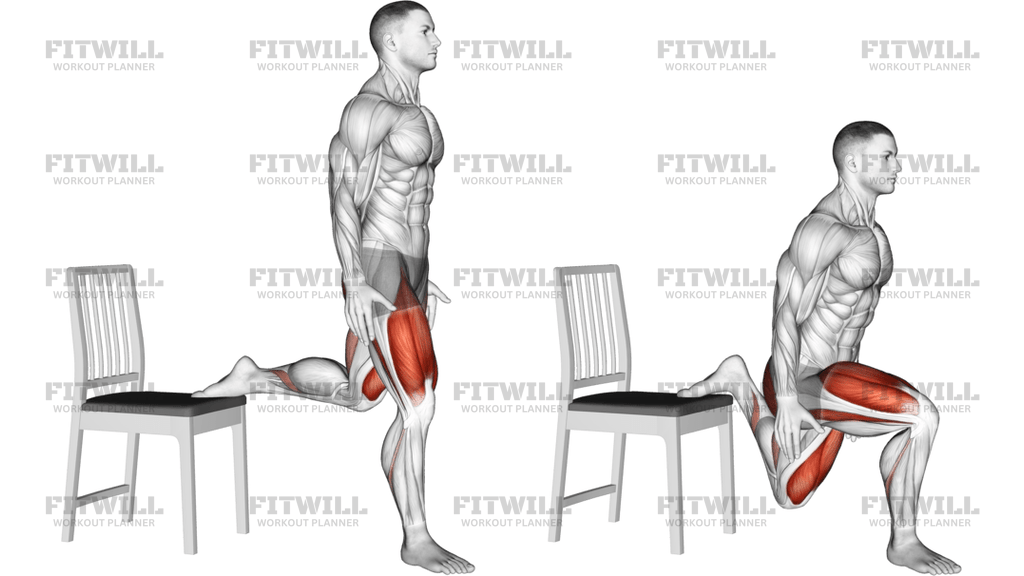
Bulgarian Split Squat With Chair is a rear-foot-elevated single-leg squat that uses a chair to put most of the work on the front leg. It is a body-weight strength exercise that builds the thighs and glutes while also challenging balance, hip control, and trunk stability. Because one foot stays elevated behind you, the exercise exposes left-to-right differences quickly and rewards clean, repeatable reps more than raw speed.
The front leg does the majority of the lifting, with the glutes and quads sharing the load and the hamstrings, core, and lower back helping you stay organized. In technical terms, the movement centers on the gluteus maximus with assistance from the quadriceps, biceps femoris, rectus abdominis, and erector spinae. The back leg should stay relaxed and mostly act as a support point, not a push-off leg.
Setup matters a lot on Bulgarian Split Squat With Chair. A sturdy chair, a stable rear-foot position, and the right front-foot distance determine whether the set feels smooth or awkward. If the front foot is too close, your knee drifts forward and the heel may lift; if it is too far away, you may lose range or feel stretched out in the hip flexor. A good setup lets you descend under control while keeping the front heel planted and the torso slightly inclined.
Lowering and rising should feel deliberate. Sink straight down between your front heel and the chair behind you, then drive the floor away through the front midfoot and heel. The front knee can travel forward as long as it tracks over the toes and the foot stays flat, but the torso should not collapse or twist. Breathing is simple: brace before the descent, inhale on the way down, and exhale as you stand.
This exercise fits well in lower-body strength work, accessory blocks, or unilateral training days when you want to build one leg at a time without a machine. It is also useful for athletes or lifters who need better single-leg stability and hip control. Beginners can use it with body weight only, or hold onto a wall or rack lightly at first, but the chair must be stable and the movement should stay pain-free and controlled from start to finish.
[ Workout Log & Planner ]
Put your next workout in Fitwill
Keep your plan and training log ready when you are.


Instructions
- Stand a comfortable stride in front of a sturdy chair and place the top of your back foot on the seat so the laces or instep rest on the chair.
- Set your front foot flat on the floor far enough away that you can lower without your heel lifting or your hips pitching forward.
- Square your hips and shoulders to the front, keep your torso tall, and brace your abdomen before you start each rep.
- Lower straight down by bending the front knee and hip, letting the back knee travel toward the floor as the front knee tracks over the toes.
- Keep most of your weight on the front foot and let the back leg stay relaxed instead of pushing off the chair.
- Descend until your front thigh is near parallel or the back knee comes close to the floor, whichever happens first without losing position.
- Drive up through the front heel and midfoot, squeezing the glute and quad of the front leg as you return to standing.
- Exhale as you stand, then reset your balance with both hips level before starting the next repetition.
- When the set is complete, lower the back foot carefully to the floor and step out of the split stance under control.
Tips & Tricks
- Use a chair that does not slide; placing it against a wall makes the rear foot position much safer.
- A slightly longer stance usually shifts more work to the glutes, while a shorter stance makes the front thigh work harder.
- If your front heel keeps popping up, move the front foot a little farther from the chair before you continue.
- Let the front knee travel forward naturally, but keep it tracking over the second and third toes instead of collapsing inward.
- Keep the back leg quiet. If you are pushing hard through the rear foot, the set is becoming more of a split squat than a rear-foot-elevated variation.
- A small forward lean from the hips is normal and helps load the front glute; rounding the lower back is not.
- Slow the lowering phase to about two or three seconds if you keep bouncing off the bottom or wobbling between reps.
- Hold onto a wall, rack, or doorway lightly only if balance is the limiter; use just enough support to keep the front leg doing the work.
- Body weight is enough for most beginners, but add dumbbells only after you can keep the chair position, knee path, and torso angle consistent.
Frequently Asked Questions
What does Bulgarian Split Squat With Chair work most?
It mainly trains the glutes and thighs of the front leg, with the quads doing a lot of the work and the hamstrings and core helping you stay stable.
How should my back foot sit on the chair in Bulgarian Split Squat With Chair?
The top of the back foot should rest on the chair seat so the rear leg stays supported without pushing you upward. The chair should be stable before you start.
How far should my front foot be from the chair?
Far enough that you can lower without the front heel lifting and without feeling cramped at the bottom. If the front knee shoots too far forward or the heel comes up, step the foot out a little farther.
Can beginners do Bulgarian Split Squat With Chair?
Yes. Start with body weight only and use a wall or rack for light balance support if needed, then build range and control before adding load.
Should I feel Bulgarian Split Squat With Chair more in my glutes or quads?
Both are involved, but a longer stance and slight forward torso lean usually bring the glutes in more, while a shorter stance tends to make the front thigh work harder.
How low should I go in Bulgarian Split Squat With Chair?
Lower until the front thigh is near parallel or the back knee is close to the floor, as long as the front heel stays down and your hips stay square.
Why does Bulgarian Split Squat With Chair bother my front knee?
The usual causes are a stance that is too short, the knee collapsing inward, or dropping too fast into the bottom. Adjust the foot distance and slow the descent.
What can I use instead of a chair for Bulgarian Split Squat With Chair?
Any sturdy bench or low box that keeps the back foot elevated at a comfortable height can work, as long as it does not move while you train.