Butt-Ups
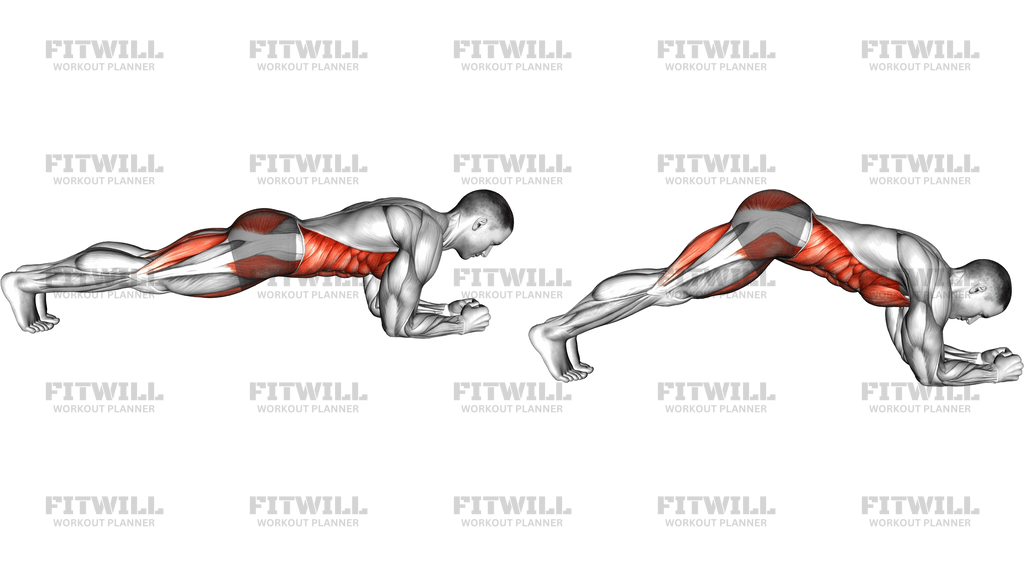
Butt-Ups are a bodyweight core exercise performed from a forearm plank. You start in a long plank on your forearms and toes, then lift the hips toward the ceiling to form a pike or inverted-V shape before lowering back to the plank. The movement looks simple, but the value comes from keeping the trunk organized while the hips travel through a controlled arc.
This exercise strongly emphasizes the abs, with the obliques and hip flexors helping to control the rise and return. In anatomy terms, the rectus abdominis does most of the work, with support from the external obliques, iliopsoas, and transversus abdominis. Because the shoulders and forearms stay fixed, the rep becomes a good test of whether the core can shorten and lengthen without the low back taking over.
The starting position matters. A solid forearm plank gives you the baseline tension you need for a smooth first rep: elbows under the shoulders, forearms planted, legs straight, toes tucked, and the head in line with the spine. From there, the hips should rise by curling the pelvis upward, not by collapsing into the shoulders or swinging the legs. That setup keeps the movement honest and protects the lower back from overextension.
At the top, the body should look compact and controlled rather than jammed together. Then lower the hips back to a straight plank with the same deliberate tempo, stopping before the lumbar spine sags. Butt-Ups are useful in core-focused sessions, warmups, and accessory blocks when you want abdominal control, shoulder stability, and a strong anti-extension challenge instead of heavy external resistance.
Treat each repetition like a clean shape change: plank to pike, pike back to plank. If the range gets short, the neck tenses, or the lower back starts to arch, the set is no longer doing the job. Choose a pace that lets you feel the abs initiate the lift and own the lowering phase all the way back to the start.
[ Workout Log & Planner ]
Put your next workout in Fitwill
Keep your plan and training log ready when you are.


Instructions
- Start in a forearm plank with your elbows under your shoulders, forearms flat, toes tucked, and legs straight behind you.
- Brace your abs, squeeze your glutes lightly, and keep your head in line with your spine before you move.
- Press your forearms into the floor and lift your hips toward the ceiling, folding at the waist until your body makes an inverted V.
- Keep your legs mostly straight as you raise the hips, letting the heels travel back as the pelvis tips upward.
- Pause briefly at the top with the ribs pulled in and the neck relaxed.
- Lower the hips back down under control until you return to a long, straight forearm plank.
- Keep breathing through the rep, exhaling as you lift and inhaling as you lower.
- Reset the plank position before starting the next repetition.
Tips & Tricks
- Think about curling your pelvis upward rather than just throwing your hips into the air.
- Keep pressure through the forearms so the shoulders stay active instead of shrugging.
- Do not let the lower back sag on the way down; the rep should finish in a true plank.
- A short pause at the top makes the abs work harder without needing speed.
- If your hamstrings are tight, slightly soften the knees instead of forcing a rigid straight-leg pike.
- Keep the chin tucked slightly so the neck does not crank upward as the hips rise.
- Use a slow lowering phase to make the core control the return to plank.
- Stop the set when you can no longer keep the torso stable and the hips start swinging.
Frequently Asked Questions
What muscles do Butt-Ups work most?
They mainly train the rectus abdominis, with the obliques and hip flexors helping to lift and control the hips.
Can beginners perform this exercise?
Yes, but beginners should use a short range, steady tempo, and a strong forearm plank before trying full reps.
What should my starting position look like?
Set your elbows under your shoulders, keep your forearms planted, tuck your toes, and hold a straight line from shoulders to heels.
Why do my hips need to rise in a pike instead of just bouncing?
The pike position forces the abs to shorten the torso under control, while bouncing usually turns the rep into momentum.
Should my legs stay straight during Butt-Ups?
Mostly yes, but a slight knee bend is fine if it helps you keep the pelvis rolling upward without losing control.
What is the biggest form mistake to avoid?
Letting the lower back sag on the way down is the main mistake, because it shifts the work away from the abs.
Can I use Butt-Ups in a warmup or core circuit?
Yes, they fit well in core circuits, warmups, and accessory work when you want trunk control rather than heavy loading.
How do I make the exercise harder without adding weight?
Slow the lowering phase, add a brief pause at the top, or extend the set only while the plank stays clean.