Dumbbell Side Plank (Version 2)
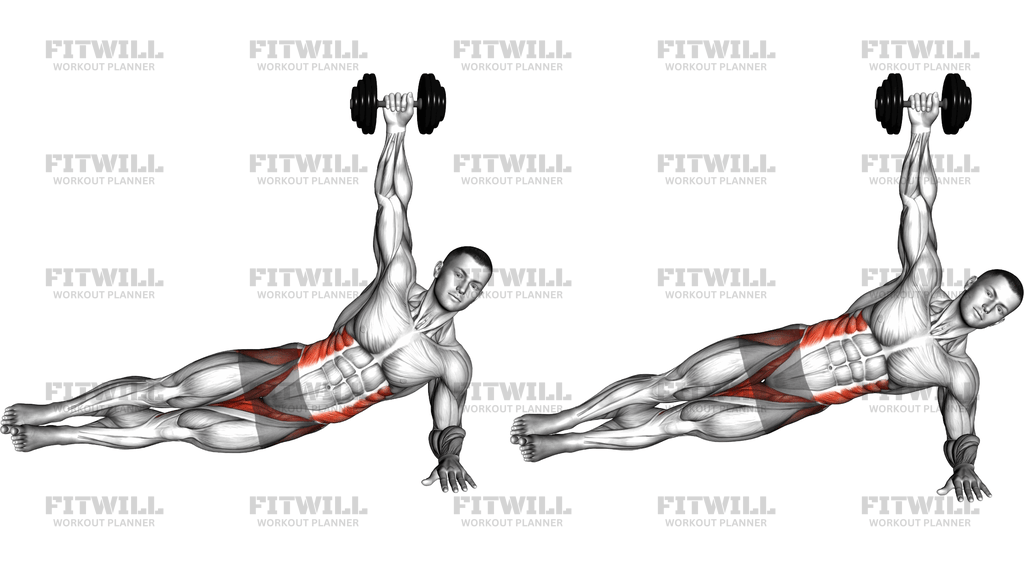
The Dumbbell Side Plank (Version 2) is an anti-lateral-flexion hold performed on the straight arm rather than the forearm, with the top hand pressing a dumbbell vertically toward the ceiling. Supporting yourself on the extended arm raises your torso higher off the floor, lengthens the lever, and adds an overhead-stability demand that the forearm version does not have. The result is a side plank that challenges your obliques, your shoulder, and your ability to keep a long, rigid line from heel to fingertips all at the same time.
This movement is especially useful for anyone who needs strong, resilient lateral core muscles: lifters who want to protect their spine under squats and deadlifts, fighters and racket-sport players who absorb force on one side at a time, and runners who need their hips to stay level through thousands of strides. Because each set works one side independently, it also exposes and helps correct left-to-right differences in trunk strength, which is one of the most common hidden weak points in regular training.
The primary workload lands on the obliques on the underside of your trunk, with the deeper abdominal wall and the quadratus lumborum working to hold the pelvis and spine in alignment. The bottom shoulder stabilizes the whole position, the glutes on the low side keep the hips from sagging, and the top arm turns the set into a shoulder-endurance exercise as it holds the dumbbell stacked over the shoulder joint. Everything has to cooperate, or the line breaks.
Setup matters more here than in most core work. Your supporting hand should sit directly under your shoulder so the joint, not the muscle, carries the skeletal load, and your feet should be stacked or staggered with the body in one flat plane. The dumbbell should start directly above the top shoulder, not drifted behind your head or forward over your chest, so that the weight loads the pillar instead of twisting it. Choose a light dumbbell at first; the hold quality falls apart quickly when the load is too heavy.
To execute it well, drive the floor away with the supporting hand, lift the hips until the body forms a straight line, and press the dumbbell toward the ceiling as if pushing it through the ceiling. Breathe steadily without letting the ribs flare or the hips drift backward, and hold for time rather than racing through reps. When the hips begin to sink or the wrist on the supporting arm starts to ache, end the set and reset rather than grinding through a collapsed position.
In practice, this exercise works well as a finisher after heavy lower-body training, as a dedicated core station in a full-body session, or as a corrective tool in warm-ups when programmed with light weight and short holds. Start with 15 to 30 seconds per side and progress by extending the hold or adding a small amount of weight before ever combining both.
Fitwill
Log Workouts, Track Progress & Build Strength.
Achieve more with Fitwill: explore over 9600 exercises with images and videos, access built-in and custom workouts, perfect for both gym and home sessions, and see real results.
Start your journey. Download today!




Instructions
- Place an exercise mat on the floor and set a light dumbbell next to your hip on the side that will become your top arm.
- Lie on your side with your legs fully extended and stacked, and position your lower palm flat on the mat directly beneath your shoulder, elbow locked out straight.
- Pick up the dumbbell with your top hand and rest it on your hip or hold it at your top shoulder while you find your balance.
- Brace your abdominal wall as if bracing for a light push, and squeeze your glutes on the lower side before you lift.
- Push the floor away through your supporting hand and raise your hips until your body forms one straight line from heels to head.
- Press the dumbbell straight up so it stacks directly over your top shoulder, wrist neutral and palm facing forward or slightly inward.
- Hold this position, keeping the hips lifted and both shoulders in a vertical line over the supporting hand, without letting the torso rotate toward the floor or the ceiling.
- Breathe in a slow, steady rhythm through the hold, exhaling gently through the nose so the brace does not collapse.
- To finish, lower the hips back to the mat under control, set the dumbbell down, then switch sides so the other arm supports and the other hand presses.
- Rest briefly between sides and reset your shoulder position and brace before starting the next hold.
Tips & Tricks
- If the dumbbell drifts behind your head, the set is usually too heavy; drop the weight until you can hold it stacked over the top shoulder for the entire duration.
- Hips sagging toward the floor mid-hold is the most common failure point. Cue yourself to push the mat away with the supporting hand and squeeze the bottom glute to lift back to level.
- Rotating the chest toward the ceiling turns this into a twisting exercise and unloads the obliques. Face straight ahead and keep the front and back of your body in one plane.
- Keep the supporting elbow fully locked. A soft elbow forces the triceps and shoulder to work overtime and makes the wrist take a beating.
- If your supporting wrist hurts, spread the fingers wide and grip the mat, or briefly transition to a forearm support until your wrist tolerance improves.
- Stack your feet directly on top of each other for the strictest version; if balance is the limiter, stagger the top foot just in front of the bottom foot without letting the hips twist.
- Do not hold your breath. A breath you cannot sustain for the whole hold is a sign the brace is too aggressive for the duration.
- Match hold times between sides exactly, and always start your second set on the weaker side so any imbalance gets extra work.
- Progress one variable at a time: extend the hold first, then add 1 to 2 kg to the dumbbell, rather than increasing both together.
Frequently Asked Questions
Which muscles does the Dumbbell Side Plank (Version 2) work the most?
The obliques on the underside of your trunk do the main work of holding your body in a straight line. The deep abdominal wall, the quadratus lumborum, the bottom glutes, and the top shoulder stabilizers all contribute significantly.
Why support on a straight arm instead of the forearm in this version?
The extended arm raises your torso higher, lengthens the lever your obliques must control, and adds a shoulder-stability job through the supporting joint. It is a harder progression, not just a variation.
How heavy should the dumbbell be?
Start with 1 to 4 kg, or even no dumbbell at all, and only add weight once you can hold the position with the arm stacked over the shoulder for 30 seconds without the hips dropping. Weight should never cost you the straight body line.
Is the Dumbbell Side Plank (Version 2) suitable for beginners?
Beginners should first master a standard side plank from the knees or forearms. Once you can hold a solid forearm side plank for 30 seconds per side, this straight-arm version with a very light dumbbell is a reasonable next step.
How long should I hold each side?
Start with 15 to 30 seconds per side for 2 to 3 sets. When you can hold 45 to 60 seconds with clean hips and the dumbbell stacked, progress the weight instead of the time.
My hips drop after a few seconds. What should I change?
That usually means the hold is too long, the dumbbell is too heavy, or the supporting hand has drifted out from under the shoulder. Shorten the set, lighten the load, and reposition the hand directly beneath the shoulder before each lift.
Can I do this exercise if my wrist bothers me in a push-up position?
Wrist discomfort is common with straight-arm supports. Spreading the fingers and gripping the mat helps, but if the pain persists, use a forearm-supported version instead and build wrist tolerance separately.
What can I substitute if I do not have a dumbbell?
A simple straight-arm side plank with the top arm reaching toward the ceiling trains the same anti-lateral-flexion pattern. A small plate, a kettlebell, or a water bottle can also work as the top-hand load.
Should my feet be stacked or staggered?
Stacked feet make the hold stricter and load the obliques more; staggering the top foot slightly in front widens the base and helps with balance. Either is acceptable, but avoid letting the stagger become a hip twist.
Is it safe to hold weight overhead in this position?
It is safe when the dumbbell stays stacked over the top shoulder and the weight is modest. Stop the set as soon as the arm drifts, the shoulder rolls forward, or the hips collapse, since those are the points where the position stops being controlled.