Dumbbell Kneeling Opposite Shoulder Press
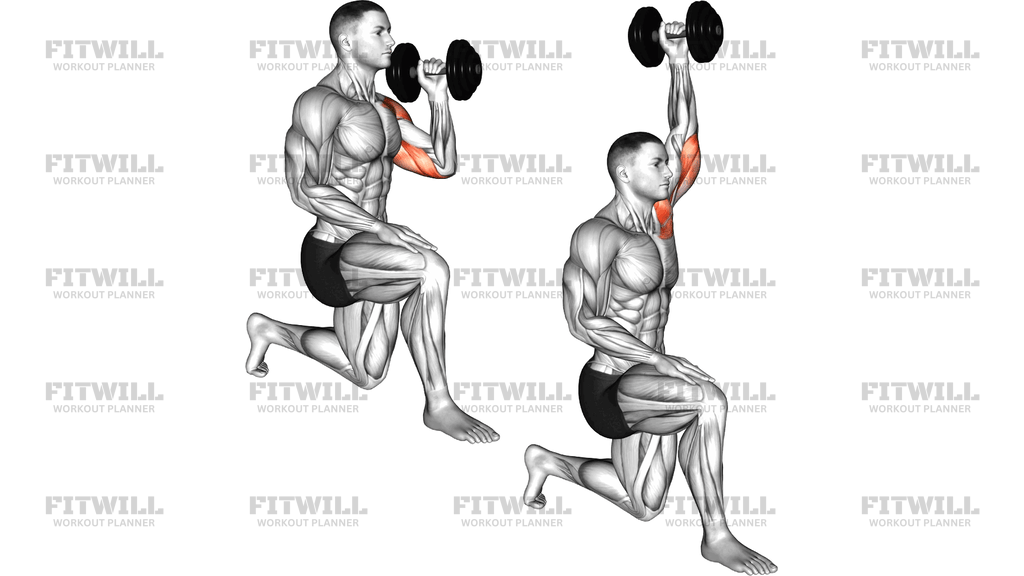
The Dumbbell Kneeling Opposite Shoulder Press is a single-arm overhead press performed from a half-kneeling position, with the pressing arm working on the opposite side of the body from the kneeling leg. So if your left knee is down, your right hand drives the dumbbell overhead, and vice versa. This crossed-leg, crossed-arm setup might look unusual, but it does something a seated or standing press cannot: it removes momentum from your legs and forces your trunk to organize itself around a diagonal line of support.
The main work is done by the deltoids pressing the weight and the triceps finishing the lockout, but the real value sits in the middle of your body. Because you only have one knee on the floor and one dumbbell loaded on one side, your obliques and deep core have to resist rotation and side-bending on every rep. The front-foot glute and the down-knee hip also stay busy stabilizing your base. It is a pressing exercise and an anti-rotation drill at the same time.
This variation suits lifters who want a strict overhead press without a backrest to hide behind, as well as anyone addressing left-to-right differences in shoulder strength or trunk control. It is a common choice in rehab-informed and athletic training settings precisely because the half-kneeling stance discourages arching the lower back and leaning into the press. If you usually press a barbell or two dumbbells and notice one arm doing extra work, this movement will expose that quickly.
Setup matters more here than in most presses. Your front shin should stay roughly vertical, your down knee planted directly under your hip, and your ribs stacked over your pelvis before the dumbbell ever moves. Many people place the hand of the non-working arm on the front knee, which gives a light reference point for staying tall and square to the front. Rushing into the set without building this base is the fastest way to turn a core-stability press into a wobbly, hip-driven shove.
Execution is deliberately simple: press the dumbbell from shoulder height to a full overhead lockout, keep your torso facing forward, and lower it with control back to the start. Breathe out on the way up, in on the way down, and complete all reps on one side before switching legs and arms. Because the position is demanding, most lifters get more out of moderate loads and crisp reps than from heavy weights pressed with a twisting torso.
[ Workout Log & Planner ]
Put your next workout in Fitwill
Keep your plan and training log ready when you are.


Instructions
- Kneel on one knee with the shin and foot of that leg resting on the floor behind you, and place the opposite foot flat on the floor in front of you so the front knee bends to about 90 degrees with the shin vertical.
- Hold a dumbbell in the hand on the opposite side of your body from the kneeling leg, raising it to shoulder height with your palm facing forward and your elbow tucked slightly in front of your ribs.
- Rest your free hand lightly on top of your front knee to help keep your chest and shoulders square to the front.
- Tall through the spine, brace your abs and glutes so your ribs stack over your pelvis and your hips stay level.
- Press the dumbbell straight up, keeping your torso from twisting, until your arm is fully extended overhead with the weight over your shoulder and your bicep near your ear.
- Pause briefly at the top without shrugging the dumbbell forward or letting your back arch.
- Lower the dumbbell under control back to shoulder height, letting your elbow travel down and slightly in rather than flaring wide.
- Exhale as you press and inhale as you lower, keeping the breath steady rather than holding it.
- Complete all reps on one side, then switch legs and arms so the opposite shoulder presses from the mirrored stance.
- Reset your stance and brace between sets rather than sliding straight into the next side with a loose torso.
Tips & Tricks
- If your torso twists toward the dumbbell as you press, drop the weight slightly — the rotation usually means the load exceeds what your obliques can control in this stance.
- Keep the front shin vertical and the front heel down; letting the knee drift forward past the toes shifts you onto your toes and steals the stable base the press depends on.
- Check your down knee: it should sit under your hip, not behind it. A knee planted too far back turns the position into a low lunge and encourages lower-back arch.
- The hand on the front knee is a guide, not a crutch — press into it lightly for feedback, but do not push off it to help the dumbbell up.
- Think of pressing the dumbbell toward the ceiling directly above your shoulder joint, not out in front of your face; finishing with the weight over the shoulder keeps the deltoids and triceps doing the work.
- If your shoulder pinches at the bottom of the rep, narrow the path slightly by bringing the elbow a touch closer to your ribs before pressing instead of pressing from a fully flared position.
- Squeeze the glute of the down-knee leg the whole set; it locks the pelvis in place and stops the hip from tilting as the weight goes overhead.
- Start with your weaker or less coordinated side first and match the reps with the stronger side so differences even out over time.
- A mat or folded towel under the down knee is worth it if the floor is hard — discomfort there will pull your attention away from pressing with a braced torso.
Frequently Asked Questions
Which shoulder should press in the Dumbbell Kneeling Opposite Shoulder Press?
The arm opposite your kneeling leg does the pressing. If your left knee is on the floor, your right hand holds the dumbbell, then you switch sides for the mirror-image set.
What muscles does the Dumbbell Kneeling Opposite Shoulder Press work?
The front and side of the shoulder do most of the pressing, with the triceps locking the arm out. The obliques and deep core work continuously to stop your torso from rotating or side-bending under the single-sided load.
Why do this instead of a regular seated dumbbell press?
The half-kneeling stance removes the backrest, so you cannot arch or lean to cheat the weight up, and the crossed leg-and-arm setup adds an anti-rotation demand a two-arm press doesn't have. It is a stricter press that also trains trunk control.
Is the Dumbbell Kneeling Opposite Shoulder Press good for beginners?
Yes, provided you start light. The position itself teaches good pressing posture, but beginners should master a balanced half-kneel with no weight or a very light dumbbell before adding load.
Why does my lower back arch when I press overhead?
That usually means the bracing has lapsed or the weight is too heavy, so your body substitutes a back extension for shoulder range. Squeeze the glute of the kneeling leg, keep the ribs down, and reduce the load until you can press with a tall torso.
My torso twists toward the dumbbell on every rep — how do I fix it?
Slow the pressing tempo down and keep your free hand resting on the front knee as a reference point. If twisting persists, the weight is likely too heavy for your core to control, so drop it a size and rebuild.
Should the front knee be at 90 degrees?
Roughly, yes. Aim for a front shin that is close to vertical with the knee stacked over the ankle, which gives you a stable base without jamming the knee or rocking onto your back foot.
Can I do the Dumbbell Kneeling Opposite Shoulder Press with a kettlebell instead?
You can, and a kettlebell sits nicely in the rack position at the shoulder, though its offset handle changes the feel slightly. A dumbbell keeps the movement as described and is the standard choice.
How heavy should I go on this exercise?
Choose a weight you can press for clean reps with zero torso rotation — typically less than you would use for a seated one-arm press. If your body starts twisting or your hip shifts, the load has passed what your core can stabilize.
Is it safe to kneel directly on a hard floor?
It is not dangerous, but it is uncomfortable and can distract you from pressing form, so place a mat or folded towel under the down knee. Keep the pressure on the soft part of the knee rather than the kneecap.