Dumbbell Standing Around Head Rotation
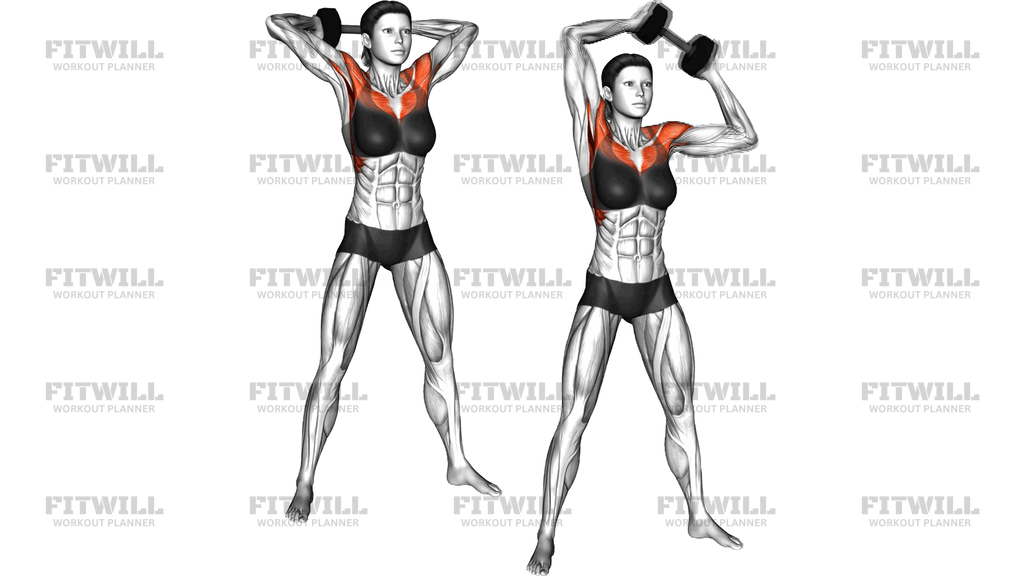
The Dumbbell Standing Around Head Rotation is a standing rotational drill in which you hold a single dumbbell with both hands and trace a smooth circle around your head. You start with the dumbbell behind your neck, elbows bent and flared out to the sides, then sweep it past one ear, around in front of your face, past the other ear, and back behind your neck. Because the weight is always offset from your midline, your shoulders have to steer it precisely while your trunk and legs keep you from leaning or twisting along with it.
This movement trains the deltoids through an unusual arc, and it asks a great deal of the rotator cuff and upper traps, which control the small adjustments that keep the dumbbell tracking close to your head. Your grip and forearms work to hold the dumbbell securely, and your obliques and deep core stay braced the entire time to keep your ribcage stacked over your hips. It is especially useful as a warm-up before overhead pressing, as a control exercise for people whose shoulder work is all presses and raises, and for anyone who wants their shoulders comfortable with rotational paths rather than just straight up-and-down ones.
The setup matters more than it looks. A stance slightly wider than shoulder width gives you a stable base, and a light dumbbell lets the circle come from your shoulder joints rather than from swaying your torso. Hold the dumbbell by the handle or the head of the weight with both hands wrapping around it, and lift your elbows so the dumbbell settles behind your head, not behind your lower neck.
Execution is about consistency of the arc. Keep the elbows bent at roughly the same angle for the whole circle, keep the weight within a few inches of your head, and move slowly enough that you could stop at any point in the rotation. Once one full circle is complete, reverse direction and go the other way so both shoulders experience the same path in both rotational orders.
Treat this as a precision exercise, not a strength grind. Two to five kilograms is plenty for most people, and if you feel pinching at the front of the shoulder or notice your lower back arching as the weight passes overhead, reduce the load or the circle size. Your head should stay still and face forward while the dumbbell moves around it, not the other way around.
[ Workout Log & Planner ]
Put your next workout in Fitwill
Keep your plan and training log ready when you are.


Instructions
- Stand with your feet slightly wider than shoulder width, toes turned out a few degrees, and hold one dumbbell with both hands by the handle or the head of the weight.
- Raise the dumbbell and bend both elbows so the weight rests behind your head at the base of your skull, with your elbows pointing up and out to the sides.
- Brace your abdominal muscles, pull your ribs down, and settle your shoulders away from your ears before the circle begins.
- Keeping the elbows bent at a fixed angle, sweep the dumbbell out and around toward one ear so it passes the side of your head.
- Continue the arc in front of your face at about forehead height, staying close to your head the whole way, then carry it past the opposite ear.
- Finish the circle by bringing the dumbbell back behind your head to the starting position, completing one full revolution.
- Reverse direction and circle the dumbbell back the other way, so the same number of revolutions go clockwise and counterclockwise.
- Exhale steadily as the weight travels around the front of your face, and inhale as it returns behind your head.
- Keep your head level and facing forward throughout, letting the dumbbell move around your head rather than turning to follow it.
- Between sets, lower the dumbbell with both hands under control and reset your stance and brace before the next round.
Tips & Tricks
- The most common mistake is going too heavy; a weight you can barely lift overhead will turn the circle into a series of jerks and force your torso to sway, so drop to a dumbbell you could hold at ear height for thirty seconds.
- If your elbows drift up and down during the circle, the arc is coming from your elbows instead of your shoulder joints—pick an elbow bend and hold it like a hinge for every rep.
- Watch for the weight cutting a wide corner in front of your face; an arc that swings far forward means your shoulders are sacrificing control, so shrink the circle until the dumbbell stays within a hand's width of your head.
- Shrugging as the weight passes overhead is a sign your upper traps are taking over; consciously press your shoulder blades down before each set and keep them there.
- An arching lower back usually appears when the dumbbell passes behind the head—tighten your glutes slightly and keep your ribs stacked over your pelvis to stop it.
- Do not turn or tilt your head to track the dumbbell; fix your gaze on a spot straight ahead at eye level so your neck stays neutral while the weight circles it.
- Start each set in the direction that feels less coordinated and do equal revolutions both ways, since the weaker rotational path usually needs the extra practice.
- If you feel a pinch at the front of one shoulder, raise the arc slightly or reduce the range on that side rather than pushing through the uncomfortable zone.
- Tempo is your quality check: a full circle should take three to four seconds, and if you are finishing faster than that, the weight is likely too light for you to feel or too heavy for you to control—adjust accordingly.
Frequently Asked Questions
Which muscles does the Dumbbell Standing Around Head Rotation work?
The deltoids of both shoulders do most of the steering, with strong support from the rotator cuff and upper traps. Your forearms and grip hold the dumbbell, while the obliques and deep core work isometrically to keep your torso from rotating with the weight.
How heavy should the dumbbell be for this exercise?
Most people do well with something between two and five kilograms. If you cannot complete a slow, smooth circle without your torso swaying or your elbows flapping, the weight is too heavy regardless of how strong you are on presses.
Should I circle the dumbbell clockwise or counterclockwise first?
Start with whichever direction feels less natural, then perform equal revolutions each way. Rotating the weaker or stiffer direction first ensures you do not skimp on it once fatigue sets in.
How is the Dumbbell Standing Around Head Rotation different from a halo?
A halo is usually done with a plate or light weight and emphasizes a fast, continuous circle around the neck. This version uses a dumbbell held in both hands with bent elbows, which places more demand on shoulder rotation and control and typically calls for a slower tempo.
Where should I grip the dumbbell during the rotation?
Hold the handle or the head of the dumbbell with both hands, one on each side, fingers wrapped securely around it. A two-handed grip keeps the weight balanced as it travels around your head, which a one-handed hold cannot do safely.
Why does my lower back arch when the dumbbell goes behind my head?
Your core is likely letting go as the weight moves behind your midline. Brace your abdominals, squeeze your glutes lightly, and slightly reduce how far the dumbbell travels back until you can hold a tall ribcage through the whole circle.
Can beginners do the Dumbbell Standing Around Head Rotation?
Yes, and it is actually a good early shoulder exercise because the light load exposes control problems right away. Begin with a very light dumbbell or even no weight, master the circular path, and only then add load.
What can I use if I do not have a dumbbell?
A small kettlebell held by the horns, a light plate, or a weighted ball all work, as long as the object is compact enough to pass close to your head. You can also practice the movement with no equipment to learn the path first.
How many reps and sets should I do?
Two to three sets of five to eight full circles in each direction is a solid working range. Keep the tempo slow, and treat the last reps the same as the first—if the circle gets sloppy, stop the set.
My shoulder clicks or pinches during the rotation—should I keep going?
Adjust the arc height or circle size first, and if the discomfort persists, stop and get the shoulder assessed by a qualified professional before continuing. Persistent pinching during rotational work is a signal to modify, not push through.