Dumbbell Standing Cross Clean
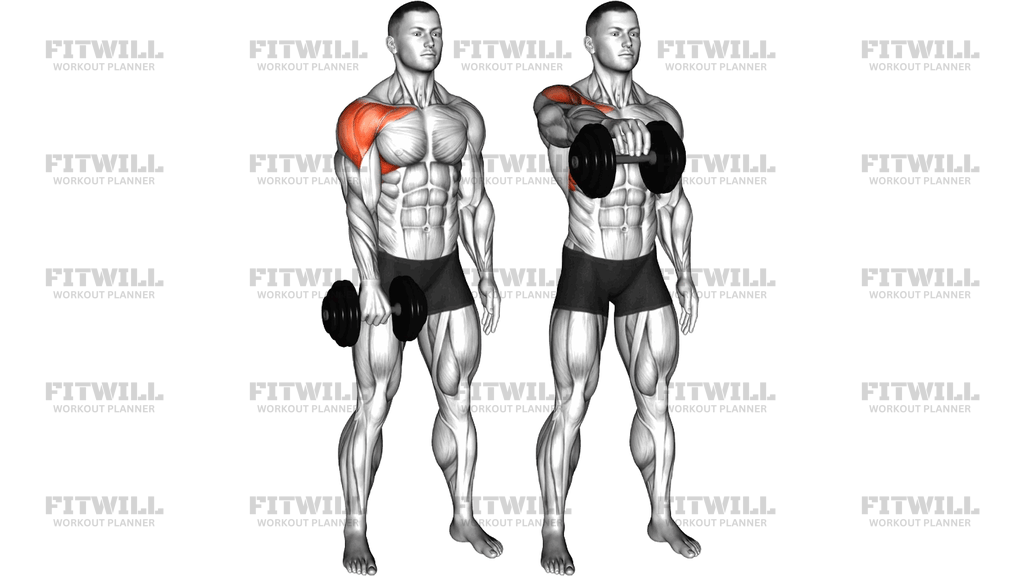
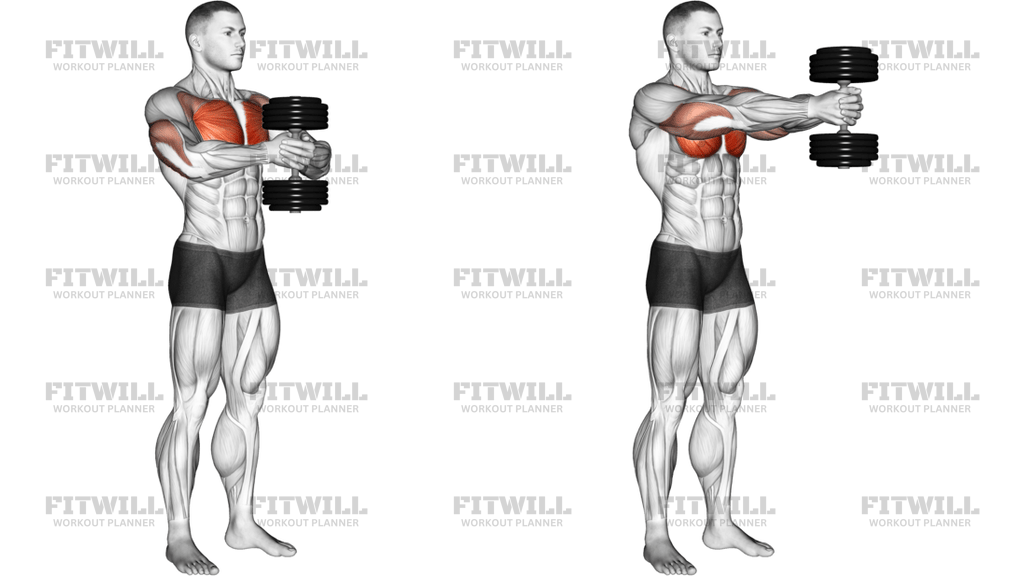
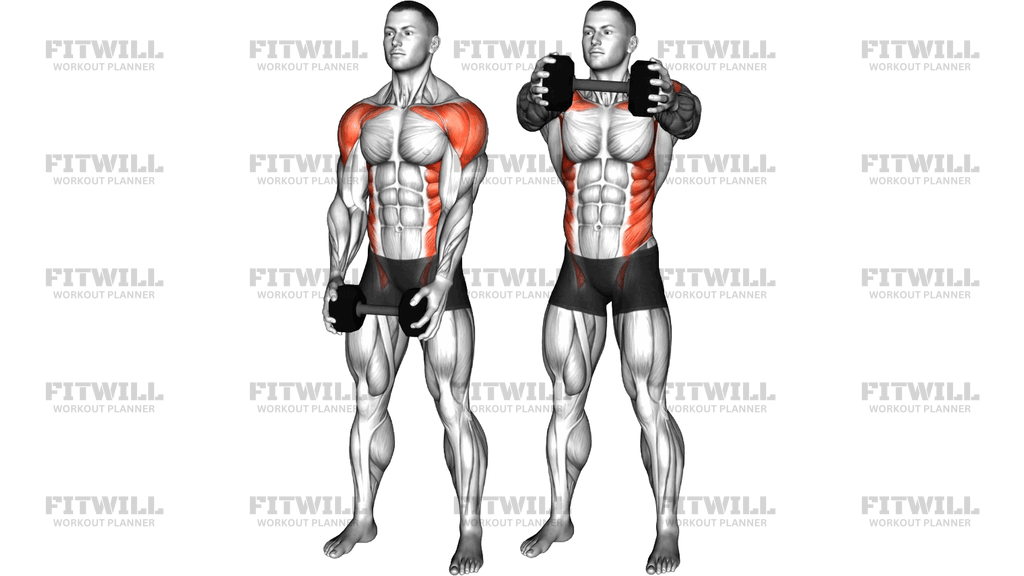
The Dumbbell Standing Cross Clean is a standing front raise variation where you hold a single dumbbell with both hands crossed over each other at the handle, then lift it from your thighs straight up along the midline of your body until it reaches chest or collarbone height. Because both hands share one weight and the wrists cross, the load sits slightly off-center relative to each arm, which forces the front shoulders to work evenly while the obliques and deep core fight to keep your torso from rotating or leaning.
This movement works best as a focused shoulder and trunk-stabilization exercise. The front delts do most of the lifting as the arms travel up, the upper traps assist near the top, and the forearms and grip stay busy holding the dumbbell steady in the crossed position. The obliques on both sides of your waist are under constant demand because the crossed-hand setup pulls your shoulders slightly out of alignment every time you raise the weight.
Setup matters more here than in a standard front raise. Your feet should be planted about hip-width apart, the dumbbell held horizontally with one hand over the other, and your spine tall before the first rep. If you start loose or slouched, the first lift will pull your chest forward and turn the movement into a momentum-driven swing rather than a controlled clean.
To execute it well, think of the dumbbell traveling up a straight vertical track in front of your sternum. Raise it with arm strength, not a hip snap or torso lean, pause briefly at the top, and lower it under control back to your thighs. The tempo on the way down is where most of the stabilization benefit lives, so resist the urge to drop the weight quickly.
This lift suits lifters who want to break up a stale shoulder routine, add an anti-rotation challenge to a front raise, or train both arms through one shared implement. It fits well as an accessory after heavier pressing work, or as part of a core-and-shoulders circuit. Because the load is limited by how much weight you can control with a crossed grip, keep expectations realistic and treat it as a precision movement, not a max-effort lift.
For safety, start lighter than you think you need. The crossed grip changes how the dumbbell sits in your hands, and a weight that feels easy in a normal front raise can feel awkward and pull your wrists into odd angles here. If you feel strain in your wrists or lower back rather than your shoulders and waist, reduce the load or slow the tempo before adding weight.
[ Workout Log & Planner ]
Put your next workout in Fitwill
Keep your plan and training log ready when you are.


Instructions
- Stand with your feet about hip-width apart, knees soft but not bent, and hold one dumbbell horizontally in front of your thighs with both hands.
- Grip the handle with your hands crossed over each other, one hand on each end of the dumbbell, and let your arms hang fully extended.
- Stand tall, lift your chest, pull your shoulder blades gently back, and brace your abdominal wall as if preparing for a light push to the midsection.
- Exhale and raise the dumbbell straight up along the midline of your body, keeping your arms nearly straight and the weight close to your torso.
- Stop when the dumbbell reaches shoulder or collarbone height, with your elbows slightly bent and pointed down or just above wrist level.
- Pause for one second at the top and feel your front shoulders and the sides of your waist holding the position without letting your torso twist.
- Inhale and lower the dumbbell slowly along the same vertical path back to the starting position at your thighs, taking two to three seconds.
- Keep breathing steadily on each rep, exhaling up and inhaling down, and avoid holding your breath through the set.
- Complete your planned reps, then switch which hand is on top of the crossed grip for the next set so both sides work symmetrically.
Tips & Tricks
- The most common mistake is turning this into a swing by popping the hips at the start. If the dumbbell gets moving before your arms pull, drop the weight until your shoulders alone can lift it.
- Keep the dumbbell tracking in front of your sternum, not drifting out in front of your face. A forward drift turns the movement into a partial raise and unloads your core.
- Do not shrug the weight up with your upper traps. If your shoulders creep toward your ears at the top, consciously press them down before starting the next rep.
- Your wrists will want to bend backward under the crossed grip. Hold the handle firmly in the middle of your palm and keep your knuckles facing forward so the joints stay stacked.
- One hand usually dominates the crossed grip, so the dumbbell can tilt slightly on each rep. Watch for a crooked bar or uneven hand height and adjust your grip before continuing.
- Control the descent for a two to three second count. Letting the dumbbell free-fall back to your thighs removes most of the oblique and shoulder-stabilizing work.
- Avoid locking your knees hard or arching your lower back as the weight rises. A soft knee and a braced midsection keep the strain on your shoulders and waist.
- If your grip gives out before your shoulders fatigue, chalk up or use a dumbbell with a thicker, knurled handle rather than switching to a heavier weight.
- Alternate the top hand between sets. Always lifting with the same hand on top builds a subtle side-to-side imbalance over weeks of training.
Frequently Asked Questions
Which muscles does the Dumbbell Standing Cross Clean work?
The front shoulders do most of the lifting as the dumbbell travels from your thighs to collarbone height. The obliques and deep core stabilize your torso against the crossed grip, while the upper traps, forearms, and grip assist throughout.
Why is the dumbbell held with crossed hands instead of a normal grip?
The cross grip places the shared load slightly off-center for each arm, so neither side can compensate for the other and your core must resist rotation. It also forces a stricter vertical path than a regular front raise.
Is the Dumbbell Standing Cross Clean good for beginners?
Yes, as long as the weight is light. Beginners should master a controlled, straight vertical path with a very manageable dumbbell before increasing load, since the crossed grip feels awkward at first.
How heavy should the dumbbell be for this exercise?
Choose a weight you can raise smoothly to collarbone height for 10 to 15 reps without hip drive, torso lean, or wrist bending. Because the crossed grip is less stable than a standard hold, start noticeably lighter than your usual front raise weight.
How is this different from a standard dumbbell front raise?
A standard front raise uses one dumbbell per hand with independent arms, while the Cross Clean uses a single dumbbell with crossed hands on a shared vertical path. This adds an anti-rotation demand on the obliques and prevents your stronger arm from taking over.
What should I do if my wrists feel strained during the movement?
Check that the handle rests across the middle of your palms and that your knuckles face forward rather than letting the wrists collapse backward. If the ache continues, use a lighter dumbbell or a handle with a larger diameter.
Can I substitute a plate or kettlebell for the dumbbell?
A weight plate held at its edges with crossed hands is a reasonable substitute and keeps a similar load path. A kettlebell works less well because its offset center of gravity changes the feel of the lift considerably.
Where should this exercise go in my workout?
It works best as an accessory after your main pressing or shoulder exercises, when you want targeted front delt work with an added core challenge. It also fits well at the end of a session as a controlled, moderate-load finisher.
Should my elbows be locked straight at the top of the rep?
No, keep a small, consistent bend in your elbows throughout. Fully locking the elbows at the top stresses the joint without adding meaningful shoulder involvement, and a soft elbow lets you control the weight better on the way down.