Dumbbell Overhead Split Squat
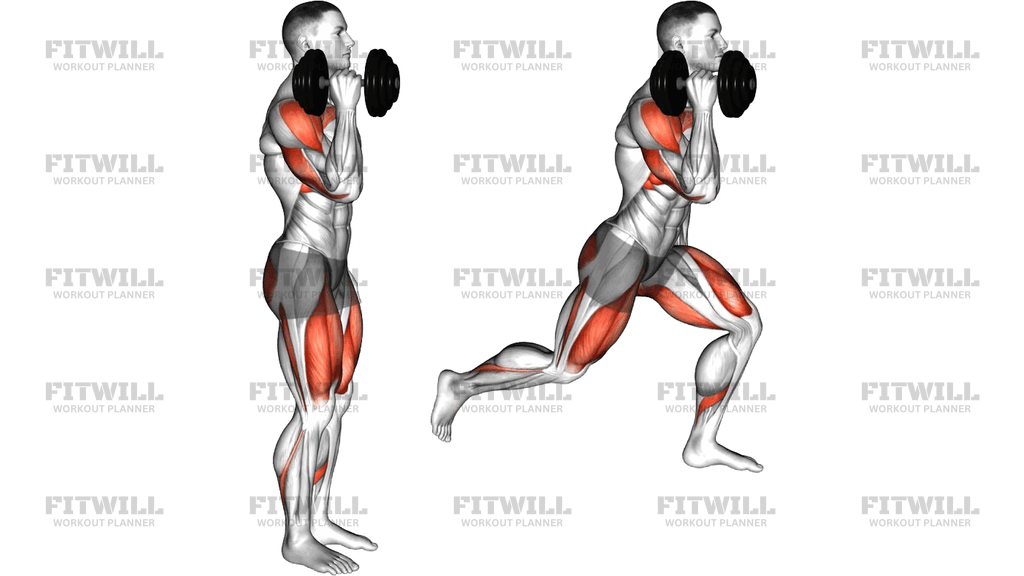
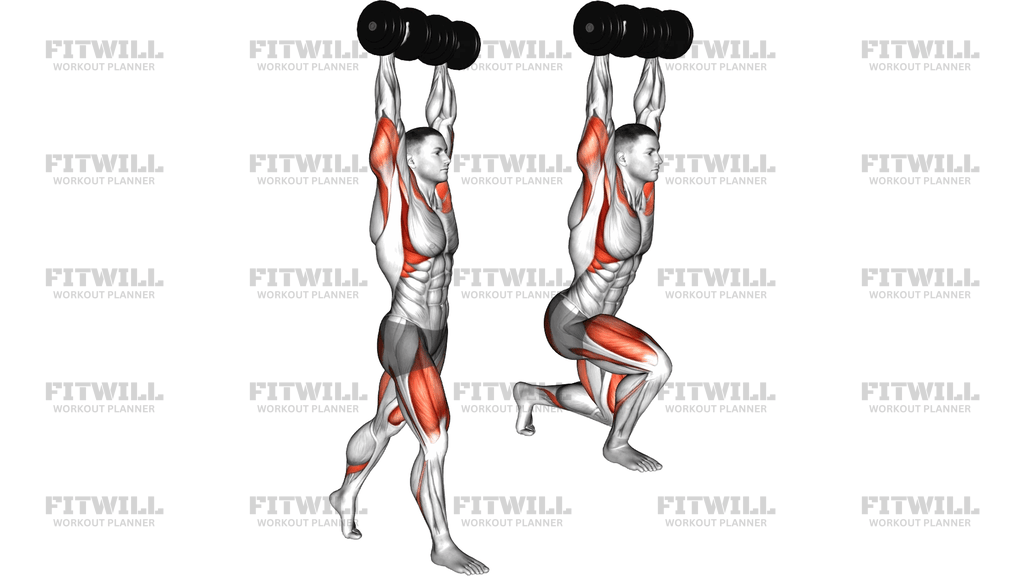
The Dumbbell Overhead Split Squat combines two demanding elements into one movement: a split-stance squat that loads the front leg through a deep range, and an overhead hold that keeps the shoulders, arms, and trunk working for the entire set. You grip a single dumbbell with both hands, press it to full extension directly over your head, and then lower yourself into a split squat while keeping the weight stacked over your midline. The result is a leg exercise that doubles as overhead stability work.
The front leg does most of the heavy lifting here. The quads control the descent and drive you back up, the glutes extend the hip as you rise, and the hamstrings and calves assist with balance and control. Meanwhile, the overhead position asks the shoulders and triceps to hold the dumbbell steady while the deep core fights to keep your ribs down and your spine neutral. Because the load sits above your head rather than on your shoulders, every wobble in the bottom of the squat has to be corrected from the trunk down.
Setup matters more in this exercise than in a standard split squat. Your stance width, the height of the weight, and where the dumbbell sits relative to your shoulders all determine whether you can stay tall and balanced or whether you drift forward and lose the overhead position. Take the time to set your feet before you press the dumbbell up, rather than searching for your footing mid-rep with a weight above your head.
To perform it well, think of your body as a vertical line from the dumbbell down to your rear knee. Descend by bending both knees and letting the rear knee travel toward the floor, keeping your torso upright and the dumbbell directly over or slightly behind your ears. Drive through the front foot to stand back up without letting the weight drift forward. The temptation to lean the torso ahead of the front shin is the most common fault, and it usually shows up as the dumbbell sliding out in front of the shoulders.
This movement suits lifters who already own a solid bodyweight split squat and want to add load and a trunk-stability challenge without placing a bar on the spine. It appears in general strength programs, in conditioning circuits where a single dumbbell is the only tool available, and in training for sports that demand force production through one leg while holding positions overhead. Because it demands mobility in the shoulders, hips, and ankles at the same time, start with a light dumbbell and treat the first few sessions as practice rather than a test.
Keep safety practical: never press the dumbbell overhead until your stance is planted, and if you lose the overhead position or your balance, lower the dumbbell to the floor rather than fighting to finish the rep. Controlled tempo, a shorter range at first, and a stable surface underfoot will do more for your progress than adding weight quickly.
[ Workout Log & Planner ]
Put your next workout in Fitwill
Keep your plan and training log ready when you are.


Instructions
- Stand holding one dumbbell with both hands cupped under the top inner head, feet hip-width apart.
- Take a split stance by stepping one foot forward roughly two to three feet and the other foot back, so your feet are staggered and your hips face straight ahead, then plant both feet firmly before moving the weight.
- Press the dumbbell straight overhead until both arms are fully extended, positioning it directly over or slightly behind the crown of your head with your biceps close to your ears.
- Brace your core, squeeze the glute of your rear leg, and pull your ribs down so your lower back is not arched under the weight.
- Inhale, then lower your body by bending both knees, letting the rear knee sink toward the floor while your front knee tracks over your mid-foot and your torso stays tall.
- Descend until your front thigh is near parallel to the floor and your rear knee is just above or lightly touching the ground, keeping the dumbbell stacked over your shoulders the whole way.
- Exhale and drive through the heel and mid-foot of your front leg to push back up to the standing split position without letting the weight drift forward.
- Complete all reps on one leg, then re-rack or lower the dumbbell, reset your stance, and switch legs.
- Keep breathing steady throughout: inhale on the way down, exhale as you drive up, and keep the dumbbell locked out overhead between reps rather than resting it down.
Tips & Tricks
- Squeeze the dumbbell hard with both hands; a loose grip almost always leads to the weight drifting ahead of your shoulders as you fatigue.
- If your lower back arches and your ribs flare under the load, the dumbbell is likely too heavy or your overhead mobility is limited—lighten the weight and spend time on thoracic extension and shoulder flexion.
- Keep your front shin close to vertical instead of letting the knee slide far past your toes; a too-long front stance turns the rep into a forward lurch and pulls the dumbbell out of position.
- Keep your rear heel lifted and your rear knee pointing at the floor, not out to the side—this keeps the hip flexors of the back leg in a lengthened, useful position and protects the knee.
- Do all reps on one leg before switching; alternating legs each rep with a weight overhead doubles the number of times you have to find balance from scratch.
- If the dumbbell wants to travel forward as you descend, cue yourself to pull it slightly back over your ears rather than pushing it up—a small backward correction keeps the weight stacked over your hips.
- Slow the lowering phase to two or three seconds; the overhead position punishes momentum, and a controlled descent exposes whether your balance or your shoulders give out first.
- Perform the movement barefoot or in flat, firm shoes; a soft, unstable sole makes the overhead hold noticeably harder to control.
- If you cannot reach full elbow lockout overhead, use a lighter dumbbell and accept a slightly shorter squat depth for a few weeks rather than compensating with an arched back.
Frequently Asked Questions
What muscles does the Dumbbell Overhead Split Squat work?
The quads and glutes of the front leg do the primary work, with the hamstrings assisting. Holding the dumbbell overhead also keeps the shoulders, triceps, and core under continuous tension throughout the set.
Should I use one dumbbell or two for the Dumbbell Overhead Split Squat?
One dumbbell held with both hands is the standard setup and makes it easier to keep the weight balanced over your midline. Two dumbbells can be used later, but each arm must then stabilize independently, which raises the demand considerably.
Is the Dumbbell Overhead Split Squat suitable for beginners?
It is best treated as a progression. Beginners should first master the bodyweight split squat and a basic overhead press, then combine them with a very light dumbbell before building load.
Why does the dumbbell keep drifting forward during the squat?
This usually happens when the torso leans ahead of the front shin or when overhead shoulder mobility is limited. Keep your chest tall, stack the dumbbell over your ears, and reduce the weight until the position feels controlled.
How wide should my split stance be in the Dumbbell Overhead Split Squat?
Aim for a stance long enough that both knees can bend to about 90 degrees at the bottom without the front heel lifting or the torso pitching forward. Too short a stance forces the front knee far past the toes and makes balance harder.
Can I do the Dumbbell Overhead Split Squat if I have limited shoulder mobility?
Full overhead lockout requires decent shoulder flexion and thoracic extension, so work on those first and use a lighter weight. If you cannot keep the dumbbell stacked over your shoulders without arching your back, a front-racked or goblet-style split squat is a better starting point.
What is a good substitute if I do not have a dumbbell?
A kettlebell held by the horns or a weight plate gripped in both hands works the same way. With no equipment at all, a bodyweight split squat with the arms locked overhead still trains the stability component, just with less load.
How heavy should the dumbbell be for this exercise?
Choose a weight you can hold locked out overhead for the entire set without your lower back arching or your elbows bending. For most people the limiting factor is overhead stability, not leg strength, so start lighter than you would for a regular split squat.
Is it safe to hold weight overhead while my legs are in a split stance?
Yes, as long as your stance is planted before you press up, your core is braced, and you lower the dumbbell to the floor the moment you lose balance. Never try to save a failing rep by twisting or reaching with the weight overhead.