Dumbbell Drag Curl (Version 2)
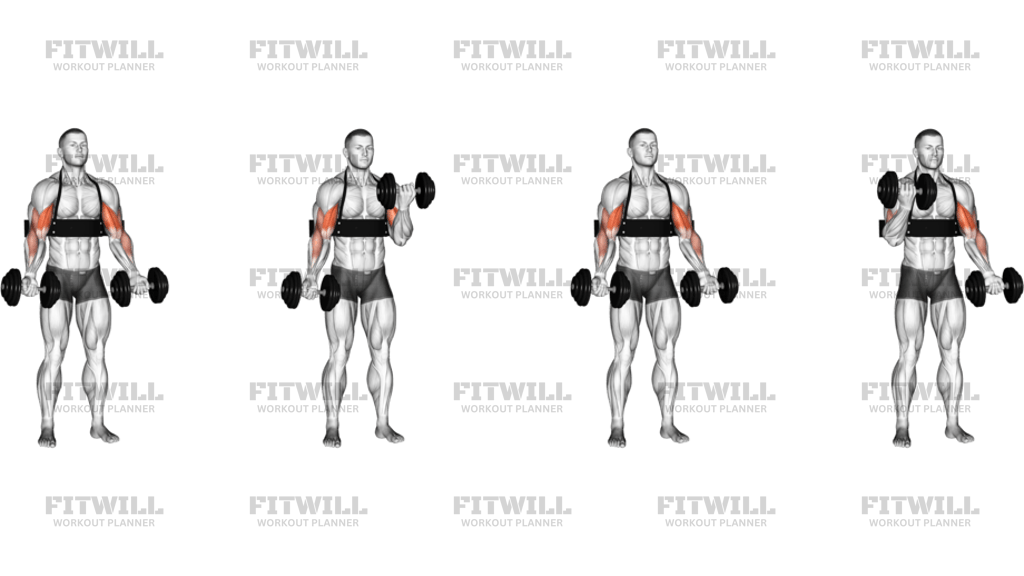
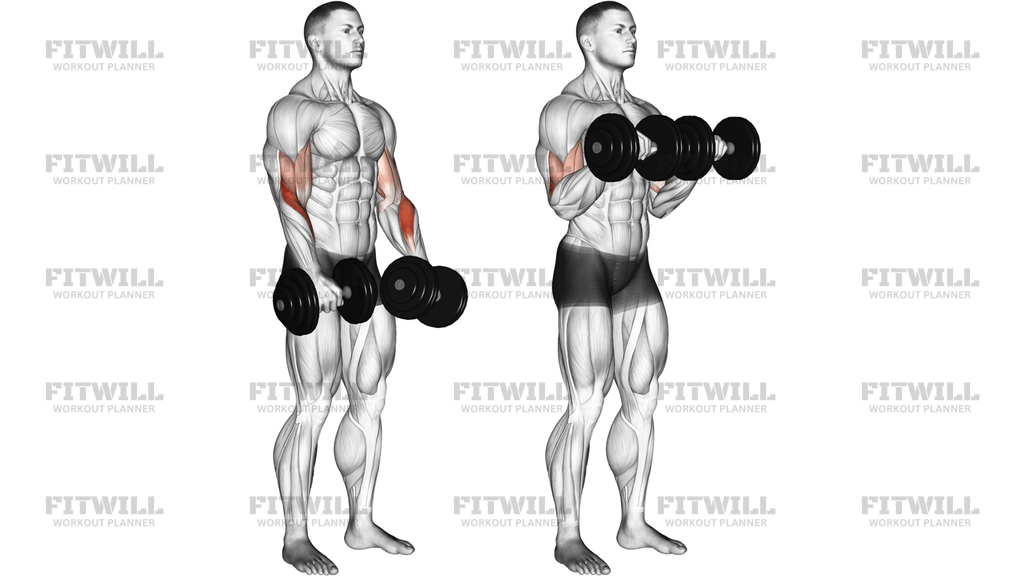
The Dumbbell Drag Curl is a standing biceps variation where you deliberately pull the dumbbells up along the front of your torso instead of curling them in a wide arc. Your elbows travel behind your body as the weights 'drag' up your sides, which removes most of the shoulder flexion you get in a standard curl and forces the biceps to do nearly all of the work. The image shows the exact path: arms hanging at the sides with palms facing forward, then the dumbbells rising close to the ribs until the elbows point back and the weights end up near the lower chest.
This movement is especially useful for lifters who have mastered the regular dumbbell curl but feel their front shoulders or traps taking over. Because the elbows stay pinned behind the torso, the long head of the biceps is placed in a slightly more favorable position, and there is simply nowhere to hide — no swinging, no leaning back, no elbow drift. Anyone chasing better arm detail, from bodybuilders to general strength trainees, benefits from having this pattern in the toolkit.
The setup matters more here than in most curl variations. A shoulder-width stance, arms fully extended, and palms facing forward give you a clean starting line. If your feet are too narrow or your shoulders round forward, the dumbbells will not track smoothly along your body and you will lose the tension that makes this exercise work. The close path along the torso is the defining feature, so anything that breaks it changes the exercise into something else.
To execute well, think of pulling your elbows back and up rather than lifting the weights. The dumbbells should lightly graze your torso the entire way up, finishing just below chest height with the wrists straight and neutral pressure in the grip. Squeeze at the top for a beat, then lower along the same track until the arms are completely straight again. Controlled tempo is non-negotiable — the drag curl is a strict, moderate-load movement, and heavy dumbbells almost always turn it into a sloppy standard curl.
Use the Dumbbell Drag Curl as a secondary arm exercise after your main pulling or pressing work, typically for sets of 8 to 15 reps. It pairs well with hammer curls or incline curls in the same session because each stresses the elbow flexors from a different angle. Keep the loads honest: if you have to swing your torso or flare your elbows away from your ribs to finish a rep, the weight is too heavy, and reducing it will give you more growth stimulus, not less.
[ Workout Log & Planner ]
Put your next workout in Fitwill
Keep your plan and training log ready when you are.


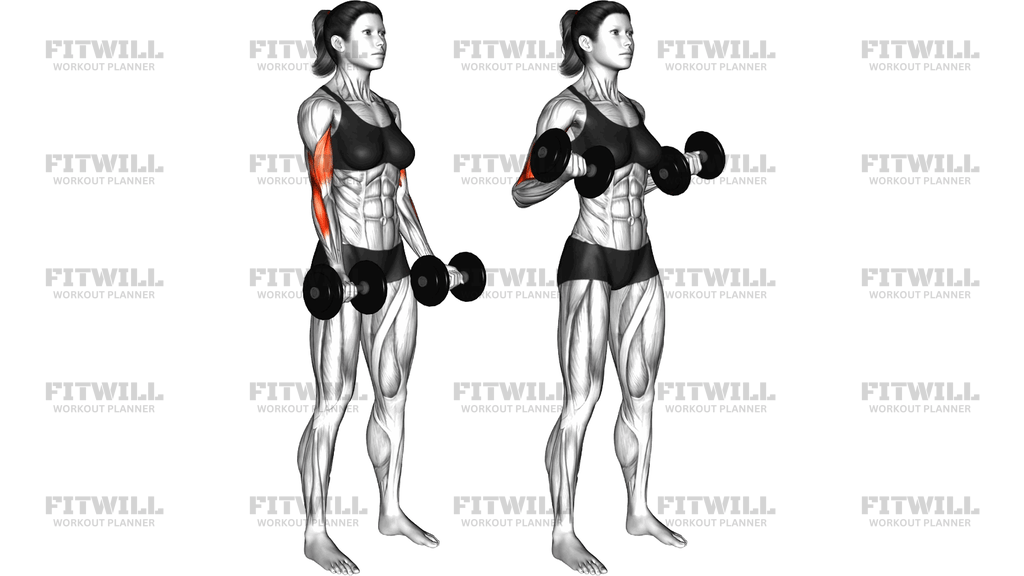
Instructions
- Stand with your feet about hip-width apart, holding a dumbbell in each hand with a supinated grip, palms facing forward and arms hanging straight down at your sides.
- Pull your shoulders back and down, brace your abdominal muscles, and keep your head neutral so your torso stays tall and vertical before the first rep.
- Begin the lift by driving your elbows backward and upward, letting the dumbbells slide up along the front of your torso rather than swinging forward in an arc.
- Keep the dumbbells in light contact with your body throughout the entire ascent — this dragging contact is the whole point of the exercise.
- Finish with your elbows pointing behind you and the dumbbells at roughly lower-chest height, squeezing your biceps hard at the top for a one-count pause.
- Lower the dumbbells along the same close path beside your torso, resisting the weight down until your arms are fully straight again.
- Exhale as you drag the weights up, and inhale as you lower them under control.
- At the bottom, reset your posture, let the arms hang fully extended for a moment, and only then start the next rep.
- Repeat for your target reps, stopping the set as soon as your elbows drift forward or your torso begins to sway.
Tips & Tricks
- If the dumbbells swing away from your ribs, the weight is usually too heavy — drop a size and relearn the straight vertical track along your torso.
- Do not let your elbows creep forward at the top; forward elbow drift converts the drag curl back into a regular curl and shifts work to the front shoulders.
- Keep your wrists stacked and straight. Bending the wrists back to help lift the dumbbells is a common failure point and adds strain without helping the biceps.
- Avoid shrugging your shoulders up as the weights rise. If your traps engage, cue yourself to press your shoulder blades down into your back pockets.
- Use a slightly lighter load than your standard dumbbell curl — most lifters need roughly 70 to 80 percent of their normal curl weight for the same rep range.
- A slow three-second lowering phase works exceptionally well here, because the close path to the torso makes the eccentric very easy to control.
- If your hips sway to help the weights up, set your stance a touch wider and think about keeping your weight even across both feet.
- Work each arm equally by keeping both dumbbells moving together; alternating sides usually encourages torso rotation that breaks the drag line.
- Skip momentum entirely. If the dumbbells need a knee bounce or a body swing to start the rep, the set is over regardless of how many reps you planned.
Frequently Asked Questions
What muscles does the Dumbbell Drag Curl work?
The biceps brachii is the primary mover, with the brachialis and brachioradialis assisting as elbow flexors. The forearms also work to hold the dumbbells, but the shoulders contribute far less than in a standard curl because the elbows stay behind the torso.
How is the Dumbbell Drag Curl different from a regular dumbbell curl?
In a regular curl the hands travel in a forward arc and the elbows move in front of the body. In the drag curl the dumbbells slide up along your torso and the elbows travel behind you, which limits shoulder involvement and keeps tension on the biceps.
Is the Dumbbell Drag Curl good for beginners?
Yes, as long as the weight is kept light, because the strict path actually teaches good curling mechanics. Beginners should learn the standard dumbbell curl first, then use the drag curl to reinforce keeping the elbows still and the torso upright.
Why should the dumbbells touch my torso during the rep?
The contact is what makes it a drag curl — it locks the weights into a vertical path and prevents the forward swing that lets the shoulders take over. If the dumbbells leave your body, the exercise loses its defining benefit.
How heavy should I go on the Dumbbell Drag Curl?
Use noticeably less weight than your regular dumbbell curl, usually around 70 to 80 percent for the same rep count. If you cannot keep the dumbbells against your torso for every rep, the load is too heavy for this variation.
Where should my elbows finish at the top of the movement?
Your elbows should end up pointing behind your body with the dumbbells near your lower chest. If your elbows push forward past your ribs, you have drifted into a standard curl and lost the drag position.
Can I do the Dumbbell Drag Curl with a barbell or EZ bar instead?
Yes, both are common substitutions and the same dragging path applies. Dumbbells allow each arm to track independently, which many lifters find more comfortable for the shoulders and wrists.
How many sets and reps should I use?
Two to four sets of 8 to 15 reps works well, placed after your heavier compound pulling or pressing exercises. Because the movement is strict and isolation-based, treat it as a finishing exercise rather than a primary mass builder.
Is it safe for my elbows or wrists?
For most people it is elbow-friendly because the close path keeps the joint in a natural line and the load stays moderate. Keep your wrists straight rather than cocked back, and stop the set if you feel pinching at the front of the shoulder or pain in the elbow joint.
Why do my shoulders want to lift as I curl?
The upper traps often try to help once the dumbbells reach torso height. Keep your shoulder blades pulled down and back throughout the set, and reduce the weight if the shrug happens on every rep.