Frog Jump
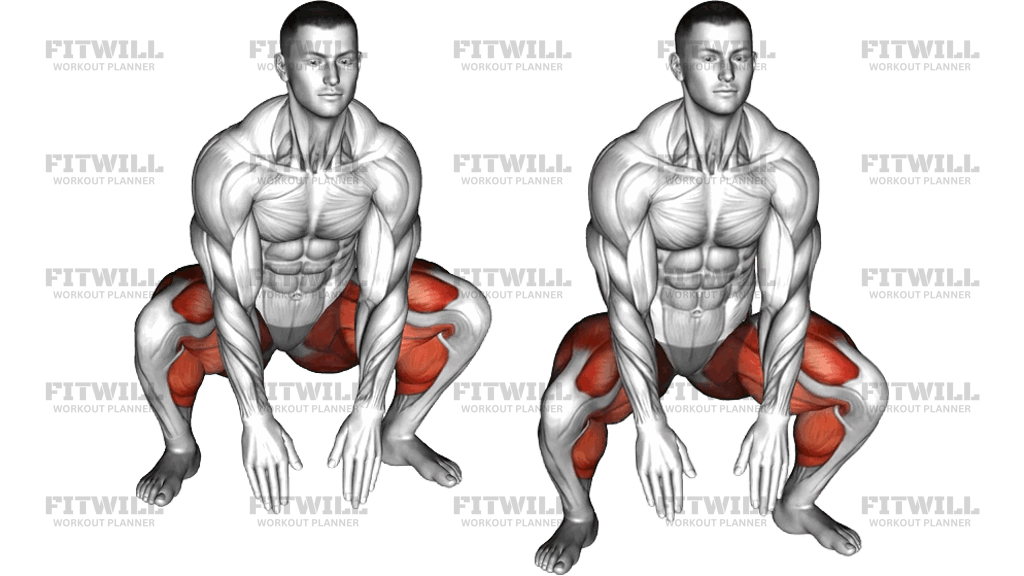
The Frog Jump is a bodyweight plyometric exercise performed from a deep, wide squat position with the hands reaching down between the knees. From that compressed frog stance, you explode upward into a vertical jump, then absorb the landing by dropping straight back into the same low position and immediately repeating. Because there is no pause at the bottom, the movement trains your legs to produce force quickly from a deep, mechanically disadvantaged position.
The wide, externally rotated stance is what separates the Frog Jump from a standard squat jump. With the knees pressed out over the toes and the adductors loaded in a stretched position, every takeoff demands strong hip and groin involvement alongside the quadriceps and glutes. This makes it a favorite for athletes in sports that require lateral power and quick changes of direction, such as basketball, tennis, soccer, and martial arts.
Beyond power, Frog Jumps are an efficient conditioning tool. A set of ten to fifteen continuous jumps raises your heart rate fast, so they appear frequently in circuit training, bootcamp workouts, and metabolic finishers. They also build ankle stiffness and landing mechanics, which transfer directly to sprinting, jumping, and cutting movements.
Setup and positioning matter more than most people expect. The depth of the squat at the bottom, the position of the hands, and the outward knee track all determine whether the jump is smooth and powerful or awkward and hard on the knees. A common error is shallow squatting between reps, which turns the exercise into small hops and removes the plyometric benefit.
Execute each rep with intent: sink fully into the wide squat, let the hands brush the floor for balance and timing, then drive through the whole foot and extend the hips and knees together. Land softly on the balls of the feet, sit back into the deep position, and control the transition before the next jump. If the depth or landing quality breaks down, stop the set rather than grinding out sloppy reps.
Frog Jumps require no equipment and very little space, which makes them easy to program at home or as part of a warm-up. Beginners should start with fewer reps and prioritize quiet landings, while more advanced trainees can add sets, increase jump height, or use them in superset pairings with strength exercises like squats or lunges.
Fitwill
Log Workouts, Track Progress & Build Strength.
Achieve more with Fitwill: explore over 9600 exercises with images and videos, access built-in and custom workouts, perfect for both gym and home sessions, and see real results.
Start your journey. Download today!




Instructions
- Stand with your feet wider than shoulder-width and turn your toes out roughly 30 to 45 degrees.
- Sink into a deep squat until your hips sit just above knee height and your inner thighs feel loaded, letting your arms hang down between your knees with your fingertips near or touching the floor.
- Keep your chest lifted, your back neutral, and your knees pushed outward so they track over your toes rather than collapsing inward.
- Brace your core and take a breath in at the bottom before each jump.
- Explosively extend your hips, knees, and ankles to jump straight up as high as you can, swinging your arms back and up for momentum.
- Exhale forcefully on the takeoff as you leave the ground.
- Land on the balls of your feet with bent knees, immediately guiding your hips back down into the same deep wide squat.
- Let your hands return down between your knees to the floor as you settle into the bottom, keeping the knees pressed out the whole way.
- Transition smoothly from landing to the next takeoff with minimal pause if you are training power endurance, or reset briefly between reps if you are training maximum jump height.
- Complete your set, then stand up fully and shake out your legs before the next round.
Tips & Tricks
- If your heels lift off the floor at the bottom, widen your stance slightly or turn your toes out a bit more so the deep squat feels stable before jumping.
- Knees caving inward on landing is the most common fault with Frog Jumps; consciously squeeze your glutes and push your knees out as you absorb each landing.
- Avoid bouncing off your lower back by hinging at the hips at the bottom instead of rounding over, even though your hands reach toward the floor.
- Keep the rep quality high: if your jump height drops noticeably in the last few reps, cut the set short rather than letting it become a slow-motion squat.
- Land quietly. A loud, heavy landing usually means stiff knees and hips, while a soft landing means you are absorbing force correctly.
- Use your arm swing deliberately; throwing the arms up on takeoff and pulling them down on the way into the squat adds meaningful height and rhythm.
- Do Frog Jumps on a firm surface with cushioning rather than concrete, and make sure your training shoes are laced so the wide stance stays secure.
- Warm up your hips and inner thighs first with light bodyweight squats or leg swings, since the stretched adductor position under load is demanding when cold.
- If deep squatting bothers your knees, reduce the depth slightly and focus on full hip extension on every jump instead of forcing the lowest position.
Frequently Asked Questions
What muscles do Frog Jumps work?
Frog Jumps primarily target the quadriceps and glutes, with strong involvement from the inner thighs because of the wide stance. The calves drive the final push-off and the core stabilizes your torso through each jump and landing.
Are Frog Jumps suitable for beginners?
Yes, but beginners should start with a smaller number of reps and focus on landing softly and keeping the knees tracking over the toes. If the deep squat position is uncomfortable, reduce the depth and build up gradually.
Why does the Frog Jump use such a wide stance?
The wide, toes-out stance loads the inner thighs and glutes in a stretched position and forces the knees to stay pushed out, which builds lateral and rotational power that a narrow-stance squat jump does not emphasize as much.
Should my hands touch the floor during Frog Jumps?
Lightly touching or brushing the floor between your knees is typical and helps with rhythm and balance, but the goal is a fluid arm swing rather than pressing weight through your hands.
What is the most common mistake with Frog Jumps?
The most common mistake is shallow squatting between reps, which turns the exercise into small bouncing hops. Another frequent fault is the knees caving inward on landing, which you can fix by actively pushing your knees out as you descend.
How many Frog Jumps should I do per set?
For power, do 5 to 8 crisp jumps with a short reset between reps. For conditioning, 10 to 15 continuous jumps per round works well, stopping as soon as your jump height or landing quality fades.
Can I substitute Frog Jumps in a workout if jumping is hard on my knees?
Yes. Slow wide-stance squat pulses or bodyweight sumo squats with a controlled tempo train similar muscles without the impact. You can also hold the deep squat position and perform a strong hip drive without leaving the floor.
Do Frog Jumps help with sports performance?
They build explosive leg power and landing control from a wide, low position, which transfers well to sprinting, jumping, and quick directional changes in field and court sports.
Should I do Frog Jumps before or after strength training?
Do them early in the session after a thorough warm-up, when your nervous system is fresh, if the goal is power. Placed at the end of a workout, they work better as a conditioning finisher.
What surface is best for Frog Jumps?
A firm surface with some shock absorption, such as a gym floor, rubber matting, or grass, is ideal. Avoid very soft or uneven ground, which can destabilize the wide stance on landing.