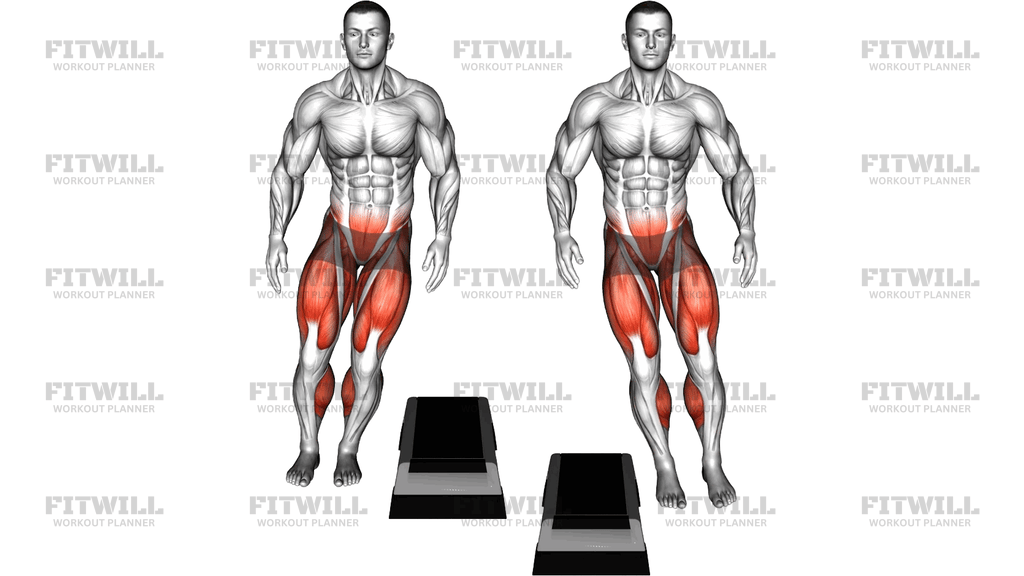
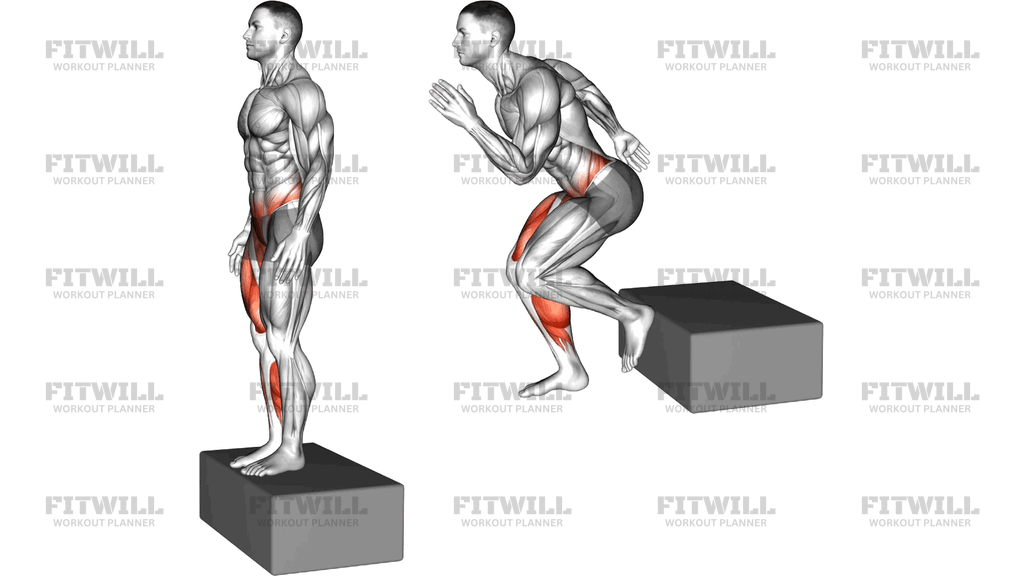
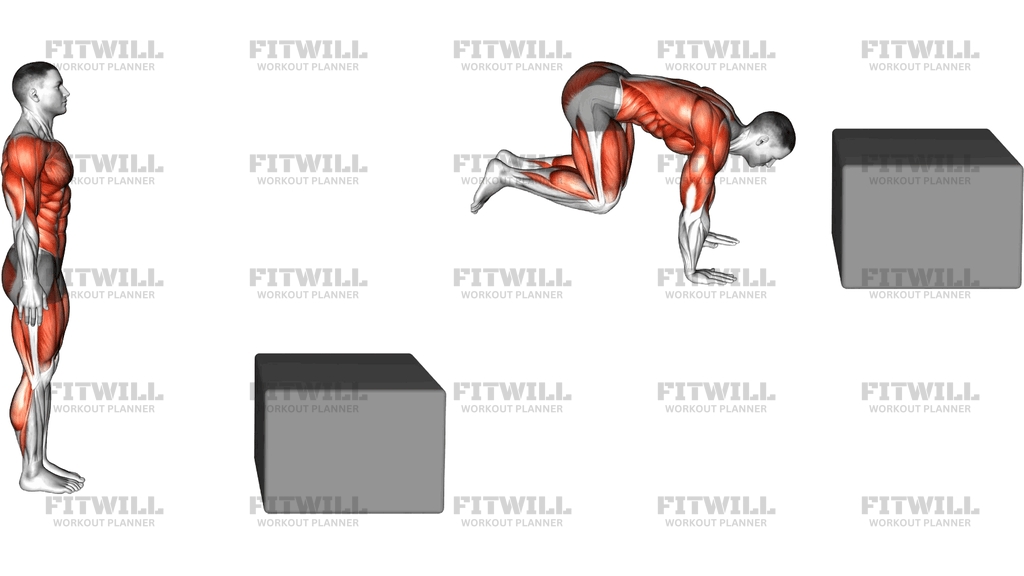
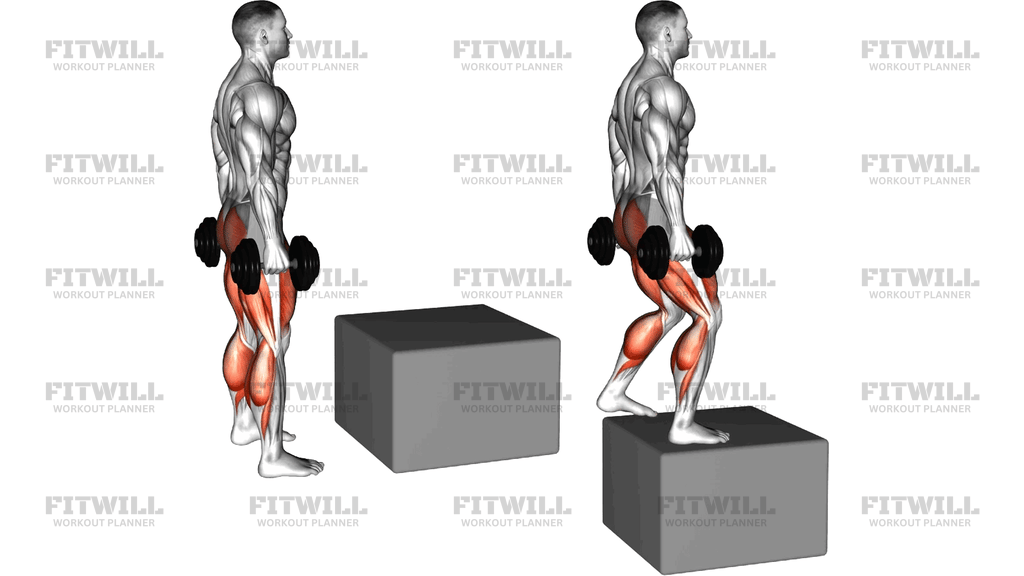
Box Jump Drop 2 Foot Land
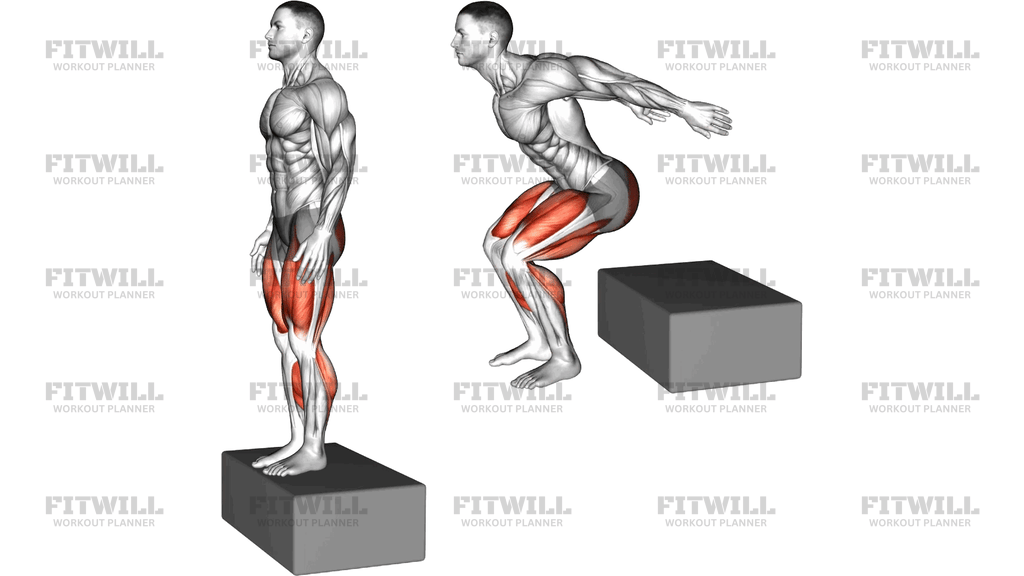
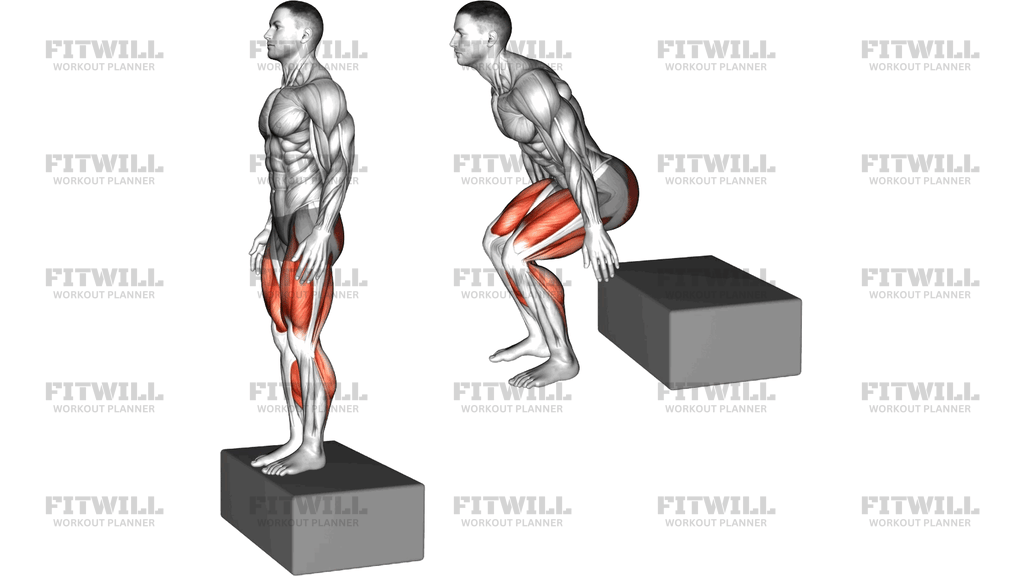
The Box Jump Drop 2 Foot Land is a plyometric drill that flips the usual box jump on its head: instead of focusing on the jump up, you start standing on top of the box and train the drop and landing. You step or hop off the box, fall under control, and absorb the impact by landing softly on both feet at the same time, sinking into a quarter squat with your hips back and chest angled forward. It is one of the simplest and most effective ways to teach your body how to accept force rather than just produce it.
Most people spend all their plyometric training on jumping higher or farther, but landing is where injuries and wasted energy happen. This exercise trains the eccentric phase — the quads, glutes, and hamstrings working to decelerate your body weight as you descend from the box — along with the calves and ankle stabilizers that stiffen the lower leg just before contact with the floor. Your core stays braced the whole time so your trunk doesn't collapse when you hit the ground.
The setup matters more than it looks. The box height should be low enough that you can drop off it without hesitating — usually somewhere between 12 and 24 inches depending on your experience. Stand tall near the edge with your feet about hip-width apart, and make sure the floor in front of the box is clear, flat, and non-slippery. Because the movement is a drop and not a step-down, the landing happens fast, and everything about your position before the drop determines how clean the landing will be.
To execute it well, think about preparing your legs before you leave the box. Push your hips back slightly, keep your weight over the midfoot, and let yourself fall rather than leaping out and away. In the air, keep your feet together and your eyes up. On contact, land with both feet at the same time, bend at the hips and knees together, and stop the descent in a controlled quarter squat — no bouncing, no deep collapse, no knees diving inward. The quieter you land, the better you are doing it.
This drill shows up constantly in athletic strength and conditioning because change of direction, sprinting, and virtually every sport demand repeated, efficient landings. It is equally useful for general lifters who want sturdier knees and better recoil in squats and jumps. Because the impact is real, treat it as a quality movement: low reps, full rest between sets, and always on a forgiving surface when possible. Stop as soon as your landings get loud or sloppy — that's your nervous system signaling fatigue, and practicing sloppy landings teaches exactly the wrong pattern.
[ Workout Log & Planner ]
Put your next workout in Fitwill
Keep your plan and training log ready when you are.


Instructions
- Choose a sturdy box or platform low enough that you can drop from it without hesitation, and set it on a flat, non-slip surface with clear space in front of it.
- Stand on top of the box near the front edge with your feet hip-width apart, arms relaxed at your sides, and your gaze forward.
- Brace your core and slightly bend your knees, shifting your weight onto the midfoot so you are ready to leave the box under control.
- Drop off the box — let yourself fall rather than jumping forward or stepping down — keeping your body compact as you descend.
- Keep both feet together and level in the air, toes pulled slightly up so the balls of your feet and heels land together.
- Land on the floor with both feet at the same time, distributing your weight evenly across the whole foot.
- Absorb the impact by pushing your hips back and bending your knees, sinking into a quarter squat with your chest angled forward and your back flat.
- Hold the landing for a beat, making sure your knees track over your toes and don't cave inward.
- Stand all the way up or walk back around to the box, reset your stance, and take a breath before the next rep.
- Breathe out on the landing, keep reps low and crisp, and rest fully between sets so every landing is deliberate.
Tips & Tricks
- Aim for a silent landing. If your heels are slamming or you hear a heavy slap, the box may be too high or you're letting your legs collapse instead of braking with your hips and quads.
- Watch for knee valgus — knees buckling toward each other on contact. Cue yourself to spread the floor slightly with your feet as you land to keep the knees tracking over the toes.
- Don't drift forward off the box. Falling out and away turns the drill into a broad jump landing and multiplies the braking demand; drop straight down to the floor just in front of the box.
- If your torso pitches way forward and your hands touch the ground, the drop is too aggressive. Lower the box height until you can stop in a shallow, stacked quarter squat.
- Keep your arms quiet and slightly behind you during the drop. Throwing them forward mid-air shifts your weight onto your toes and makes a balanced two-foot landing much harder.
- Land toe-ball-heel as one smooth contact, not flat-footed or heel-first. Heel-first landings send the shock straight up the shin and knee.
- Do this drill early in your workout, while you're fresh. Landing mechanics fall apart fast under fatigue, and each tired rep reinforces a worse pattern.
- Start around 3 to 5 reps per set and prioritize quality over volume. Two or three crisp sets beat ten sloppy ones every time.
- Barefoot or flat-soled shoes both work; avoid heavily cushioned, squishy shoes that make it harder to feel where your weight is on your feet.
Frequently Asked Questions
What muscles does the Box Jump Drop 2 Foot Land work?
The main work comes from the quads and glutes as they decelerate your body on landing, with the hamstrings, calves, and ankle stabilizers controlling the lower leg. Your core braces throughout to keep your trunk from folding on impact.
How high should the box be for the Box Jump Drop 2 Foot Land?
Start with a low box, roughly 12 to 18 inches, and only go higher when every landing is quiet and you can stop in a shallow quarter squat. Height that makes you hesitate mid-drop is too much.
Is this exercise safe for beginners?
Yes, if you start with a very low box or even a single plate and focus entirely on soft, two-foot landings. Beginners often benefit more from this drill than from max-height jumps because it builds the landing skill first.
What's the most common mistake in the Box Jump Drop 2 Foot Land?
Collapsing into a deep squat or letting the knees cave inward on contact. The fix is bracing before you drop, sitting the hips back, and stopping the descent at a controlled quarter squat.
Why drop off the box instead of jumping onto it?
Dropping isolates the eccentric phase, where your muscles absorb force. Jumping onto a box actually reduces landing stress, so this reverse setup gives you the impact-training benefit the standard box jump removes.
How many reps should I do?
Keep it low and sharp — 3 to 6 landings per set for 2 to 4 sets, with full rest in between. End the set the moment your landings become loud or your knees start drifting inward.
Can I do the Box Jump Drop 2 Foot Land if my knees are sensitive?
Be cautious and scale down: use a very low box, land on a forgiving surface like a rubber floor or grass, and keep the landing shallow. If landing from even a small height causes discomfort, stick to non-impact lower-body work and consult a professional before continuing.
What can I use if I don't have a plyo box?
Any stable, non-slip platform works — a low step platform, a sturdy bench, or stacked bumper plates. Avoid anything wobbly or padded that shifts when you weight and unweight it during the drop.
Should my feet land together or apart?
Together and at the same time, about hip-width once your feet contact the floor. A staggered or split landing doubles the load on one leg and defeats the purpose of the two-foot land.
How is this different from a depth jump?
A depth jump drops from a box and immediately rebounds into a maximal jump, while the Box Jump Drop 2 Foot Land ends at the landing itself. That makes it a better teaching tool for absorbing force before you add the reactive rebound.