Dumbbell Standing Front Raise Above Head
The Dumbbell Standing Front Raise Above Head is a front raise taken through a full arc: you start with a dumbbell in each hand at thigh level and lift both arms straight forward until the weights finish directly overhead with your arms extended. Unlike the standard front raise that stops at shoulder height, this longer range keeps the front delts working through the top half of the movement and adds a strong lockout demand on the upper traps and shoulder stabilizers at the finish.
The main muscle at work is the anterior deltoid, the front cap of the shoulder, which drives the arm forward and up. As you pass shoulder height and press toward the ceiling, the side delts, upper chest fibers near the collarbone, and upper traps assist, while the core works continuously to keep your torso upright instead of leaning back. Because you are standing rather than seated, your legs and trunk provide the stable base, which makes this a useful movement for teaching the shoulders and core to coordinate under load.
This exercise suits lifters who already tolerate overhead work and want to build fuller front delts, stronger lockouts for pressing, or better shoulder endurance for sports like swimming, volleyball, and throwing. It also pairs well with pressing movements: where an overhead press relies heavily on the triceps, this raise isolates the shoulder itself, so you feel exactly where the delts are strong and where they lag.
Setup matters more here than in most raises because the weights travel close to your face and finish overhead. Keep the dumbbells close together or lightly touching in front of your thighs, stand with feet about hip-width apart, and set your ribs down over your hips before the first rep. A slight, fixed bend in the elbows is fine, but the elbow angle should not change as you lift, or the movement turns into a partial press.
Execution comes down to a smooth, arcing path. Raise the dumbbells forward and up in one plane, letting the weights travel just in front of your body rather than out to the sides, and finish with the arms nearly vertical over your shoulders. Lower with the same control, resisting the weights back to your thighs. If you have to swing, lean, or shrug heavily to get the weights up, the load is too heavy for this range.
A practical safety note: the overhead position puts the shoulder in a demanding spot, so warm up the shoulders first and choose lighter dumbbells than you would for shoulder-height raises. Stop the set if you feel pinching at the top of the lift or lower back strain from arching, and reduce the range or weight accordingly.
[ Workout Log & Planner ]
Put your next workout in Fitwill
Keep your plan and training log ready when you are.


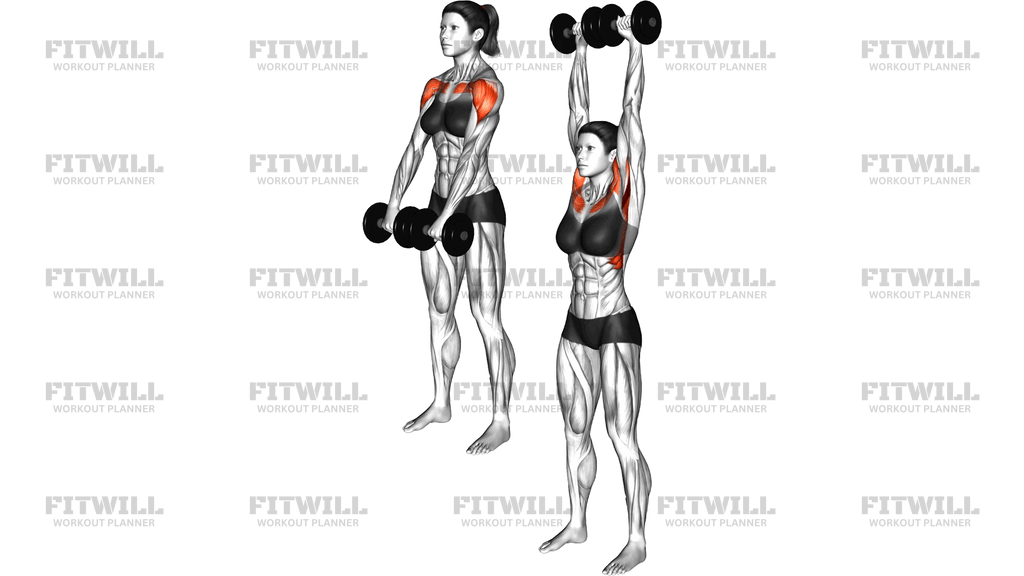
Instructions
- Stand upright with feet hip-width apart, holding a dumbbell in each hand with an overhand grip, arms straight down so the weights rest in front of your thighs.
- Position the dumbbells close together in front of your body, palms facing your thighs, and keep a soft, unchanged bend in both elbows.
- Set your posture before lifting: brace your abs lightly, draw your ribs down over your hips, and pull your shoulder blades back and down.
- Exhale as you raise both dumbbells forward and up in a smooth arc, keeping the weights in front of your body and close together rather than flaring them outward.
- Continue lifting past shoulder height until your arms are nearly vertical and the dumbbells finish directly above your shoulders, not out in front of your face.
- At the top, reach fully overhead with straight elbows and feel your upper traps and shoulders supporting the weights without shrugging them toward your ears.
- Inhale as you lower the dumbbells along the same forward arc, controlling the descent so the weights do not drop back to your thighs.
- Pause briefly at the bottom with arms extended down and tension still on the shoulders, then begin the next rep without swinging or using momentum from your legs.
- Keep your torso still throughout the set; if you catch yourself leaning back as the weights pass your head, reset your stance and lighten the load.
Tips & Tricks
- The most common mistake is turning the top half into a press: if your elbows bend more as the weights rise past your head, you are pressing instead of raising, so lock the elbow angle from start to finish.
- Leaning back as the dumbbells pass face level is a sign the weight is too heavy for the overhead range; drop to a lighter pair and finish every rep with straight arms instead.
- Keep the two dumbbells tracking parallel and close together; letting them drift out to the sides shifts work away from the front delts and makes the lockout less stable.
- Think of lifting the weights along a vertical wall in front of you rather than in a big circle, which keeps the path tight and reduces strain on the shoulder joint at the top.
- Avoid shrugging hard at the finish; a small upper trap involvement at lockout is normal, but yanking the shoulders to your ears usually means momentum is doing the lifting.
- Because the finish is overhead, your grip fatigues before your shoulders on longer sets; use a firm, full-hand grip and chalk or wrist straps if the handles start slipping.
- Breathe out on the way up and in on the way down; holding your breath through the top position raises tension in the neck and makes the lockout feel heavier than it is.
- If the very top of the arc feels pinchy, cut the range just short of full elbow lockout for a few sessions and gradually extend it as the shoulder warms up to the position.
- Lighter than you think is the right call: the front raise overhead demands far more control than a shoulder-height raise, and weights sized for presses will usually wreck your form here.
Frequently Asked Questions
Which muscles does the Dumbbell Standing Front Raise Above Head work?
The front delts do most of the lifting from thigh level all the way overhead. The side delts, upper chest, and upper traps assist, especially through the top half of the arc, and your core stabilizes your torso throughout.
How is the Dumbbell Standing Front Raise Above Head different from a regular front raise?
A regular front raise stops at shoulder height, while this version continues until the arms are fully extended overhead. The extra range increases the demand on the upper traps and shoulder stabilizers and keeps tension on the front delts through a longer path.
Is the Dumbbell Standing Front Raise Above Head suitable for beginners?
Beginners can do it, but it is smarter to master the shoulder-height front raise first. Once you can control lighter dumbbells to shoulder level without swinging, extend the range overhead with a lighter weight than you used before.
How heavy should the dumbbells be for this exercise?
Choose noticeably lighter dumbbells than you would use for overhead presses or shoulder-height raises, since the long arc and overhead finish demand control, not maximal load. A weight you can lift with straight, non-bending elbows for 10 to 15 clean reps is a good starting point.
Why do I feel the Dumbbell Standing Front Raise Above Head in my lower back?
That usually means you are arching and leaning back as the weights pass your head. Tighten your abs, keep your ribs stacked over your hips, and if the pull to arch persists, the dumbbells are too heavy for the overhead portion.
Should my elbows stay straight or bent during the raise?
Keep a small, fixed bend in the elbows to protect the joint, but do not let that bend increase as you lift. If the elbows open up mid-rep, the movement becomes a partial press and the front delts stop getting the isolated work.
What can I substitute for the Dumbbell Standing Front Raise Above Head?
A standard dumbbell front raise to shoulder height, a cable front raise, or a plate raise all train the front delts with a shorter, easier arc. If the overhead position itself is uncomfortable, stick with the shoulder-height versions and build up gradually.
How many sets and reps should I do?
Because this is an isolation movement with a demanding top position, 2 to 4 sets of 10 to 15 controlled reps works well. Keep the tempo even, and stop the set as soon as your form forces you to swing or lean.
Can I do this exercise every day?
Daily training is not necessary; the front delts also get worked by presses and many pulling warm-ups. Two to three focused sessions per week with rest days between them is enough to build strength and size in the shoulders.