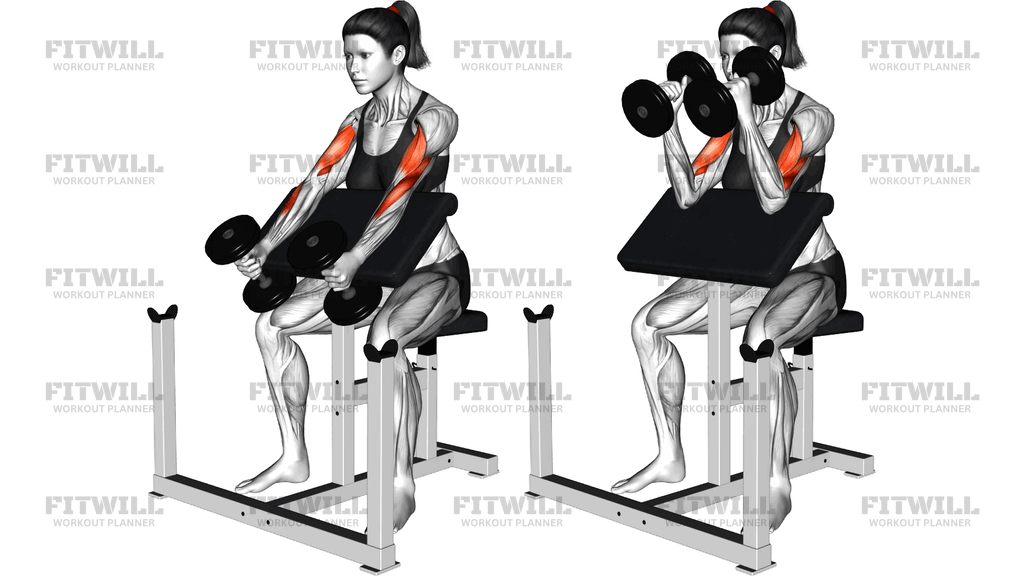
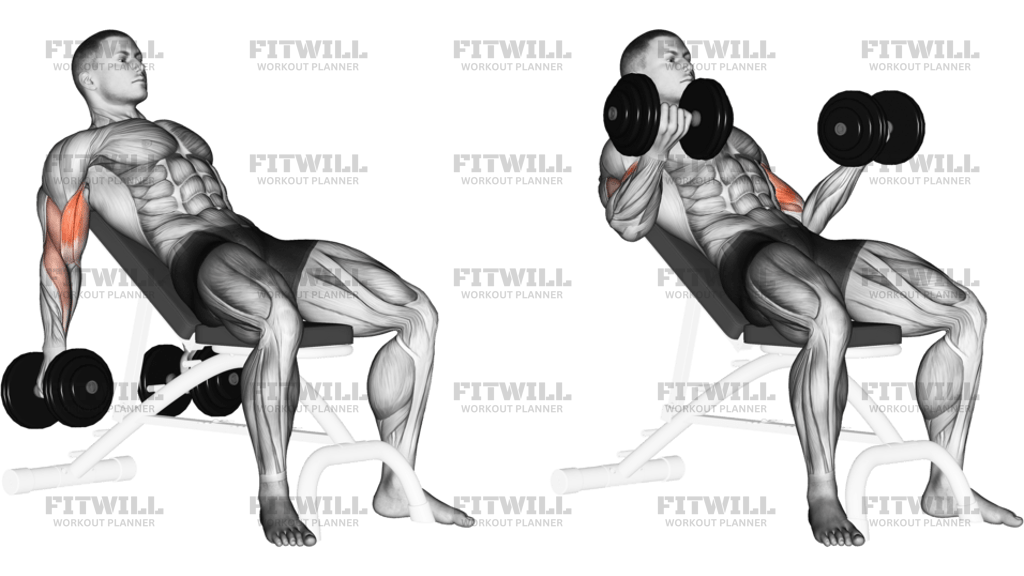
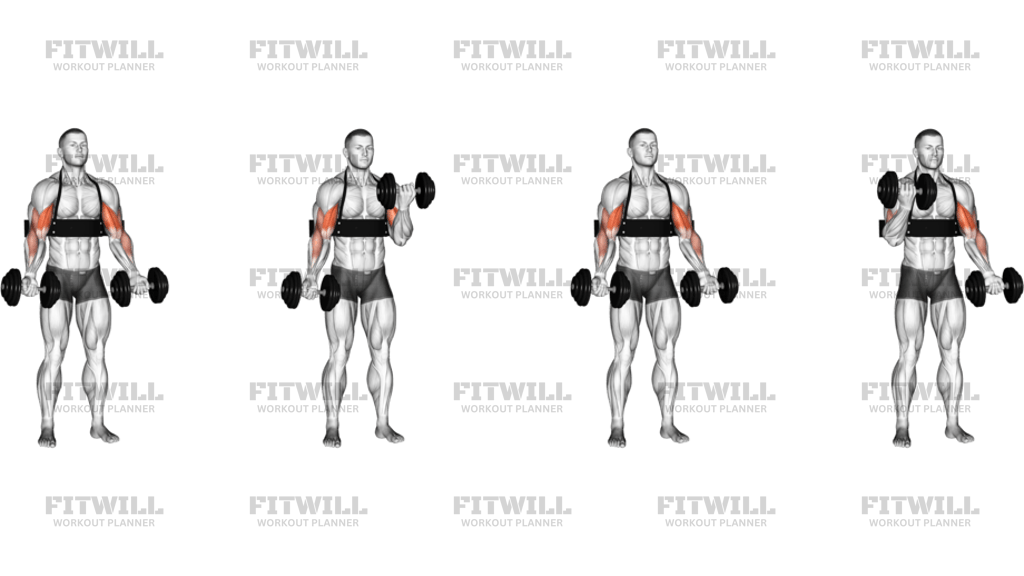
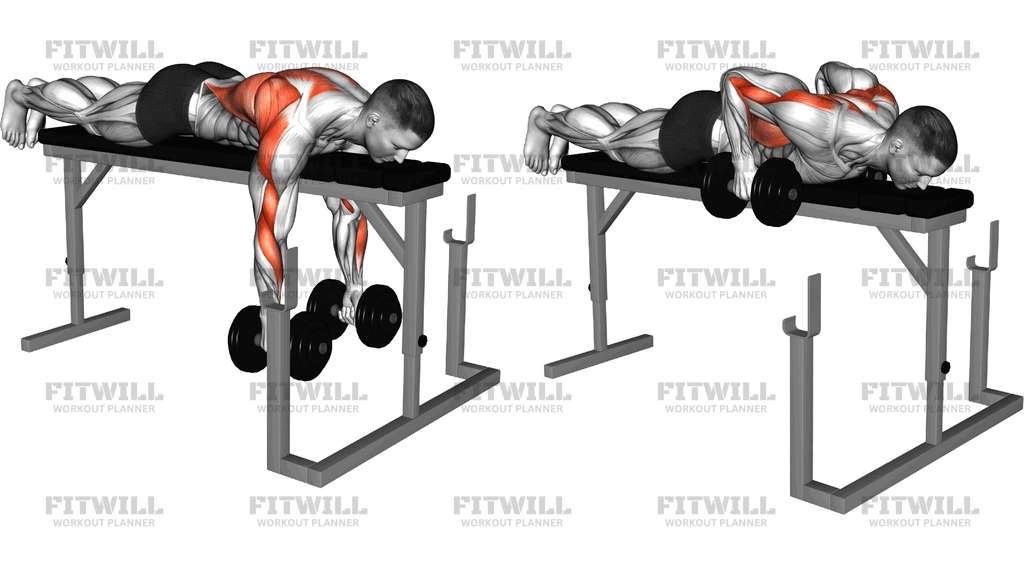
Dumbbell Hammer Srtict Curl
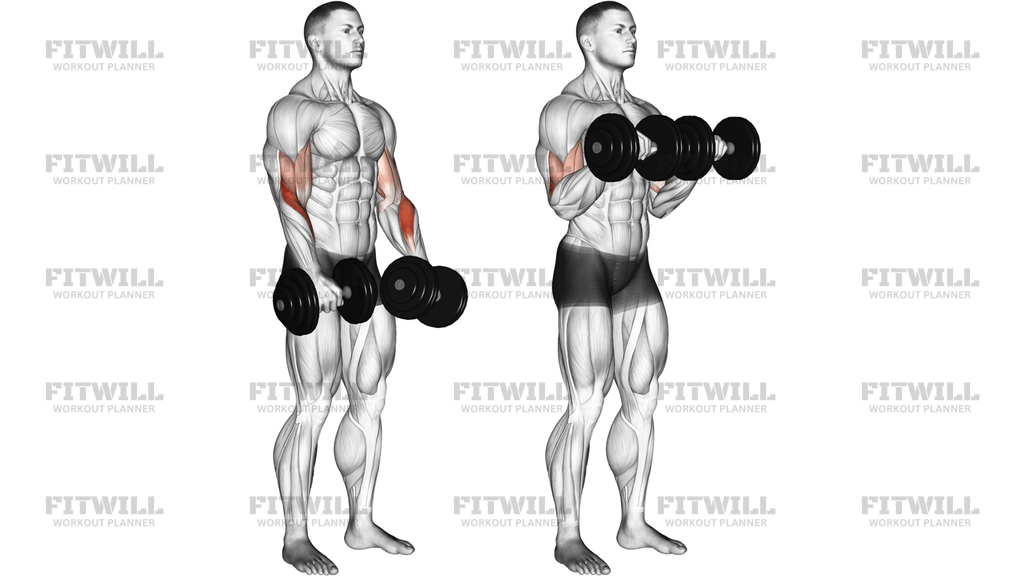
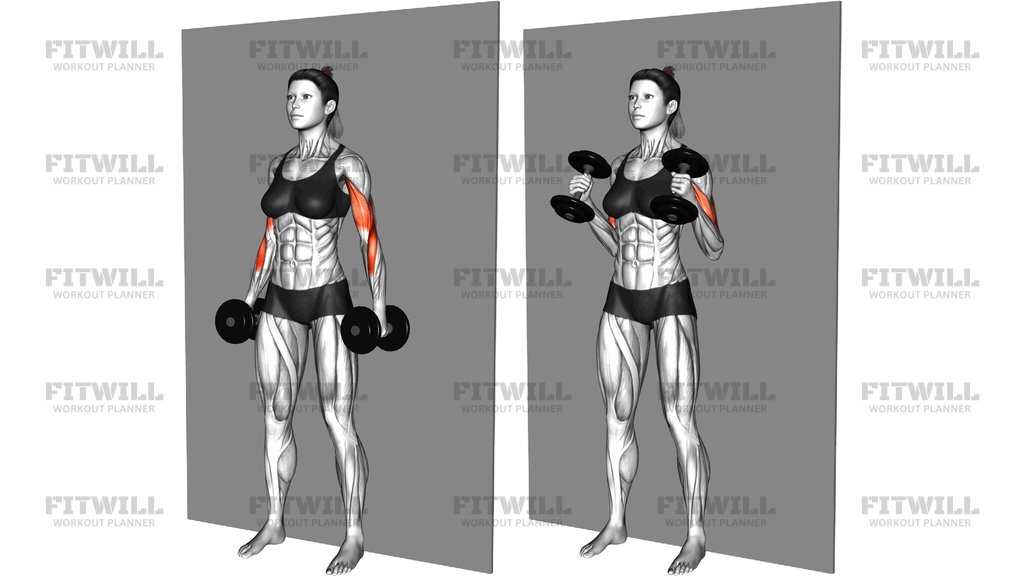
The Dumbbell Hammer Strict Curl is a standing arm exercise performed with a neutral, palms-facing grip, so the dumbbells stay oriented like hammers throughout the entire rep. Unlike a standard curl where the palms rotate up toward the ceiling, here the wrist position never changes, which shifts a large share of the work onto the brachialis and brachioradialis while the biceps still contract hard to bend the elbow. The word strict is the important part: the torso stays upright and still, the elbows stay pinned to your sides, and only the forearms travel.
This movement is especially useful for building the thickness of the upper arm. The brachialis sits underneath the biceps, and when it grows it pushes the biceps up, adding arm width that a regular curl alone does not always deliver. The brachioradialis, the biggest muscle of the forearm near the elbow, also works hard in the neutral grip, so lifters who want fuller forearms alongside bigger arms get both from one exercise. It is a smart choice for anyone whose arms have stalled on conventional curls.
Setup matters more than it looks. Stand tall with a dumbbell in each hand, arms fully extended at your sides, feet about hip width apart, and elbows tucked close to the torso without pressing them back or flaring them forward. Because there is no bench or back support, your own posture is the only thing preventing body English, so bracing your core and keeping your shoulders down and back is what makes this version strict.
To perform the rep, curl both dumbbells up in an arc toward your shoulders, keeping the palms facing each other the whole way. Stop when the dumbbells are near shoulder height and your elbows are still at your sides, then lower the weight under control to full extension before starting the next rep. Squeezing at the top and resisting the descent is where most of the growth stimulus lives; dropping the weight quickly turns the set into a swing.
You will see this exercise used as a primary arm builder in hypertrophy programs, as a strict accessory after heavier back work, or as a teaching tool for lifters who cheat too much on standard curls. Because the grip is neutral and the wrists are never extended under load, it is also one of the more elbow- and wrist-friendly curl variations for people who find supinated curls uncomfortable. Keep the loads moderate, the reps clean, and let the elbows do the moving.
[ Workout Log & Planner ]
Put your next workout in Fitwill
Keep your plan and training log ready when you are.


Instructions
- Stand upright with a dumbbell in each hand, arms hanging straight down at your sides, and the handles held in a neutral grip so your palms face your body.
- Set your feet about hip width apart, soften the knees slightly, and pull your shoulders down and back so the dumbbells sit just in front of your thighs.
- Brace your core lightly and fix your elbows against your sides; they are the hinge point and should not drift forward or outward during the set.
- Exhale and curl both dumbbells up at the same time in a smooth arc toward your shoulders, keeping the palms facing each other for the entire range.
- Continue until the dumbbells are at shoulder height and your forearms are roughly vertical, then squeeze the biceps at the top without letting your elbows travel forward.
- Inhale as you lower the dumbbells slowly back along the same arc, resisting the weight until your arms are fully straight at your sides.
- Pause for a moment at the bottom with arms extended, reset your posture, and make sure the next rep starts from the same locked-out position.
- Keep your torso still throughout; if your upper back leans or your hips push forward to help the weight up, the set is no longer strict.
- Choose a weight you can lower under control for every rep, and stop the set when your elbows start to drift or your torso begins to sway.
Tips & Tricks
- The most common failure with the Dumbbell Hammer Strict Curl is swinging the torso to start the rep. If you catch your shoulders leaning back, drop the weight by 10-15% until your trunk stays vertical.
- Do not let your elbows slide forward at the top. When the elbows chase the dumbbells, the front shoulders take over and the biceps lose tension at the peak of the contraction.
- Keep the curl in an arc slightly in front of your body rather than dragging the dumbbells straight up your sides; the forearm should angle toward the shoulder, not the chest.
- Your wrists should stay straight and neutral, neither cocked back nor flexed. A bent wrist means the dumbbell is too heavy or your grip is set unevenly in the hand.
- Fully straighten the arms at the bottom of every rep. Half-range hammer curls shorten the brachioradialis work and let the elbow joint take over the load at the start of each rep.
- Because there is no back support, think about squeezing your glutes and bracing your ribs down before the first rep; this gives you a stable base the same way a preacher pad would.
- Use a slower lowering phase, around two to three seconds, since the brachialis responds well to tension during the descent and fast drops waste most of the set.
- If one arm fatigues faster than the other, slow down and match the weaker side rather than letting the strong arm set the pace, since both dumbbells move together here.
- Alternate the Dumbbell Hammer Strict Curl with regular curls across the week rather than replacing them entirely; the neutral grip grows the brachialis but does not maximally load the biceps in a supinated position.
Frequently Asked Questions
Which muscles does the Dumbbell Hammer Strict Curl work?
The main drivers are the biceps brachii, brachialis, and brachioradialis, with the forearm flexors working to hold the dumbbells. The neutral grip puts extra emphasis on the brachialis and the top of the forearm compared to a standard palms-up curl.
How is the Dumbbell Hammer Strict Curl different from a regular dumbbell curl?
The grip stays neutral with palms facing each other instead of rotating to face the ceiling. This changes the muscle emphasis toward the brachialis and brachioradialis and keeps the wrists in a more comfortable position.
What does the strict part of the Dumbbell Hammer Strict Curl mean?
It means the torso stays upright and motionless and the elbows stay locked at your sides, so only the forearms move. Without back support or momentum, the arm muscles do all of the work instead of your hips and shoulders.
Is the Dumbbell Hammer Strict Curl good for beginners?
Yes, it is one of the easier curl variations to learn because the wrist never rotates and the movement path is simple. Beginners should start light and focus on keeping the elbows pinned before adding weight.
Why do my wrists bend backward during hammer curls?
This usually means the dumbbell sits unevenly in your hand or the weight is too heavy for your grip. Grip the handle centered so the weight stacks over your wrist, and reduce the load until you can keep the wrist perfectly straight.
Should I curl both arms at the same time or one at a time?
The standard version curls both dumbbells together, which keeps your torso from twisting to help one side. If you want to focus on a weaker arm, you can alternate, but keep your trunk equally still.
Can I do the Dumbbell Hammer Strict Curl seated?
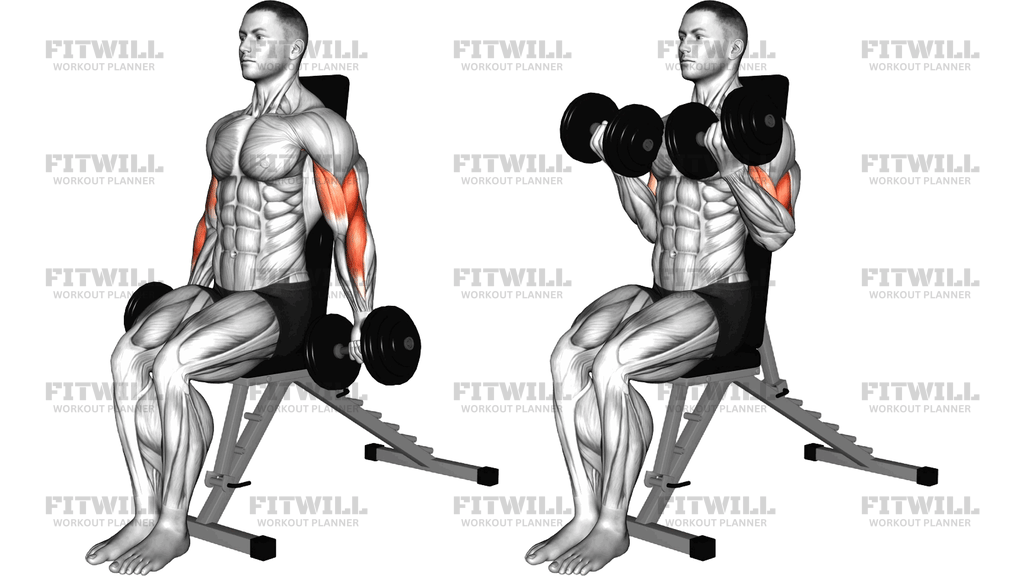
You can, and sitting on a bench with an upright back removes any chance of using momentum, making the set even stricter. The standing version additionally challenges your posture and core stability.
What can I use if I do not have dumbbells for this exercise?
A cable with a rope attachment or a straight bar held in a neutral-ish grip can replicate the movement pattern, and a resistance band works when anchored under your feet. The key detail to preserve is the palms-facing grip and a still torso.
Is it safe for the elbows to do hammer curls with heavy weight?
The neutral grip is generally comfortable for the elbow joint, but jerky reps and uncontrolled drops put stress on the tendons. Use a weight you can lower slowly and stop the set if you feel pinching at the inner elbow.
How many reps should I do for the Dumbbell Hammer Strict Curl?
Because the strict form limits how heavy you can go, sets of around 8 to 15 controlled reps work well for muscle growth. Prioritize full range and a slow lowering phase over pushing maximal weight.