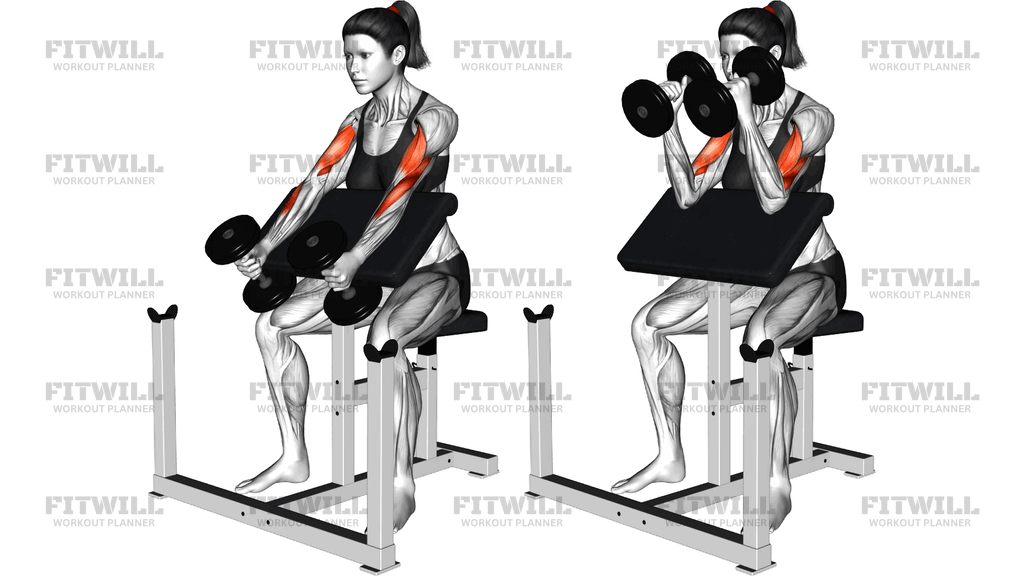
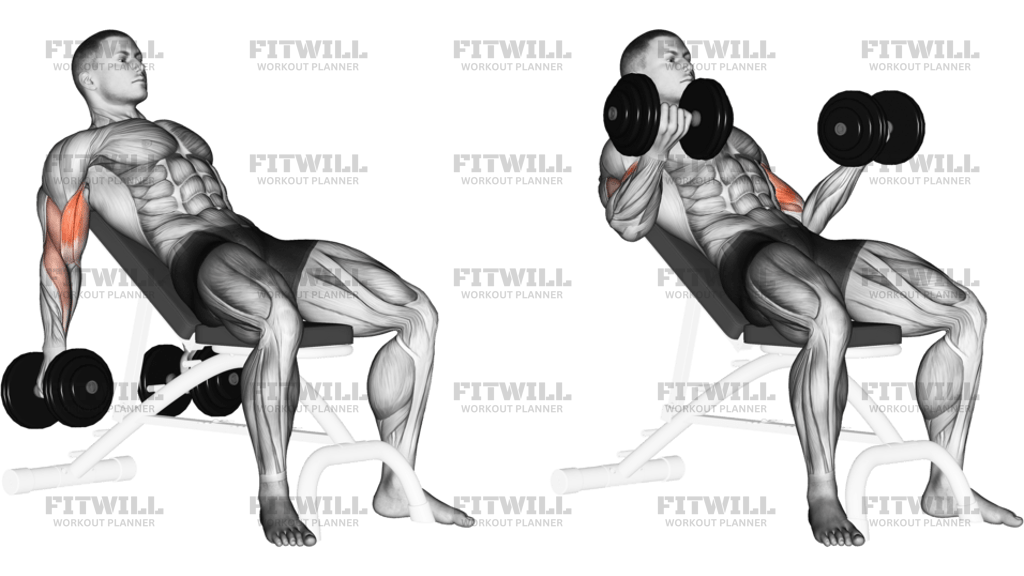
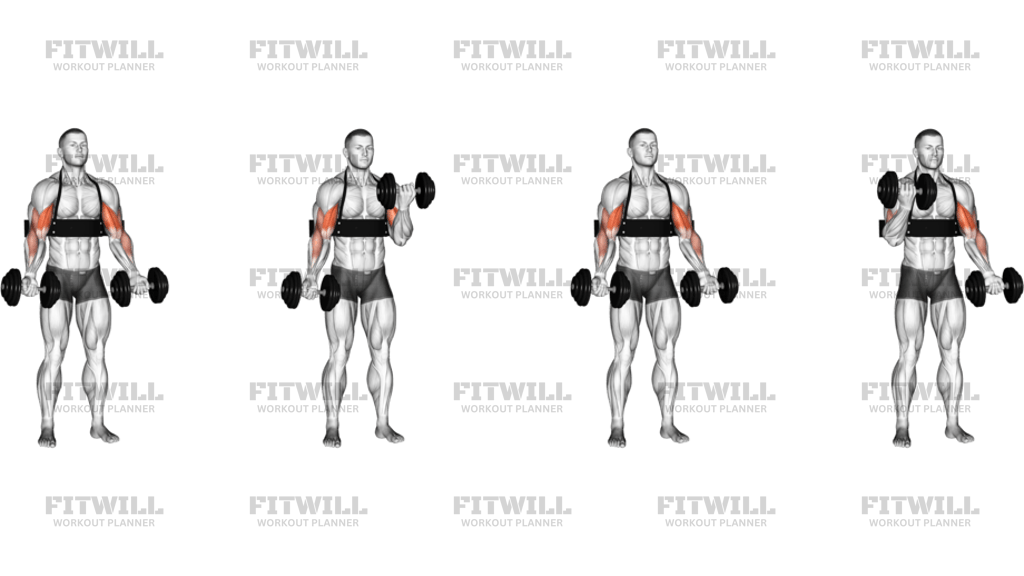
Dumbbell Biceps Curl (Version 3)
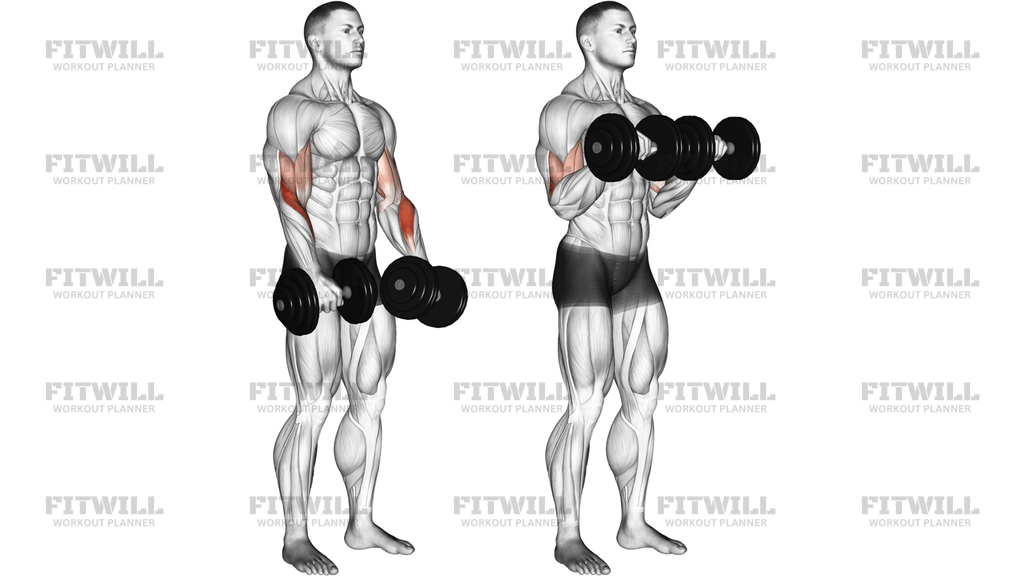
The Dumbbell Biceps Curl is the classic standing arm builder: you hold a dumbbell in each hand at your sides and curl both weights up to shoulder height with your palms facing forward, then lower them under control. Because each arm works with its own weight, both sides have to pull their share of the load, which quickly exposes and corrects a stronger side doing more than its fair share.
This movement primarily trains the biceps brachii on the front of the upper arm, with solid support from the brachialis underneath it and the brachioradialis and forearm muscles that keep your grip locked in. The standing stance also asks your core and shoulder stabilizers to hold your torso quiet while the arms move, so you get a small but real amount of whole-body stability work for free.
Setup matters more than most people assume. Your feet, elbow position, and starting posture all determine whether the tension stays on the biceps or leaks into your shoulders and lower back. Stand tall with a dumbbell in each hand, arms fully extended at your sides, and keep your elbows pinned close to your torso for the entire set. If your elbows drift forward as you curl, your front shoulders take over and the top half of the rep loses much of its biceps focus.
To execute it well, curl both dumbbells up in a smooth arc by bending at the elbows only, letting your wrists stay neutral and relaxed rather than cocked back. Squeeze at the top without swinging the weights toward your chest, then resist the way down for two to three seconds. The lowering phase is where a lot of the growth stimulus lives, so treat it as part of the rep instead of a return trip.
This exercise fits almost any training goal. Beginners use it to learn what a real biceps contraction feels like, general lifters use it to round out pulling days, and anyone training at home appreciates that a single pair of dumbbells is all it takes. It also pairs naturally with compound back work, since heavy rows and pulldowns pre-fatigue the arms less than you might expect and leave plenty in the tank for direct arm work.
Keep the weight honest. A load you can only move by rocking your torso or launching the dumbbells with your hips is a load that trains momentum, not biceps. Choose a weight that lets you complete every rep with your back against an imaginary wall and your elbows glued to your ribs, and progress from there.
[ Workout Log & Planner ]
Put your next workout in Fitwill
Keep your plan and training log ready when you are.


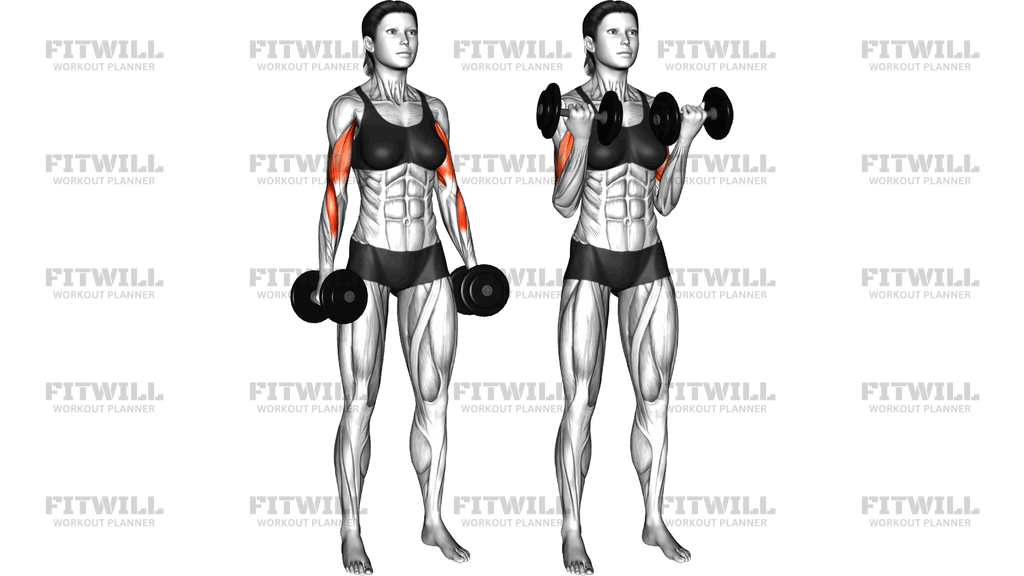
Instructions
- Stand with your feet about hip-width apart, a dumbbell in each hand, and let your arms hang straight down at your sides with palms facing forward or slightly turned in.
- Set your posture before the first rep: chest up, shoulders back and down, eyes ahead, and a soft bend in the knees so you are not locked out and rigid.
- Brace your core lightly as if bracing for a light push, and pull your elbows in so they sit close to your ribs for the whole set.
- Exhale as you curl both dumbbells up in a smooth arc, bending only at the elbows and keeping your upper arms still.
- Curl until the dumbbells are near shoulder height and your biceps are fully contracted, without letting your elbows travel forward.
- Pause for a beat at the top and squeeze your biceps rather than shrugging the weights higher.
- Inhale as you lower both dumbbells slowly along the same arc, taking two to three seconds per rep until your arms are fully extended.
- Let your arms hang long at the bottom and feel a brief stretch in the biceps before starting the next rep.
- Reset your posture between reps if you feel your torso leaning, and stop the set as soon as your elbows start drifting or your back starts swinging.
- When finished, set the dumbbells down with a bend in your knees rather than rounding over to reach the floor.
Tips & Tricks
- If your torso rocks backward as the weights rise, the dumbbells are too heavy or you are rushing the first third of the rep. Drop the load slightly and think about driving the movement from the elbow only.
- Keep your wrists straight and relaxed. Cocking the wrists back at the top shifts tension away from the biceps and strains the forearm flexors.
- Do not let the elbows slide forward as you curl. When the upper arm moves, the front shoulders join in and the hardest part of the range gets easier for the biceps.
- Lower the dumbbells slower than you lift them. Many people control the curl but drop the descent, losing the half of the rep that drives most of the muscle-building tension.
- Fully straighten the arms at the bottom of every rep. Partial reps that never reach full extension let the biceps shorten over time and skip the stretched position.
- Suppress the urge to shrug. If your shoulders climb toward your ears as you fatigue, the upper traps are jumping in to help, which is a signal to end the set.
- Experiment with a slight inward turn of the dumbbells at the top, as if pouring a jug, to feel a stronger squeeze if a standard curl feels flat.
- Grip the handles firmly but not white-knuckle tight. Excessive grip tension recruits the forearms so hard that the biceps never get a clean signal.
Frequently Asked Questions
Which muscles does the Dumbbell Biceps Curl work?
The biceps brachii on the front of the upper arm is the prime mover, supported by the brachialis and brachioradialis. Your forearms work to hold the dumbbells, and the front shoulders and core stabilize while your arms move.
Should I curl both dumbbells at the same time or one arm at a time?
This version has you curl both arms together, which saves time and keeps your setup symmetric. If your form breaks down quickly with both arms, alternating lets you focus on one side and usually keeps the movement cleaner.
Why do my shoulders take over during Dumbbell Biceps Curls?
This usually happens when your elbows travel forward as you curl or when the weight is heavy enough that you swing it up. Pin your elbows to your sides and reduce the load until the movement comes purely from the elbow joint.
How heavy should the dumbbells be for this exercise?
Pick a weight you can control for 8 to 15 reps with a slow lowering phase and no torso swing. If your back moves or your elbows drift forward, the dumbbells are too heavy regardless of how many reps you can finish.
Is the standing Dumbbell Biceps Curl good for beginners?
Yes, it is one of the simplest arm exercises to learn because the movement path is natural and the equipment is just a pair of dumbbells. Start light, master the elbow position, and progress the weight gradually once your form is consistent.
Should my palms face forward or stay neutral at the start?
Starting with palms forward or slightly turned in puts the biceps in its strongest line of pull for a standard curl. A neutral grip with palms facing your thighs shifts more work to the brachialis and brachioradialis, so the small starting rotation changes the emphasis.
How can I stop swinging my body during the Dumbbell Biceps Curl?
Brace your core before the set, keep a soft bend in the knees, and imagine your upper back pressed against a wall. Slowing the first third of the lift and exhaling as you curl also removes the momentum that comes from leaning back.
What can I use instead of dumbbells for this movement?
A barbell or EZ barbell works for the same curling pattern, and a resistance band anchored under your feet gives a similar arc with a peak of tension at the top. Cable curls are another option and keep tension on the biceps even at the bottom of the rep.
Is it safe to curl with a sore lower back or wrist?
The standing curl is generally low impact, but a cranky wrist may prefer a neutral or angled grip, and a tired lower back may feel better with a supported version like a seated or preacher curl. If pain changes how you move, adjust the setup or consult a professional before continuing.
How do I know when to increase the weight on Dumbbell Biceps Curls?
When you can complete all your reps with elbows pinned, a full stretch at the bottom, and a two to three second lowering phase, add a small increment. If adding weight forces your torso to swing, go back down and add reps instead.