Dumbbell Kickbacks On Exercise Ball
Dumbbell Kickbacks On Exercise Ball is a chest-supported triceps isolation exercise that uses the ball to take most of the strain off the lower back while keeping the arms in a fixed, disciplined path. With the torso draped over the ball and the knees braced on the floor, the movement becomes a strict kickback instead of a standing swing. That makes it a good option when you want direct triceps work with less cheating from the hips or shoulders.
The main target is the triceps brachii, especially when you lock the upper arm in place and extend only through the elbow. The forearms work to hold the dumbbells steady, the front shoulders help stabilize the upper arm, and the core keeps the ribcage from collapsing into the ball. This combination makes Dumbbell Kickbacks On Exercise Ball useful as accessory work after presses, for arm-focused sessions, or anywhere you want a lighter, more controlled triceps stimulus.
The setup matters more than the load. Position your chest and upper abdomen on the top of the ball, spread your knees for a stable base, and hinge until your torso is nearly parallel to the floor. From there, let the upper arms hang close to the sides of the ribcage with the elbows bent and the wrists neutral. If the ball is too far forward or the hips are too high, the shoulders start doing the work and the kickback loses its purpose.
Each repetition should feel like the forearm is swinging around a fixed elbow joint. Press the dumbbells back until the arms are straight and the triceps are fully contracted, then return slowly until the elbows are bent again without letting the upper arms drift. The top position should feel deliberate, not snappy, and the lowering phase should stay smooth so tension stays on the triceps instead of the shoulders or lower back.
Use Dumbbell Kickbacks On Exercise Ball when you want strict arm work with a stability challenge that still lets you concentrate on the triceps. It is approachable for beginners if the dumbbells are light and the ball position is stable, but it rewards careful pacing more than heavy loading. Keep the motion clean, keep the chest supported, and stop the set once the elbows start flaring or the torso begins sliding off the ball.
[ Workout Log & Planner ]
Put your next workout in Fitwill
Keep your plan and training log ready when you are.


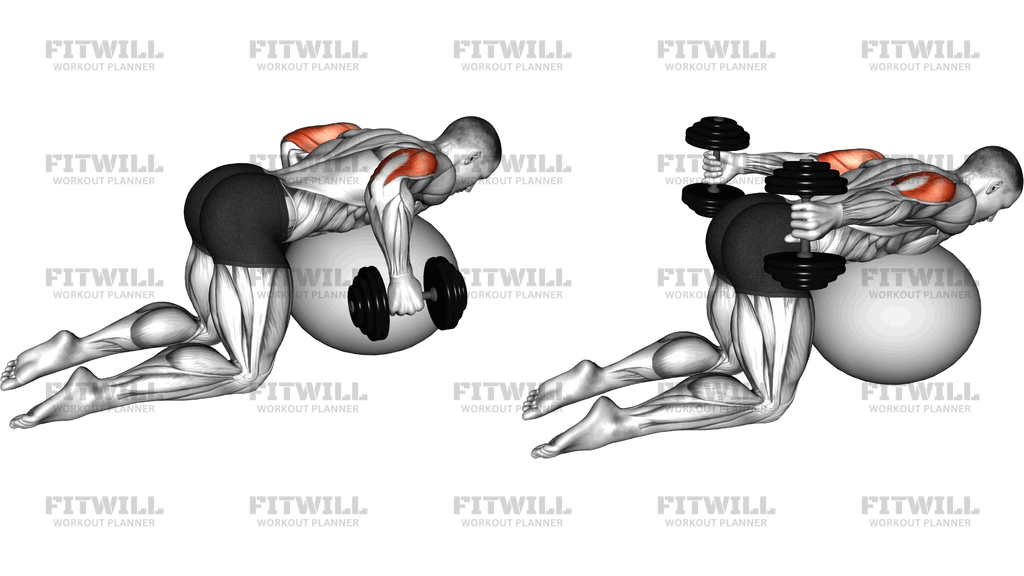
Instructions
- Place your chest and upper abdomen on the exercise ball and set your knees wide on the floor behind you for a stable base.
- Hold a dumbbell in each hand with your palms facing in and let your upper arms hang close to your sides.
- Hinge until your torso is nearly parallel to the floor, then keep your neck long and your ribs lightly down against the ball.
- Bend both elbows so the dumbbells sit near your lower ribs, with your upper arms staying still.
- Exhale and extend the elbows until your arms are straight behind you and the triceps are fully squeezed.
- Pause briefly at the top without lifting the shoulders or arching the lower back.
- Inhale and lower the dumbbells slowly until the forearms return to roughly a right angle with the upper arms.
- Keep the elbows tucked in the same position throughout the set and avoid letting the upper arms swing.
- Repeat for the planned reps, then lower the dumbbells to the floor before rolling off the ball.
Tips & Tricks
- Think about pinning the upper arms to your sides; if the elbows drift, the shoulders start stealing the work.
- Keep the chest supported on the ball, not hanging far off the front edge, or the hips will shift and the set will turn into a sway.
- Use lighter dumbbells than you would for standing kickbacks; the ball makes it easier to lose position when the load is too heavy.
- Stop the rep when the elbows are straight, not when the dumbbells swing higher behind you.
- A narrow knee stance makes the ball feel unstable, so widen your knees until you can stay quiet through the torso.
- Keep the wrists neutral so the dumbbell handles stay lined up with the forearms instead of folding back.
- Lower the bells for at least two counts; the slow return is where the triceps stay loaded most cleanly.
- If your lower back arches, reset the torso lower on the ball and soften the rib flare before the next rep.
- Breathe out through the extension and avoid holding your breath for a long set of small arm reps.
Frequently Asked Questions
What muscles do Dumbbell Kickbacks On Exercise Ball work most?
The triceps do most of the work, with the forearms, front shoulders, and core helping to stabilize the position on the ball.
Why use an exercise ball instead of a bench for Dumbbell Kickbacks On Exercise Ball?
The ball removes some lower-back stress and adds a stability challenge, but it also makes control more important because the torso can shift if the load is too heavy.
Should my upper arms move during Dumbbell Kickbacks On Exercise Ball?
No. The upper arms should stay close to the torso while only the elbows open and close.
How heavy should the dumbbells be for this exercise?
Use a load that lets you lock out cleanly without swinging the torso or shrugging the shoulders. This is usually lighter than people expect.
Can beginners do Dumbbell Kickbacks On Exercise Ball?
Yes, if they start with light dumbbells and a wide, stable knee base. The ball setup makes sloppy reps obvious, which can help teach control.
What is the most common form mistake here?
The usual mistake is turning the kickback into a shoulder swing by letting the elbows drift away from the ribcage.
How do I know if I am using the right range of motion?
At the top, the elbows should be straight and the triceps hard, but the dumbbells should not travel so far back that the shoulders roll or the spine arches.
What can I pair with Dumbbell Kickbacks On Exercise Ball in a workout?
It fits well after pressing work, push-ups, or other triceps-focused movements when you want a strict isolation finisher.