Dumbbell Standing Front Raise Twist
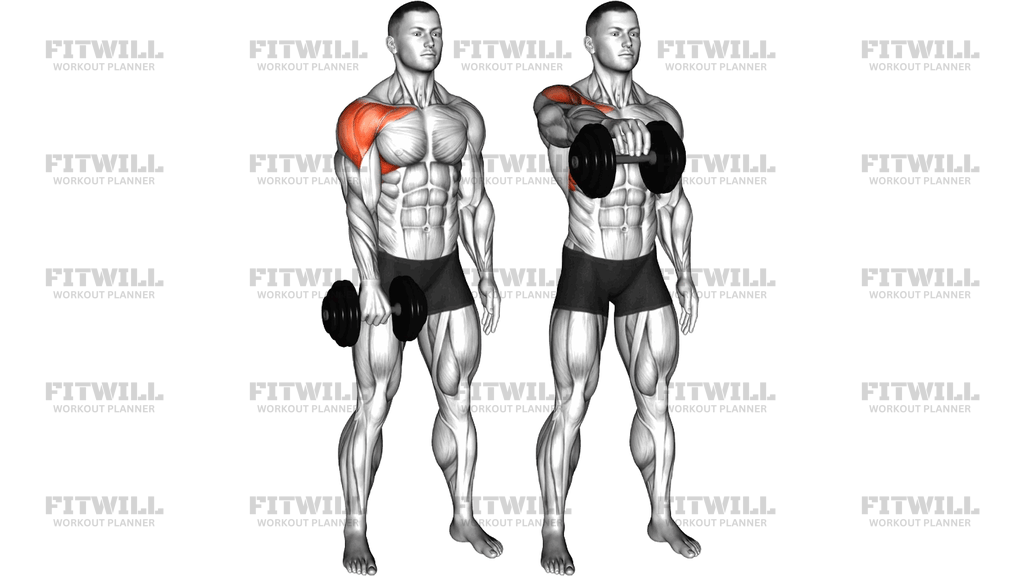
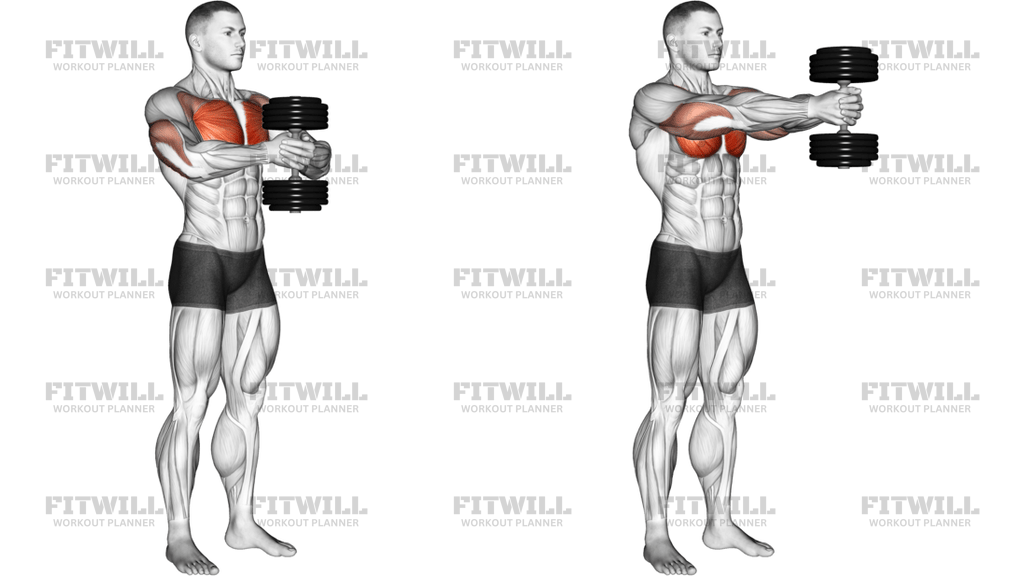
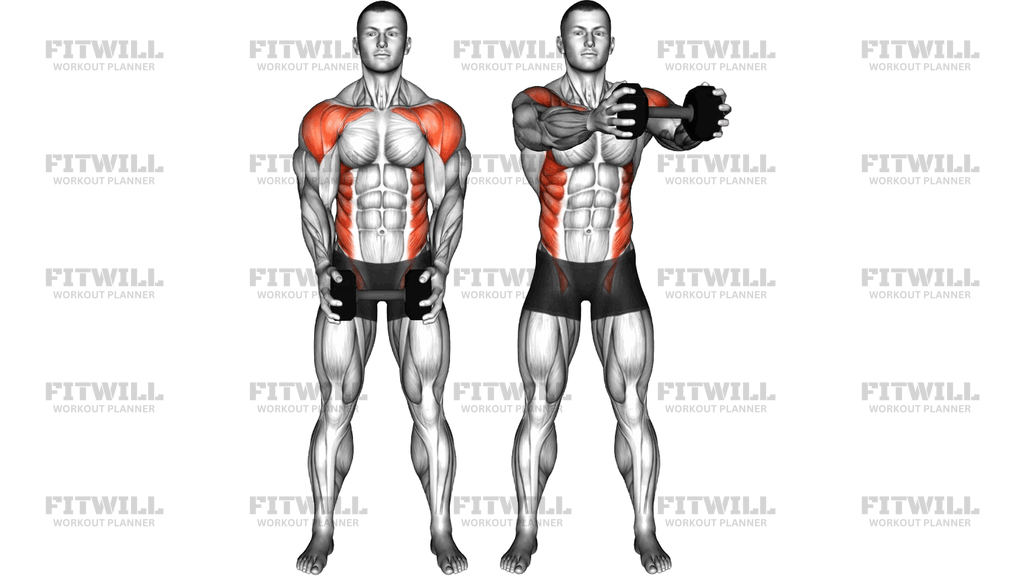
The Dumbbell Standing Front Raise Twist is a front raise variation where you hold a single dumbbell with both hands and rotate your wrists as the weight travels from your thighs up to shoulder height. Instead of a straight lift with a fixed grip, your forearms rotate throughout the movement, which adds a rotational demand that a standard front raise does not have. The lift itself targets the front of the shoulders, while the twist brings in the forearms and forces your trunk to stay controlled against a rotating load.
The main work is done by the anterior deltoids, with support from the lateral deltoids and the clavicular head of the chest as the arms reach shoulder height. Because both hands share one dumbbell and rotate in opposite directions around the handle, the forearm muscles and grip work continuously. Your abs and obliques stay busy too, bracing your torso so the twisting weight does not pull your ribcage or hips out of line.
Setup matters more here than in most raises. Stand tall with feet about hip width, hold the dumbbell horizontally by the handle with both hands, and let it hang at arm's length against your thighs. If your stance is too narrow or your torso leans back, the lift turns into a swinging motion and your shoulders stop doing the work. A braced core and a neutral spine give the delts a stable platform to pull from.
To execute it, raise the dumbbell forward with nearly straight elbows while rotating your wrists so your palms turn from facing down or toward your thighs to facing upward or inward by the time the dumbbell reaches shoulder height. Pause briefly at the top, then reverse the rotation on the way down so you finish in the same grip you started with. The lift and the twist should finish together, smoothly, not as two separate jerky actions.
This movement fits well as an accessory lift on shoulder days, as a warm-up primer before pressing, or as a finisher when you want extra deltoid and forearm volume without heavy loading. It is also a practical choice for people whose sports or work involve combined lifting and turning motions, since it trains the shoulders and trunk to cooperate under rotation. Keep the weight light to moderate; this is a control exercise, not a max-effort lift.
From a safety standpoint, stop the dumbbell at shoulder height rather than forcing it higher, and keep your wrists straight rather than bent back under load. If you feel shoulder pinching at the top, lower the range slightly or reduce the weight. Anyone with a recent shoulder or wrist injury should get clearance before adding rotational loaded work like this.
[ Workout Log & Planner ]
Put your next workout in Fitwill
Keep your plan and training log ready when you are.


Instructions
- Stand with your feet hip-width apart, knees soft, and hold one dumbbell horizontally with both hands gripping the handle, arms fully extended so the dumbbell rests in front of your thighs.
- Set your grip with palms facing down or toward your thighs, and keep about a hand's width of space between your hands on the handle.
- Brace your abs, pull your ribs down, and pull your shoulder blades back so your torso is locked in before the weight moves.
- Exhale and raise the dumbbell straight out in front of you with nearly straight elbows, leading with the hands rather than the elbows.
- As the dumbbell travels upward, rotate your wrists so your palms turn from facing down to facing upward by the time the dumbbell reaches shoulder height.
- Stop when your arms are parallel to the floor at shoulder level, with the dumbbell level and your wrists straight, and hold for a brief pause.
- Lower the dumbbell under control back toward your thighs while rotating your wrists in reverse, returning your palms to the starting position.
- Inhale at the bottom, reset your brace, and begin the next repetition without swinging or leaning back.
- Keep your head neutral and your eyes forward throughout, and avoid letting your hips or shoulders rotate with the twisting motion.
Tips & Tricks
- If the dumbbell tilts at the top, your hands are rotating at different speeds; practice the twist slowly with no weight or a very light dumbbell until both wrists turn together.
- Swinging the weight off the thighs is the most common fault here. Stand close to a wall with your glutes and upper back touching it to learn a strict, swing-free path.
- Do not let your elbows bend as the weight gets heavy. Bent elbows turn this into a partial upright row and reduce the front raise effect on the delts.
- Keep the twist inside a comfortable wrist range. If your wrists complain at full palm-up, rotate only partway and gradually increase over sessions.
- Stop at shoulder height. Raising the dumbbell above parallel shifts tension to the traps and can pinch the shoulder joint at the top.
- Pick a lighter dumbbell than you would use for a regular two-handed front raise, because the rotation makes the same weight feel noticeably harder.
- Avoid leaning your torso backward as the arms rise. If you catch yourself arching, brace harder or drop the weight by a small increment.
- Control the lowering phase for two to three seconds. The eccentric portion is where you build the most coordination between the lift and the twist.
- Breathe out on the way up and in on the way down rather than holding your breath through the twist.
Frequently Asked Questions
Which muscles does the Dumbbell Standing Front Raise Twist work the most?
The front of the shoulders does the primary lifting work, with help from the side delts and upper chest near the top. The wrist rotation adds continuous forearm involvement, and your abs and obliques stabilize the trunk against the turning load.
Why twist the wrists instead of doing a plain front raise?
The twist rotates the shoulder slightly as the arm rises, changes the line of pull on the deltoid, and adds forearm and grip work. It also makes the core work harder because the load shifts as your hands turn.
How heavy should the dumbbell be for this exercise?
Use noticeably less weight than you would for a standard two-handed front raise, since the rotation makes the movement harder to control. Most people do well starting with a light dumbbell they can raise strictly for 10 to 15 repetitions.
Should my palms start facing down or facing my thighs?
Either start works, as long as you rotate the opposite way by the top. The most common version starts with palms down and supinates to palms up at shoulder height, then reverses on the way down.
Can beginners do the Dumbbell Standing Front Raise Twist?
Yes, provided they start light and master the straight front raise first. A beginner who cannot yet raise a dumbbell to shoulder height without swinging should build that base before adding the wrist rotation.
Why does my lower back feel it during this movement?
That usually means you are arching or leaning back to help the weight up. Brace your abs harder, slow the tempo, and reduce the weight so the front delts do the lifting instead of your torso.
What can I use if I do not have a dumbbell?
A small weight plate held with both hands or a light barbell plate can substitute, though the twist is harder to perform. A single kettlebell held by the horns also works but changes the wrist angle, so use a lighter load.
How high should I raise the dumbbell at the top?
Stop when your arms are parallel to the floor at shoulder height. Going higher tends to shift work to the upper traps and can compress the shoulder joint, especially with a rotated grip.
Is it safe for my wrists and shoulders?
It is generally fine with light weight, straight wrists, and a controlled range. If you have a current or recent shoulder impingement or wrist injury, skip the twist or clear it with a professional first, since rotation under load places extra demand on both joints.
Where should this exercise fit in my workout?
It works best as an accessory or finisher after your main pressing or shoulder lifts, in the 10 to 15 repetition range. It can also serve as a light activation drill before overhead pressing days.