Plank Knee Tap
The Plank Knee Tap is a core stability exercise performed from a forearm plank position. From a solid plank, you slowly lower one knee at a time to the floor, tap it lightly, and lift it back to the full plank. The movement looks simple, but because you are removing and replacing a point of support one side at a time, your trunk has to fight rotation and hip movement throughout every rep.
This exercise is useful for almost anyone who can hold a basic plank for 20 to 30 seconds. Beginners use it as a progression step between a standard plank and harder anti-rotation work like plank shoulder taps or plank reaches. More advanced trainees use it as a controlled warm-up or as high-rep finisher work that challenges endurance in the abs, obliques, and glutes without loading the spine.
The main muscles working are the deep core and rectus abdominis, which hold your ribcage and pelvis in a neutral line. The obliques on the front and side of your trunk resist the rotation that wants to happen each time one knee leaves the floor. Your glutes and quads keep the tapping leg moving smoothly, while your shoulders, chest, and upper back stabilize the upper body on your forearms.
Setup matters more than speed here. Elbows stacked directly under the shoulders, forearms parallel or lightly clasped, and a straight line from head to heels give you a stable base. If your hips sit too high or sag toward the floor, the tap becomes a hip exercise instead of a core exercise, and your lower back takes on stress it should not.
To execute well, brace your midsection as if bracing for a light punch, squeeze your glutes, then lower one knee until it touches the mat with control. The knee should kiss the floor, not slam into it. Press back up, re-establish your plank, and only then switch legs. Two or three slow breaths per rep is a realistic rhythm at first; the tap should feel deliberate rather than rushed.
You will see the Plank Knee Tap in group classes, warm-ups, and home programs because it needs nothing more than a mat and a few square feet of floor. Keep the reps smooth and the hips quiet, and stop the set as soon as your lower back starts arching or your hips start rocking side to side.
[ Workout Log & Planner ]
Put your next workout in Fitwill
Keep your plan and training log ready when you are.


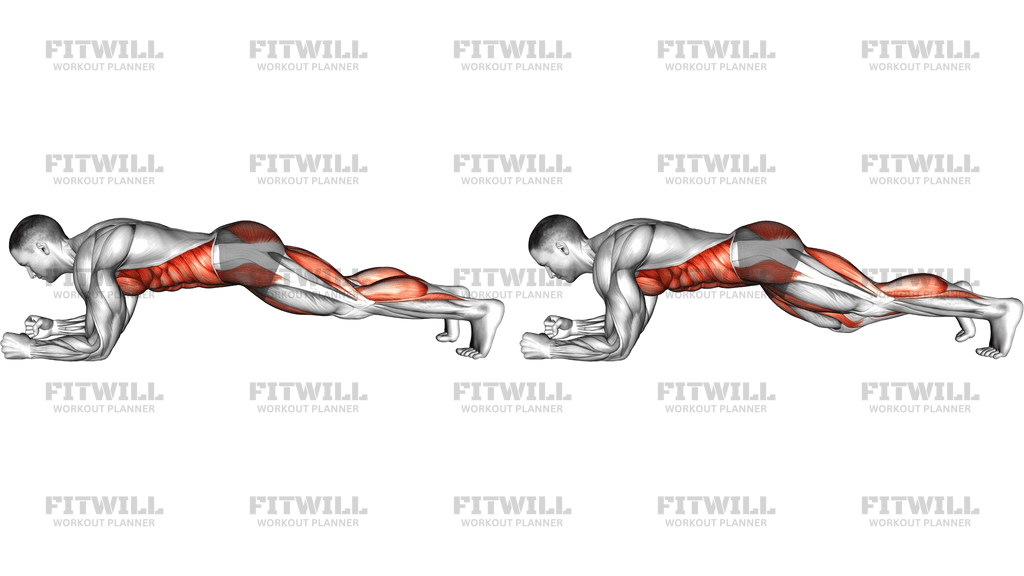
Instructions
- Place an exercise mat on the floor and set up on your forearms and toes, with your elbows stacked directly under your shoulders and your forearms pointing forward or hands lightly clasped.
- Extend both legs behind you so your body forms one straight line from your head through your hips to your heels, with your feet about hip-width apart.
- Squeeze your glutes, brace your abdominal wall, and pull your ribcage down slightly so your lower back is flat rather than arched.
- Keep your neck neutral by looking at the floor just ahead of your hands, and shift your weight slightly forward over your elbows so the shoulders stay stable.
- Without letting your hips rotate or lift, slowly bend one knee and lower it until your kneecap lightly taps the mat.
- Pause for a beat at the tap, keeping the other leg straight and your torso square to the floor.
- Press the knee back up to the full plank and re-establish your straight line before switching sides.
- Alternate knees for reps, or complete all reps on one side before switching, breathing steadily throughout and exhaling as each knee lowers.
- When the set is done, lower both knees to the mat, sit back, and reset your brace before starting the next set.
Tips & Tricks
- The most common mistake is hip sway: if your hips rock toward the side that is tapping, slow the tempo down and imagine a cup of water balanced on your lower back.
- Do not let the tapping foot collapse inward; keep the toes tucked and the leg active so the knee travels straight down to the mat.
- A light tap is the goal. If you hear a thud, your leg is dropping under gravity rather than being lowered under control, and your core is missing half the work.
- If your elbows drift forward of your shoulders as you fatigue, your upper back is rounding; walk your elbows back and restart the set with fewer reps.
- Bending the tapping knee too much and letting the thigh rotate outward turns this into a hip movement; keep the knee tracking down toward the same side of the floor.
- If a full forearm plank is too shaky, drop to a high plank on straight arms instead, or widen your feet to give yourself a more stable base.
- Glute tension is your anti-sag insurance; actively squeeze the glute of the standing leg each time the other knee goes down.
- Stop the set when your form changes, not when you hit a rep number. Two clean sets of eight taps beat five sloppy sets of twenty.
- On a hard floor, always use a mat or pad under the knees; even light taps add up over repeated sessions.
Frequently Asked Questions
Which muscles does the Plank Knee Tap work the most?
The abs and deep core do most of the work, with the obliques resisting the rotation created each time one knee leaves the floor. The glutes, quads, and shoulder stabilizers support the position throughout.
Is the Plank Knee Tap suitable for beginners?
Yes, provided you can already hold a basic plank for around 20 to 30 seconds. Beginners can start with a high plank version on straight arms or perform the taps slowly with a wider foot stance for extra stability.
How is the Plank Knee Tap different from a mountain climber?
A mountain climber drives the knee forward toward the chest with speed, while the Plank Knee Tap lowers the knee straight down to the floor in a slow, controlled tap. The tap version emphasizes anti-rotation and control; the climber emphasizes dynamic hip flexion and cardio demand.
Why do my hips rock side to side during the Plank Knee Tap?
Hip sway usually means the obliques and glutes are not bracing hard enough, or you are moving too fast. Slow each tap down to two or three seconds, squeeze the glute of the standing leg, and widen your feet slightly until the sway disappears.
Should my knee actually touch the floor, or just hover?
A light, deliberate touch is the standard version, since the brief contact gives you a clear end point without unloading the core. If you have sensitive knees, hover just above the mat instead and use the same controlled lowering.
Can I do the Plank Knee Tap if my wrists bother me in push-up positions?
Yes. The forearm plank position keeps your wrists out of the movement entirely, which makes this a good core option for people who tolerate forearms on the floor better than straight-arm support.
How many reps and sets should I do?
Two to three sets of 10 to 20 total taps, alternating sides, is a practical range. Because this is an endurance and control exercise, prioritize smooth reps over chasing high numbers.
What can I substitute if the Plank Knee Tap is too difficult?
Drop to a high plank on straight arms, widen your feet, or perform the taps from a knee plank first. All three reduce the stability demand while keeping the same alternating knee-lowering pattern.
Is it safe to do the Plank Knee Tap every day?
Because it is low load and body weight based, frequent practice is generally fine as long as your shoulders and lower back feel good and your form stays clean. If you notice persistent shoulder or lower back discomfort, reduce frequency and check your plank alignment.