Lying Bent Legs Raise
Lying Bent Legs Raise is a floor-based core exercise that trains the abs to control the pelvis while the knees stay bent. The shortened lever makes it easier to learn than a straight-leg raise, but it still demands real control from the lower abs, deep core, and hip flexors. Done well, it teaches you to keep the ribs down and move without swinging the legs.
This exercise is useful when you want a strict abdominal movement that highlights trunk control instead of speed. The bent-knee position reduces strain on the low back for many people, while still making the abs work hard to curl the pelvis upward. That makes Lying Bent Legs Raise a practical option for beginners learning core bracing as well as experienced lifters who want a cleaner accessory movement.
Start by lying on your back on a mat or flat bench with your arms relaxed by your sides for support. Bend your knees so your thighs are roughly perpendicular to the floor and your shins are parallel to it, then set your lower back gently into the surface. That start position matters because the exercise becomes much harder to control if your ribs flare or your hips tip forward before the first rep begins.
From there, exhale and curl your knees toward your chest by lifting your pelvis a few inches off the floor. Think about rolling the tailbone upward instead of kicking the feet or swinging the thighs. At the top, the movement should feel tight and deliberate, with the abs doing the work and the neck staying relaxed.
Lower under control until your lower back settles back down and your knees return to the start position without losing tension. The best reps use a small, clean range rather than a big rocking motion, and the speed should stay slow enough that you can stop at any point. If you feel the movement mostly in the front of the hips, shorten the range and focus on curling the pelvis instead of lifting the legs higher.
Lying Bent Legs Raise fits well in core circuits, accessory work, or a warmup when you want to wake up the trunk before heavier training. It is also a good regression for athletes or gym-goers who are not ready for straight-leg raises yet. Keep the motion strict, stop the set when your low back starts arching, and use the exercise to build repeatable control rather than chasing momentum.
[ Workout Log & Planner ]
Put your next workout in Fitwill
Keep your plan and training log ready when you are.


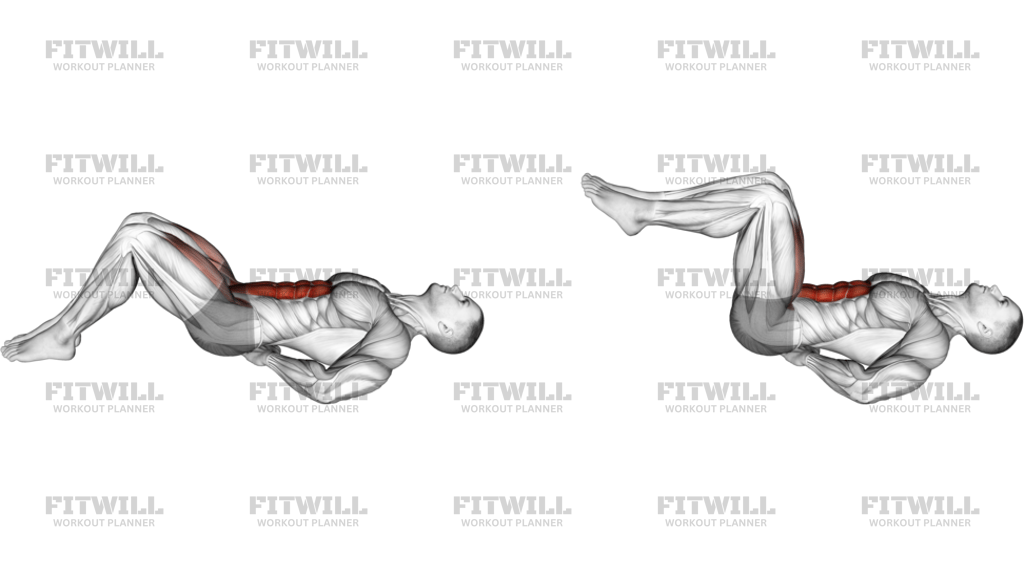
Instructions
- Lie on your back on a mat or flat bench with your arms by your sides for balance.
- Bend your knees to about 90 degrees and lift your feet so your shins are roughly parallel to the floor.
- Set your lower back gently against the surface and keep your ribs pulled down before you start.
- Exhale as you curl your knees toward your chest and lift your pelvis a few inches off the floor.
- Keep the motion driven by your abs, not by kicking your feet or swinging your thighs.
- Pause briefly at the top when your tailbone lifts and your knees move closest to your torso.
- Lower slowly until your lower back returns to the mat and your knees come back to the starting angle.
- Reset your brace between reps and repeat for the planned number of repetitions.
Tips & Tricks
- Keep your knees bent at roughly 90 degrees; straighter legs turn this into a much harder hip-flexor-dominant lift.
- Let the pelvis curl up first. If your feet move before your hips, you are swinging instead of crunching.
- Press the low back down before each rep, then let it peel up only as far as you can control.
- Exhale on the curl and finish the breath before you lower so the ribs do not flare on the way down.
- Use a small range if the tops of your thighs feel tight or the low back starts arching.
- Keep your neck heavy on the floor and look straight up instead of reaching your chin toward your knees.
- Lower slowly; the eccentric phase should feel like you are resisting the floor, not dropping back to it.
- Stop the set when the pelvis stops curling and the motion turns into a leg swing.
Frequently Asked Questions
What does Lying Bent Legs Raise work most?
It mainly trains the lower abs and the muscles that control pelvic tilt, with the hip flexors assisting.
Is Lying Bent Legs Raise a good beginner core exercise?
Yes. The bent-knee position shortens the lever and makes it easier to learn than a straight-leg raise, as long as you keep the movement controlled.
Should my lower back lift off the floor in Lying Bent Legs Raise?
Only slightly. A small pelvic curl is the goal; if the low back arches hard or you rock your whole torso, the range is too large.
Where should I put my hands during Lying Bent Legs Raise?
Keep your arms by your sides or lightly on the floor for balance. Do not use your hands to pull the legs or push the hips off the mat.
Why do I feel Lying Bent Legs Raise more in my hip flexors than my abs?
That usually means the knees are drifting too far away from the body or the pelvis is not curling. Shorten the range and focus on lifting the tailbone first.
How can I make Lying Bent Legs Raise easier?
Keep the knees a little closer to the torso, reduce the height of the curl, and lower more slowly instead of chasing a bigger rep.
What is the most common mistake in Lying Bent Legs Raise?
Swinging the legs to start the rep. The movement should come from a controlled pelvic curl, not from kicking the knees upward.
When should I stop a set of Lying Bent Legs Raise?
Stop when your low back starts arching, your knees stop tracking smoothly, or you can no longer curl the pelvis without momentum.