Plank Jump In Squat
Plank Jump In Squat is a bodyweight plyometric exercise that links two demanding positions with an explosive jump. You begin in a high plank, snap both feet forward between or beside your hands to land in a low squat, then explode back out to the full plank. It is essentially the heart of a burpee without the push-up and vertical jump, which makes it faster to cycle and easier to pace in longer sets.
Because every rep forces you to jump your entire body in and out, this movement hits a broad swath of musculature at once. The quadriceps and glutes absorb and produce the landing and takeoff force, the hip flexors drive the feet forward, and the abs, obliques, and deep core work overtime to keep your spine from sagging in the plank and to control the landing in the squat. Your shoulders and triceps hold you up through the top position, and the calves contribute to the push-off back out.
This exercise suits anyone building general conditioning, athletes who need hip and trunk power in a hurry, and people training at home with no equipment. It shows up in circuit training, bootcamp-style workouts, and warm-ups for sports that involve sprinting or changing direction. Because it requires no gear and very little floor space, it is one of the more practical ways to raise your heart rate quickly.
Setup matters more than most people expect. Hands placed under the shoulders, a braced trunk in the plank, and feet landing flat and outside your hands in the squat all determine whether the jump feels crisp or sloppy. A wide, stable hand position gives your feet somewhere to land, and a controlled squat depth on the catch keeps your knees and lower back out of trouble. Rushing the landing is where most of the quality is lost.
To execute it well, think of the movement as jump in, catch, jump out, catch. Land softly each time, with weight spread across the whole foot in the squat and across the whole hand in the plank. Reset your brace briefly at the top of the squat if your hips start to drift upward or your back rounds.
The main safety point is landing mechanics. If you cannot land quietly in the squat, slow the tempo down or step the feet in instead of jumping until your control improves. Skip this exercise on days when your wrists, knees, or lower back are aggravated, since all three take repeated loading here.
[ Workout Log & Planner ]
Put your next workout in Fitwill
Keep your plan and training log ready when you are.


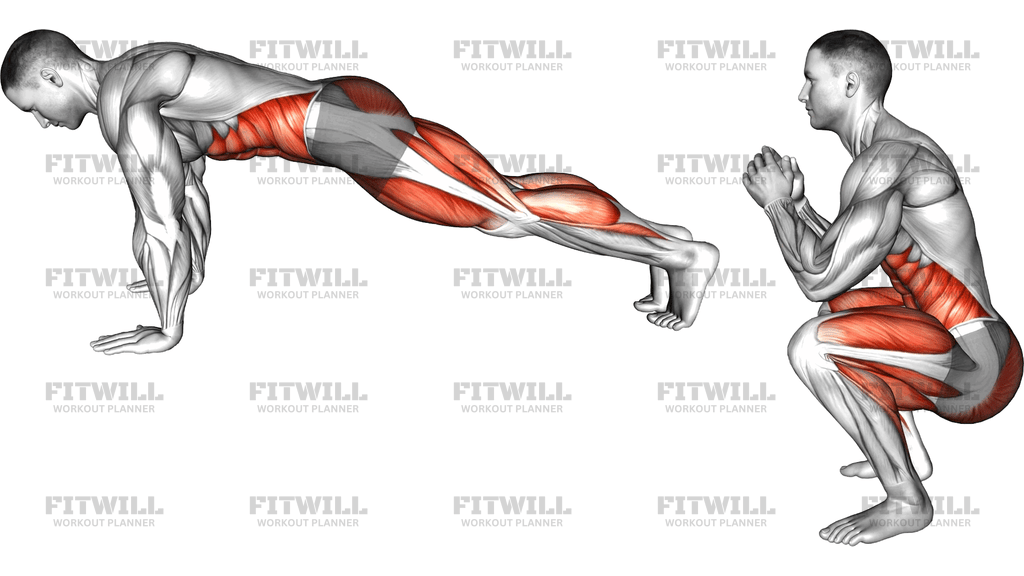
Instructions
- Start on the floor in a high plank with your hands directly under your shoulders, arms straight, and your body forming one line from head to heels.
- Set your feet about hip-width apart with your weight on the balls of your feet, and squeeze your glutes and abs to lock in the plank position.
- Brace your core as if bracing for a light tap to the stomach, and look down at the floor so your neck stays neutral.
- In one explosive motion, bend your knees and jump both feet forward toward your hands, keeping your hands planted the entire time.
- Land with your feet flat on the floor outside your hands, hips low, in a deep squat position with your chest up and heels down.
- Pause for a beat in the squat to feel the catch, keeping your knees tracking over your toes and your back flat rather than rounded.
- Drive through your heels and jump both feet explosively back to the starting plank, landing on the balls of your feet with hips level.
- Exhale sharply as you jump in and as you jump out; inhale briefly during the short pause in the squat.
- Continue at a steady rhythm, resetting your plank line after every rep before starting the next jump.
Tips & Tricks
- If your hips pike up toward the ceiling when you jump back out, you are rushing the return; extend through the hips deliberately and land in a true plank before the next rep.
- Landing on your toes with heels high in the squat usually means the feet are not coming far enough forward — aim to place your feet fully outside your hands so you can get your heels down.
- Wrist discomfort often comes from letting your weight roll onto the fingertips in the plank; press the base of your palms and knuckles into the floor and spread your fingers.
- Keep the squat catch active rather than collapsing into it — think of it as a soft landing you control, not a drop.
- Rounding the lower back when jumping back to plank is a common fault; reset your brace at the top of the squat and push the floor away with straight arms as you extend back.
- Start with a step-in and step-out version if the jump makes your form fall apart; the positioning and muscle work carry over once you add the explosive element.
- Quality beats speed here — a slower set of clean, quiet landings trains more and risks less than a fast set of slappy, hips-high reps.
- On a hard floor, a mat under your hands and feet reduces impact and gives you better grip for both positions.
- If your knees drift inward on the squat landing, cue yourself to spread the floor with your feet as you catch.
Frequently Asked Questions
What muscles does the Plank Jump In Squat work the most?
The quadriceps and glutes do the bulk of the landing and takeoff work, while the abs and deep core stabilize your trunk through both positions. The hip flexors power the feet forward, and the shoulders and triceps support you in the plank.
Is the Plank Jump In Squat suitable for beginners?
Yes, as long as beginners start with the step-in version: walk or step the feet to the squat and back to the plank instead of jumping. Once the positions feel solid and landings are quiet, add the explosive jump.
Should my feet land inside or outside my hands in the squat?
Outside your hands is the standard landing for the Plank Jump In Squat. This gives your hips room to drop into a deep squat and lets you get your heels flat, which protects your knees and keeps the catch stable.
How is the Plank Jump In Squat different from a burpee?
It skips the push-up at the bottom and the vertical jump at the top, so each rep is shorter and faster to repeat. That makes it a good choice for high-rep conditioning sets where burpees would grind you down too quickly.
Why do my hips ride up when I jump back to the plank?
That usually means the trunk is losing its brace and the hips are being pulled up by the hamstrings out of habit. Slow the return slightly, squeeze the glutes, and consciously land in a straight line from shoulders to heels before the next rep.
Can I do the Plank Jump In Squat every day?
Because it is an impact exercise, daily high-volume use can beat up your wrists, knees, and calves. Two to four sessions per week with recovery days between hard sets is a more sustainable approach.
What can I substitute if jumping is uncomfortable for me?
Step the feet in and out one at a time, or perform a slow squat thrust where you control both directions. Both options keep the same positions and muscle work while removing the landing impact.
How many reps of the Plank Jump In Squat should I do?
For conditioning, work in timed sets of 20 to 40 seconds or sets of 8 to 15 reps, stopping when your landings get loud or your hips sag. Form quality is the better cutoff than a fixed number.
Do I need any equipment or floor surface considerations for this exercise?
No equipment is needed, but an exercise mat helps on hard floors for wrist comfort and foot grip. Avoid slick surfaces, since your hands need to stay planted while your feet jump in and out.
My wrists ache during this movement — what should I change?
Check that your hands are under your shoulders with fingers spread and weight spread across the palm rather than dumped on the wrists. If discomfort persists, switch to the step-in version or use a mat, and avoid the exercise while the wrists are aggravated.