Side Plank With Knee Bend
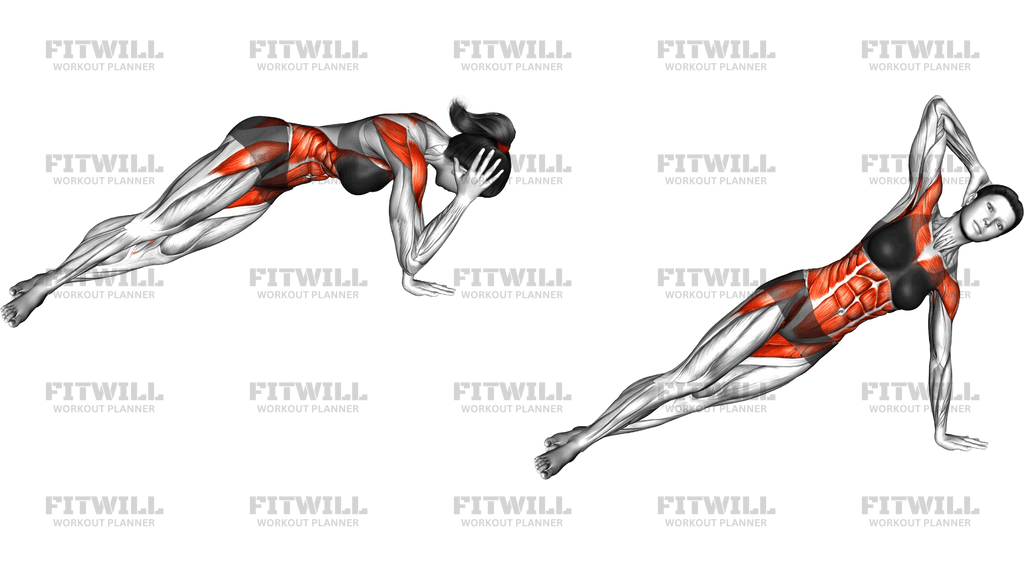
The Side Plank With Knee Bend is a bodyweight core exercise performed while holding a side plank on your forearm, with your top hand placed behind your head and your legs stacked or staggered on the floor. From that side-supported position, you draw the knee of your top leg up toward your torso, then extend it back to the stacked position. The combination of a static side hold and a moving knee gives you two challenges in one: resisting side-to-side collapse while your center of mass shifts, and actively flexing the hip against the tension of the plank.
The main work comes from the obliques on the underside of your trunk, which must hold your ribcage and pelvis in a straight line the entire time. Bending the top knee also recruits the hip flexors and quadriceps of that leg, while the glute of the bottom leg and the deep core stabilizers keep your hips from sagging or rotating. Because only a forearm and the side of one foot touch the floor, the demand on lateral trunk control is much higher than in a standard front plank.
This movement suits anyone who has already mastered a basic side plank and wants a more dynamic progression. It is commonly used in core circuits, in rehab-informed programs for building lateral hip and trunk control, and by runners and field-sport athletes who need to transfer force between the legs and torso without leaking energy through the waist. It requires no equipment beyond a mat and enough floor space to lie down, which makes it easy to program at home or as a finisher in the gym.
Setup quality determines whether this exercise trains your core or just stresses your shoulder. Place your elbow directly under your shoulder so the floor supports your frame rather than your deltoid, and keep your head, hips, and heels aligned before you start moving. If your hips drop or your torso rolls forward the moment the knee bends, shorten the hold or reduce the range instead of pushing through a crooked position.
Execute the knee bend slowly and deliberately: pull the knee up toward your top elbow or the side of your ribs, pause briefly, then return it to meet the bottom leg without letting your pelvis tip. Breathe steadily throughout, exhaling as the knee comes up. Expect the side facing the floor to fatigue first, so always match the number of repetitions on each side before moving on.
[ Workout Log & Planner ]
Put your next workout in Fitwill
Keep your plan and training log ready when you are.


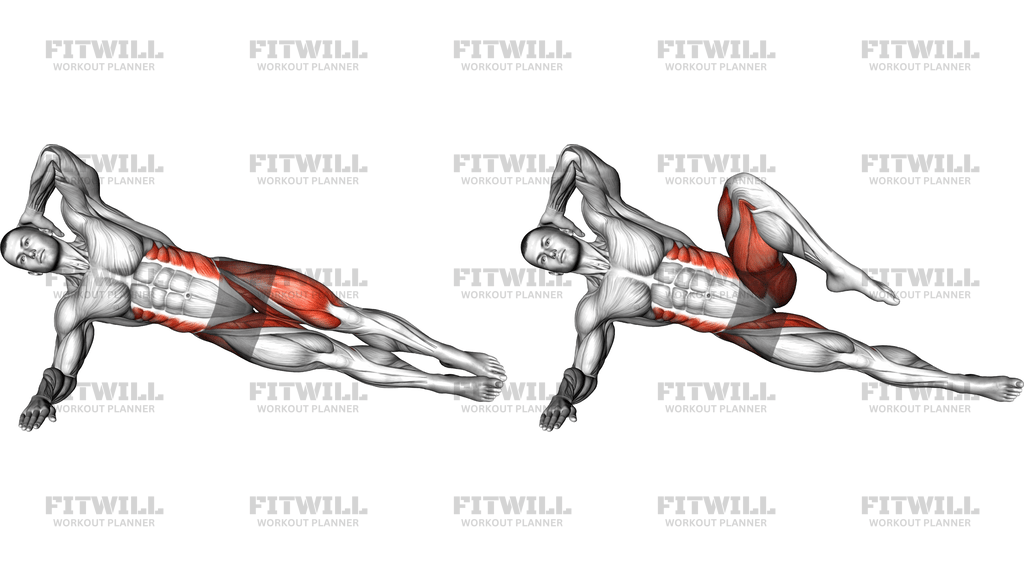
Instructions
- Lie on your right side on an exercise mat with your legs extended and stacked, and prop your upper body on your right forearm with the elbow placed directly under the shoulder.
- Place your left hand lightly behind your head with the elbow pointed up, and set your left foot on top of your right foot.
- Lift your hips off the floor until your head, hips, and heels form one straight line, and brace your abdominals as if bracing for a light push to the side.
- Keep your supporting forearm planted and your neck neutral, with your gaze forward rather than down at the floor.
- Exhale and bend your left knee, drawing it up toward your top elbow or the side of your ribs while your torso stays perfectly stacked.
- Pause for a moment at the top of the bend, feeling the obliques on your lower side work to keep the hips high and square.
- Inhale and slowly extend the knee back until your legs are stacked again, controlling the leg down rather than letting it drop.
- Complete your repetitions on the right side, then roll over and perform the same number on the left side with your left forearm supporting.
- If your hips sag before the set ends, lower them to the mat with control, rest, and resume rather than holding a collapsed position.
Tips & Tricks
- The most common failure is the hips drifting forward as the knee comes up; film yourself from the front once so you can see whether your torso stays stacked over the supporting shoulder.
- Do not push your head forward with the hand behind your head; keep the elbow wide and let the neck stay long, or you will strain the neck instead of loading the obliques.
- If the supporting shoulder complains, press the floor away actively with your forearm so the space around the shoulder stays open instead of sinking into the joint.
- Beginners can bend the bottom knee 90 degrees and rest it on the floor for extra support, which shortens the lever while the top knee still does the bending.
- Keep the bend in the sagittal plane: the knee travels up toward the elbow, not out to the side, so the hip flexors and obliques do the work rather than the hip rotators.
- Slow the return down rather than the lift; most people snap the leg back and lose the lateral brace in the last third of the range.
- Spread the floor with your bottom foot by pressing the outer edge down and squeezing the glute, which steadies the whole plank and protects the lower back.
- Match sides exactly, and start on your weaker side so both sets end at the same fatigue point.
- Stop the set when your hips drop even slightly; a side plank held in a sagged position trains nothing useful and loads the spine awkwardly.
Frequently Asked Questions
Which muscles does the Side Plank With Knee Bend work the most?
The obliques on your underside do most of the stabilizing, supported by the deep core. Bending the top knee adds work for the hip flexors and quadriceps of that leg, while the glute of the bottom leg helps hold the hips up.
Is the Side Plank With Knee Bend suitable for beginners?
It is best treated as a progression from a standard side plank. If you can hold a solid side plank for 20-30 seconds per side, start here with a small knee range; otherwise build the static hold first.
Why does my supporting shoulder hurt during the Side Plank With Knee Bend?
Usually the elbow has drifted out from under the shoulder or you are sinking into the joint. Realign the elbow directly beneath the shoulder and actively press the floor away with your forearm throughout the set.
Should the top knee bend toward the elbow or out to the side?
Bend it up toward your top elbow or the side of your ribs, keeping the movement in front of your hip plane. Letting the knee flare outward turns it into a hip rotation exercise and reduces the core demand.
How many repetitions should I do per side?
Start with 6-10 controlled knee bends per side, holding the plank continuously during the set. Progress by adding repetitions or a pause at the top of each bend rather than rushing the tempo.
Can I do the Side Plank With Knee Bend if my hips keep dropping?
Yes, but scale it down first. Perform it from the knees, or bend the bottom knee and rest it on the mat so the hold is easier while the top knee still does the bending.
What can I substitute if a full Side Plank With Knee Bend is too hard?
A knee-supported side plank with a knee bend, or a simple side plank hold, covers the same lateral core pattern with less load. A standing side leg raise with an oblique brace is another low-threshold option.
How is this different from a regular side plank?
A regular side plank is purely static, while the knee bend shifts your center of mass and adds dynamic hip flexion. That makes the trunk work harder to stay square and brings the hip flexors and quadriceps into play.
Is it safe for the lower back?
When your elbow is stacked under the shoulder and your hips stay high and square, the spine is held in a neutral side position. If you feel twisting discomfort in the waist or back, reduce the range or move to the knee-supported version.